Skip to main content Explore View all products (200+) Microsoft Foundry Azure Copilot GitHub Copilot Azure Kubernetes Service (AKS) Azure Cosmos DB Azure Database for PostgreSQL Azure Arc Microsoft Fabric Linux virtual machines in Azure Foundry Models Foundry Agent Service Foundry IQ Foundry Tools Foundry Control Plane Observability in Foundry Control Plane Azure OpenAI in Foundry Models Azure Speech in Foundry Tools Azure Machine Learning View all databases Azure Cosmos DB Azure DocumentDB Azure SQL Azure Database for PostgreSQL Azure Managed Redis Microsoft Fabric Azure Databricks Linux virtual machines in Azure Windows Server on Azure Azure Functions Azure Virtual Machine Scale Sets Azure API Management Azure Container Apps Azure Kubernetes Service (AKS) Azure Kubernetes Fleet Manager Azure Container Registry Azure Red Hat OpenShift Azure Container Instances Azure Container Storage Azure Arc Azure Local Microsoft Defender for Cloud Azure Monitor Microsoft Sentinel Azure Migrate View all solutions (40+) Cloud solutions for small and medium businesses Cloud migration and modernization center Data analytics for AI Azure Databases AI apps and agents Microsoft Marketplace Microsoft Sovereign Cloud AI apps and agents Responsible AI with Azure AI Infrastructure Data analytics for AI Machine learning operations (MLOps) Low-code application development on Azure Integration Services Serverless computing DevOps Migration and modernization center .NET apps migration Databases on Azure Linux on Azure Oracle on Azure SAP on the Microsoft Cloud Adaptive cloud High-performance computing (HPC) Infrastructure as a service (IaaS) Resiliency Azure Essentials Frontier Accelerate for Azure FinOps on Azure Microsoft Marketplace Azure pricing overview Create an Azure account Free Azure services Flexible purchase options Pricing calculator FinOps on Azure Maximize ROI from AI Azure savings plans Azure reservations Azure Hybrid Benefit Virtual Machines Azure SQL Microsoft Foundry Microsoft Fabric Azure Kubernetes Service (AKS) Microsoft Defender for Cloud View more Software Development Companies Microsoft Marketplace Find a partner Resources for Azure partners Get started with Azure Customer stories Analyst reports, white papers, and e-books Videos Learn more about cloud computing Documentation Explore Azure portal Developer resources Quickstart templates Resources for startups Developer community Students Azure for partners Blog Events and Webinars Learn Support Contact Sales Get started with Azure Sign in

Azure Service Bus has been the Messaging as a Service (MaaS) option of choice for our enterprise customers. We’ve seen tremendous growth to our customer base and usage of the existing namespaces, which inspires us to bring more features to the service.

We recently expanded Azure Service Bus to support all Azure regions with Availability Zones to help our customers build more resilient solutions. We also expanded the Azure Service Bus Premium tier to more regions to enable our customers to leverage many enterprise ready features on their Azure Service Bus namespaces while also being closer to their customers.

The Azure Service Bus Premium tier is a relatively newer offering, made generally available in September 2015, that allows our customers to provision dedicated resources for their Azure Service Bus namespaces. This in turn provides reliable throughput and predictable latency, along with production and enterprise ready features at a fixed price per Messaging Unit. This is a major improvement from the Azure Service Bus Standard tier that is a multi-tenant system optimized for lower throughput systems using a pay-as-you-go model.

Our Azure Service Bus Premium tier offering has resonated well with the customers, who have been excited to get onboard to enjoy the value add that it provides. However, until now, we haven’t had a way to upgrade the existing Azure Service Bus Standard namespaces to the Premium tier. That is now about to change.

Today, we’re happy to announce tools, both on the Azure portal and via the Command Line Interface/PowerShell that enables our customers to upgrade their existing Azure Service Bus Standard namespaces to the Premium tier. This tooling will ensure that no configuration changes are required on the sender and receiver applications, while enabling our customers to adopt the best offering for their use case, with minimal downtime.
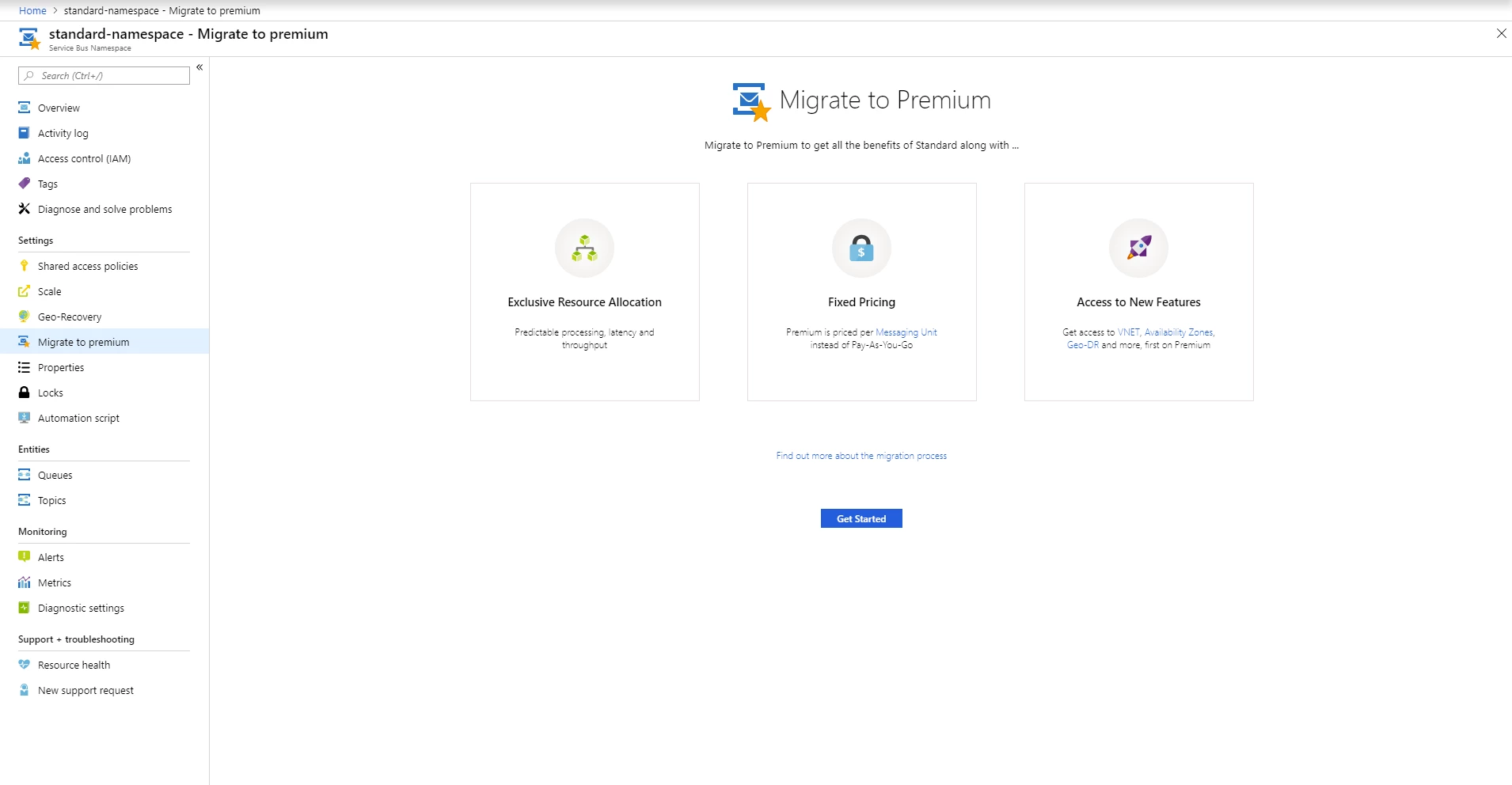
Migrate to premium in Azure Service Bus Standard

To know more about this feature and the finer details on what is happening under the hood, please read the documentation.

You can access the portal tool by clicking on the “Migrate to Premium” menu option on the left navigation pane under the Service Bus Standard namespace that you are looking to migrate.


WE ARE MICROSOFT

Explore Microsoft Foundry

The future of AI starts here. Envision your next great AI app with the latest technologies. Get started with Azure.