Better scale and more power for IT professionals and developers!
We’re excited to announce the general availability of larger, more powerful standard file shares for Azure Files. Azure Files is a secure, fully managed public cloud file storage with full range of data redundancy options and hybrid capabilities using Azure File Sync.
Here is a quick look at some of the improvements in the Azure Files standard file shares’ capacity and performance.
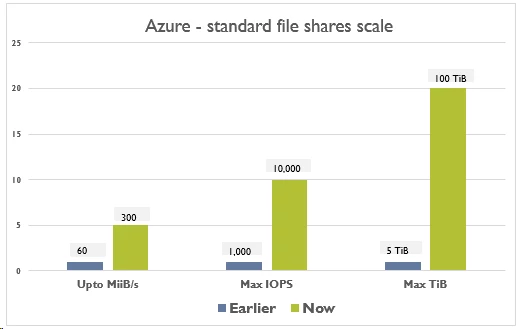
With the release of large file shares, a single standard file share in a general purpose account can now support up to 100 TiB capacity, 10K IOPS, and 300 MiB/s throughput. All premium file shares in Azure FileStorage accounts currently support large file shares by default. If your workload is latency sensitive and requires a higher level of performance, you should consider Azure Files premium tier. Visit Azure Files scale limits documentation to get more details.
What’s new?
Since the preview of large file shares, we have been working on making the Azure Files experience even better. Large file shares now has:
- Ability to upgrade existing general purpose storage accounts and existing file shares.
- Ability to opt in for larger files shares at a storage account instead of subscription level.
- Expanded regional coverage.
- Support for both locally redundant and zonal redundant storages.
- Improvements in the performance and scale of sync to work better with larger file shares. Visit Azure File Sync scalability targets to keep informed of the latest scale.
Pricing and availability
The increased capacity and scale of standard file shares on your general purpose accounts come at zero additional cost. Refer to the pricing page for further details.
Currently, standard large file shares support is available for locally redundant and zone redundant storages and available in 13 regions worldwide. We are quickly expanding the coverage to all Azure regions. Stay up to date on region availability by visiting Azure Files documentation.
Getting started
You no longer need to register your subscription for the large file shares feature.
New storage account
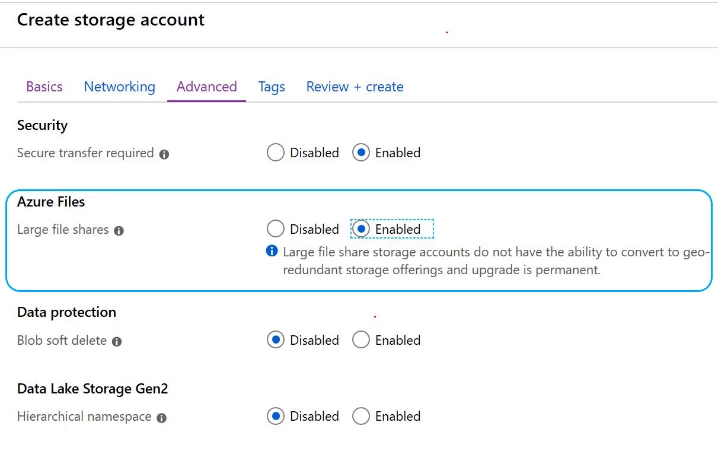
Create a new general purpose storage account in one of the supported regions on a supported redundancy option. While creating storage account, go to Advanced tab and enable Large file shares feature. See detailed steps on how to enable large file shares support on a new storage account. All new shares created under this new account will, by default, have 100 TiB capacity with increased scale.
Existing storage account
On an existing general purpose storage account that resides on one of the supported regions, go to Configuration, enable Large file shares feature, and hit Save. You can now update quota for existing shares under this upgraded account to more than 5 TiB. All new shares created under this upgraded account will, by default, have 100 TiB capacity with increased scale.
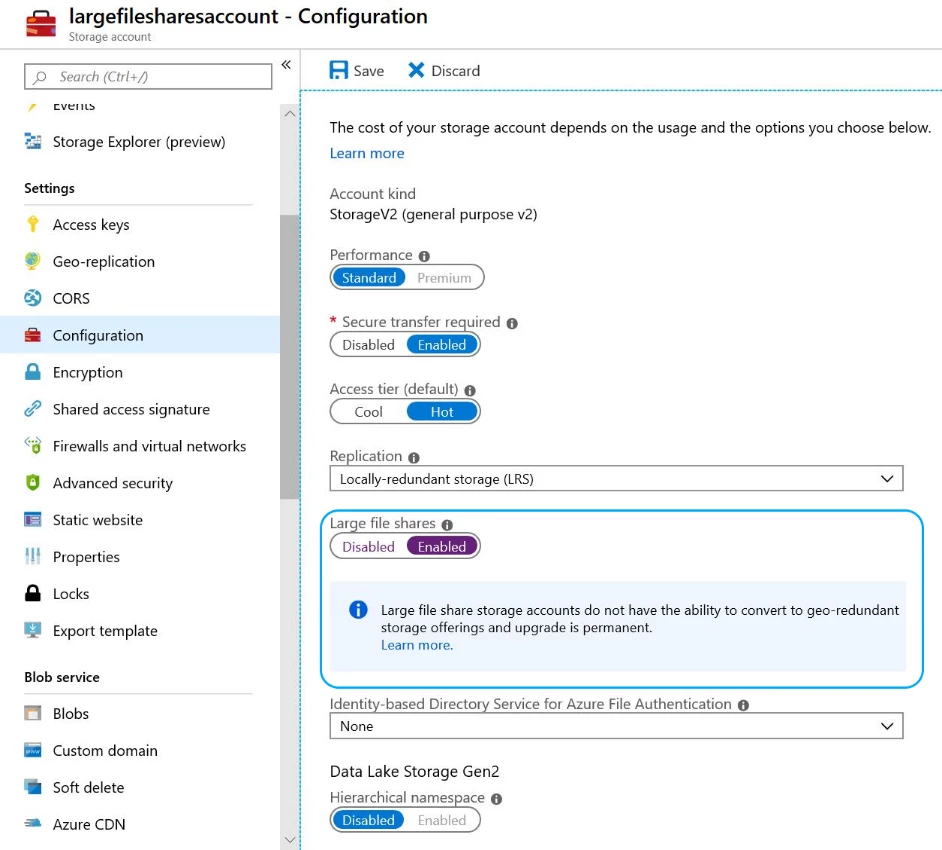
See detailed steps on how to enable large file shares support on an existing storage account.
Opting in your storage accounts into large file shares feature does not cause any disruption to your existing workloads, including Azure File Sync. Once opted in, you cannot disable the large files shares feature on your account.
Feedback
Please share your feedback on the Azure Storage forum or send us email at AzureFiles@microsoft.com. You can also post your ideas and suggestions about Azure Storage on our feedback forum.
Happy sharing!