In June 2021, Microsoft and AT&T reached a major milestone when we announced an industry-first collaboration to evolve Microsoft’s hybrid cloud technology to support AT&T’s 5G core network workloads. Since then, we have had requests from many operators, partners, and customers to share more details. This blog is intended to do just that.
An eye toward future innovation: Harnessing the power of the cloud
Through Azure for Operators, Microsoft has forged close ties with AT&T personnel, product services groups, and partners. At the heart of the value Microsoft delivers in each of these relationships, is the way in which we leverage the power of the cloud to improve the next generation of telco networks. Microsoft aims to harness trends toward Software Defined Networking (SDN), Cloud-Native Network Functions (CNFs), and Virtualized Network Functions (VNFs) coupled with the service-based architecture of 5G, to begin digitally transforming the network.
This evolution involves introducing both hybrid infrastructure and software, building scalable elastic carrier-grade networks, and using the power of AI and machine learning to build self-optimizing networks that can heal, defend, and provision themselves. These efforts will enable operators to hyper-automate the business itself, bringing down costs and improving the overall service experience. Azure for Operators represents the set of investments Microsoft is making to bring the power of the cloud to the network.
Many of the benefits that Microsoft delivered in the enterprise space are directly applicable in the networking space. First, however, they need to be modified to account for the unique carrier-grade needs of operators. Our efforts are aimed at getting workloads on the network to function on a carrier-grade cloud, which is a hybrid cloud, spanning both public and dedicated on-premises cloud infrastructure. Telecommunication services are highly distributed and will likely become more so over time. As a result, the value of creating a carrier-grade hybrid cloud model lives in its ability to meet customers where they are—at the edge of the cloud, the edge of the network, or the edge of the enterprise.
The progress toward the acquisition
In 2013 AT&T adopted an aggressive position on Software Defined Networks (SDNs) and virtualization, with the ultimate goal of delivering 75 percent of their network using virtualized technology by 2020, which they succeeded at. Back then, there was no commercial cloud option available that included the necessary features and capabilities to enable carrier-grade cloud. AT&T created a standards-based implementation of cloud technology that was deployed in their on-premises data centers. This initial integrated cloud evolved into a Network Cloud, and today, we’ve arrived at Network Cloud 2.7—representing seven years of experience developing on-premises cloud for network workloads.
With Microsoft’s recent acquisition of this technology, development teams from AT&T’s Network Cloud organization have moved into Azure for Operators, directly integrating the intellectual property into a Microsoft offering and assuring a seamless transition.
There are three key reasons why this collaboration is unique. For starters, this is the first time that a tier-one operator has embraced commercial hybrid cloud technology to run mobility network workloads that support their existing consumer base. The second aspect that’s unique is that the effort is entirely focused on the mobility core network versus go-to-market collaborations at the edge. And third, the arrangement is multi-vendor. Microsoft hybrid cloud technology supports the AT&T mobile core network that spans more than 60 cloud-native network functions (CNFs) and virtual network functions (VNFs) from 15 different vendors.
What the Network Cloud acquisition means
Network Cloud technology originally developed by AT&T can be utilized by multiple carriers, maintaining security, without losing differentiation, and with the added benefit of having many costs such as security patching, vendor updates, and regulatory changes delivered as part of a standard commercial product.
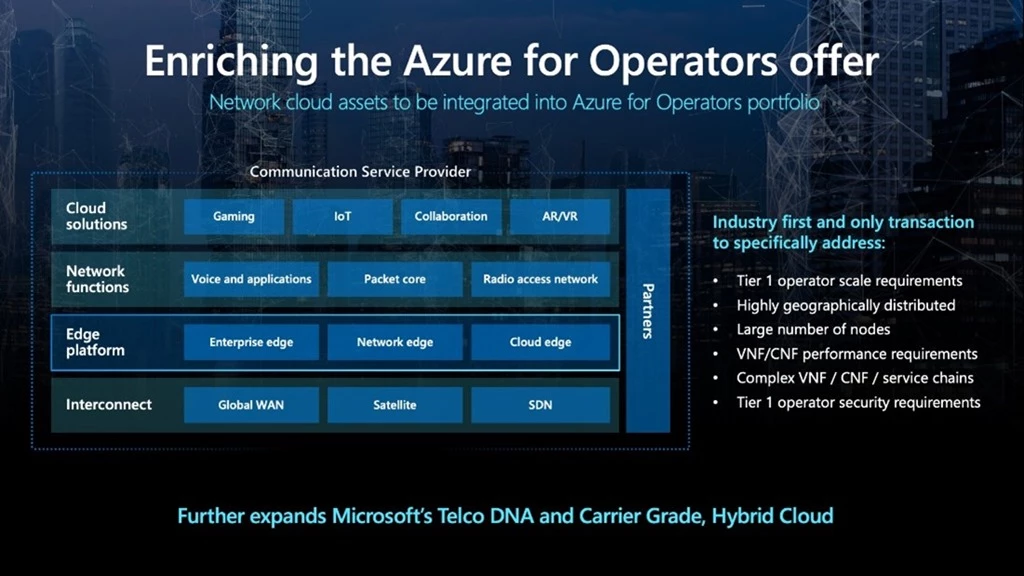
These capabilities will be combined with Microsoft’s edge platform, our hybrid management platform, Azure Arc, and our ecosystem of partners including equipment providers, hardware vendors, and software vendors. By joining the Network Cloud with our platform and growing ecosystem, we have achieved a carrier-grade hybrid cloud solution that will be delivered as the Azure for Operators platform.
One key aspect of this collaboration is our respective roles—Microsoft develops the carrier-grade hybrid cloud technology that supports the AT&T mobility core network workloads. AT&T continues to select and manage the network applications (VNFs and CNFs) and their configurations to deliver mobility services to AT&T customers. As such, we’re taking the AT&T Network Cloud technology, building it into Microsoft’s standard hybrid cloud product, and then delivering a carrier-grade hybrid cloud solution back to the market and AT&T itself, where it can run at AT&T on-premises or on Azure public cloud. Microsoft hybrid cloud technology supports the AT&T mobility core network workloads used to deliver 5G connectivity that supports consumer, enterprise, and the FirstNet responder community. In terms of security, it’s important to note that Microsoft does not access AT&T customer data—AT&T continues to hold access to that data, and Microsoft cannot see it.
For AT&T, this collaboration puts them in a position to deliver new services faster and more flexibly across Azure public cloud and on-premises with common tooling and services, reducing time-to-market for a cloud-native approach. We believe the result will be better resiliency across the network, cost advantages when it comes to scaling existing services, and a more effective introduction of new services resulting in continuous improvements to the customer experience.
Learn more
Microsoft’s acquisition of AT&T’s Network Cloud, as well as Metaswitch Networks and Affirmed Networks, brings the anchor applications and telco know-how to build the features that are required for a carrier-grade hybrid cloud. These features, available to the entire partner ecosystem, contribute to an open, interoperable network that offers support to all operators. The message to operators from Microsoft is simple and straightforward: your partners and your customers—and the relationship is powered by our technology.