Skip to main content Explore View all products (200+) Microsoft Foundry Azure Copilot GitHub Copilot Azure Kubernetes Service (AKS) Azure Cosmos DB Azure Database for PostgreSQL Azure Arc Microsoft Fabric Linux virtual machines in Azure Foundry Models Foundry Agent Service Foundry IQ Foundry Tools Foundry Control Plane Observability in Foundry Control Plane Azure OpenAI in Foundry Models Azure Speech in Foundry Tools Azure Machine Learning View all databases Azure Cosmos DB Azure DocumentDB Azure SQL Azure Database for PostgreSQL Azure Managed Redis Microsoft Fabric Azure Databricks Linux virtual machines in Azure Windows Server on Azure Azure Functions Azure Virtual Machine Scale Sets Azure API Management Azure Container Apps Azure Kubernetes Service (AKS) Azure Kubernetes Fleet Manager Azure Container Registry Azure Red Hat OpenShift Azure Container Instances Azure Container Storage Azure Arc Azure Local Microsoft Defender for Cloud Azure Monitor Microsoft Sentinel Azure Migrate View all solutions (40+) Cloud solutions for small and medium businesses Cloud migration and modernization center Data analytics for AI Azure Databases AI apps and agents Microsoft Marketplace Microsoft Sovereign Cloud AI apps and agents Responsible AI with Azure AI Infrastructure Data analytics for AI Machine learning operations (MLOps) Low-code application development on Azure Integration Services Serverless computing DevOps Migration and modernization center .NET apps migration Databases on Azure Linux on Azure Oracle on Azure SAP on the Microsoft Cloud Adaptive cloud High-performance computing (HPC) Infrastructure as a service (IaaS) Resiliency Azure Essentials Frontier Accelerate for Azure FinOps on Azure Microsoft Marketplace Azure pricing overview Create an Azure account Free Azure services Flexible purchase options Pricing calculator FinOps on Azure Maximize ROI from AI Azure savings plans Azure reservations Azure Hybrid Benefit Virtual Machines Azure SQL Microsoft Foundry Microsoft Fabric Azure Kubernetes Service (AKS) Microsoft Defender for Cloud View more Software Development Companies Microsoft Marketplace Find a partner Resources for Azure partners Get started with Azure Customer stories Analyst reports, white papers, and e-books Videos Learn more about cloud computing Documentation Explore Azure portal Developer resources Quickstart templates Resources for startups Developer community Students Azure for partners Blog Events and Webinars Learn Support Contact Sales Get started with Azure Sign in

Today, we are announcing the general availability of App Service Isolated, which brings the simplicity of multi-tenant App Service to the secure, dedicated virtual networks powered by App Service Environment (ASE). 

Azure App Service is Microsoft’s leading PaaS (Platform as a Service) offering hosting over 1 million external apps and sites. It helps you build, deploy and scale web, mobile and API apps instantaneously without worrying about the underlying infrastructure. It allows you to leverage your existing skills by supporting an increasing array of languages, frameworks, and popular OSS, and has built-in capabilities that streamline your CI/CD pipeline. ASE was introduced in 2015 to offer customers network isolation, enhanced control, and increased scale options. The updated ASE capabilities that comes with the new pricing tier, App Service Isolated, now allow you to run apps in your dedicated virtual networks with even better scale and performance through an intuitive user experience.

Streamlined scaling

Scaling up or out is now easier. The new ASE eliminates the need to manage and scale worker pools. To scale, either choose a larger Isolated plan (to scale up) or add instances (to scale out), just like the multi-tenant App Service. It’s that easy. To further increase scaling flexibility, App Service Isolated comes with a maximum default scale of 100 Isolated plan instances. You now have more capacity for large implementations.

Upgraded performance

The new ASE uses dedicated Dv2-based machines boasting faster chipsets, SSD storage, and twice the memory per core when compared to the first generation. The dedicated worker sizes for the new ASE are 1 core with 3.5 GB RAM, 2 cores with 7 GB RAM, and 4 cores with 14 GB RAM. With this upgraded infrastructure, you will be able to run your apps with lower latency, have more power to handle heavier workloads, and support more users.

Simplified experience

Creating the new ASE is easy. By selecting the Isolated pricing tier, App Service will create an App Service Plan (ASP) and a new ASE directly. You will just need to specify the Virtual Network that you want to deploy your applications to. There is no separate workflow required to spin up a new ASE in your secure, dedicated virtual networks.
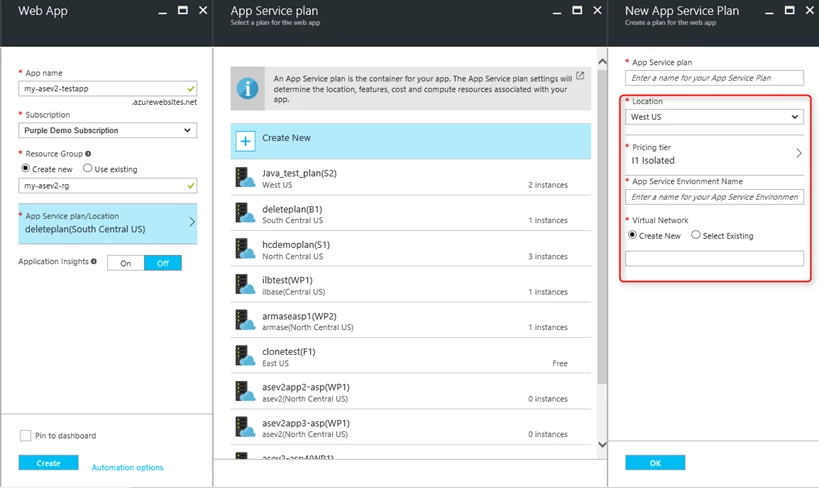
App Service Plan

We’ve made App Service Environment (ASE) faster, more efficient, and easier to deploy into your virtual network, enabling you to run apps with Azure App Service at high scale in an isolated network environment. Check out the Azure Friday video. Partners and customer can also learn more about how to get started and set up.


WE ARE MICROSOFT

Explore Microsoft Foundry

The future of AI starts here. Envision your next great AI app with the latest technologies. Get started with Azure.