Legacy systems can be a nightmare for any business to maintain. In the insurance industry, carriers struggle not only to maintain these systems but to modify and extend them to support new business initiatives. The insurance business is complex, every state and nation has its own unique set of rules, regulations, and demographics. Creating new products such as an automobile policy has traditionally required the coordination of many different processes, systems, and people. These monolithic systems traditionally used to create new products are inflexible and creating a new product can be an expensive proposition.
The Azure platform offers a wealth of services for partners to enhance, extend, and build industry solutions. Here we describe how one Microsoft partner, Sunlight Solutions, uses Azure to solve a unique problem.
Monolithic systems and their problems
Insurers have long been restricted by complex digital ecosystems created by single-service solutions. Those tasked with maintaining such legacy, monolithic systems struggle as the system ages and becomes more unwieldy. Upgrades and enhancements often require significant new development, large teams, and long-term planning which are expensive, unrealistic, and a drain on morale. Worse, they restrict businesses from pursuing new and exciting opportunities.
A flexible but dedicated solution
An alternative is a single solution provider that is well versed in the insurance business but able to create a dedicated and flexible solution, one that overcomes the problems of a monolith. Sunlight is such a provider. It allows insurance carriers to leverage the benefits of receiving end-to-end insurance administration functionality from a single vendor. At the same time, their solution provides greater flexibility, speed-to-market, and fewer relationships to manage with lower integration costs.
Sunlight’s solution is a single system which manages end-to-end functionality across policy, billing, claims, forms management, customer/producer CRM, reporting and much more. According to Sunlight:
“We are highly flexible, managed through configuration rather than development. This allows for rapid speed to market for the initial deployment and complete flexibility when you need to make changes or support new business initiatives. Our efficient host and continuous delivery models address many of the industry’s largest challenges with respect to managing the cost and time associated with implementation, upgrades, and product maintenance.”
In order to achieve their goals of being quick but pliable, the architecture of the solution is literally a mixture of static and dynamic components. Static components are fields that do not change. Dynamic components such as lists populate at run time. This is conveyed in the graphic below, the solution uses static elements but lets users configure with dynamic parts as needed. The result is a faster cycle that maintains familiarity but allows a variety of data types.
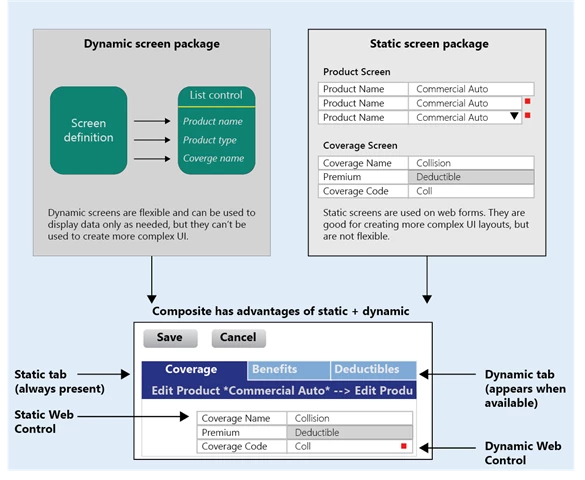
In the figure above, data appears depending on the product. When products are acquired, for example through mergers, the static data can be mapped. If a tab exists for the product, it appears. For example, “benefits” and “deductibles” are not a part of every product.
Benefits
In brief, here are the key gains made by using Sunlight:
- End-to-end functionality: Supports all products/coverages/lines of business
- Cloud-based and accessible anywhere
- Supports multiple languages and currencies
- Globally configurable for international taxes and regional regulatory controls
- Highly configurable by non-IT personnel
- Reasonable price-point
Azure services
- Azure Virtual Machines are used to implement the entire project life cycle quickly.
- Azure Security Center provides a complete and dynamic infrastructure that continuously improves on its own.
- Azure Site Recovery plans are simple to implement for our production layer.
- Azure Functions is utilized in order to quickly replicate environments.
- Azure Storage is used to keep the application light with a range of storage options for increased access time based on the storage type.
Next steps
To learn more about other industry solutions, go to the Azure for insurance page. To find more details about this solution, go to Sunlight Enterprise on the Azure Marketplace and select Contact me.