What does hybrid cloud mean to IT professionals, and why are so many companies using it? Microsoft conducted a survey with research firm Kantar TNS in January 2018, asking more than 1700 respondents to chime in. Surveys were collected from IT professionals, developers, and business decision makers to identify how they perceive hybrid cloud, what motivates adoption, and what features they see as most important. Survey participants in the United States, the United Kingdom, Germany, and India were asked their thoughts about hybrid, which for the survey was defined as consisting of “private cloud or on-premises resources/applications integrated with one or more public clouds”. We’ve created a summary infographic of the survey that you can review. A few survey highlights:
- Hybrid is common, with a total of 67 percent of respondents now using or planning to deploy a hybrid cloud. Many of those hybrid users have made the move recently, 54 percent of users in the past two years.
- Cost, a consistent IT experience, and the ability to scale quickly were all given as important reasons for moving to hybrid cloud.
- The perceived benefits of hybrid cloud, as well as some of the challenges, vary by the geographic location of respondents. For example, increased security was the top benefit cited in the United Kingdom and Germany, while the top United States benefit was better scalability of compute resources.
- The top use case given for hybrid cloud was controlling where important data is stored at 71 percent. Using the cloud for backup and disaster recovery was a close second at 69 percent.
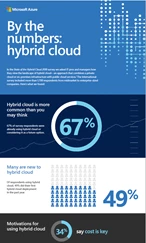
We invite you to download and share our infographic on the state of today’s hybrid cloud. For a more complete review of the State of Hybrid Cloud 2018 survey findings, watch the on-demand webinar Among the Clouds: Enterprises Still Prefer Hybrid in 2018.
For more information about hybrid networking, identity, management and data on Azure, you can also check out this new Azure Essentials segment, Integrating Azure with your on-premises infrastructure.
State of Hybrid Cloud 2018 survey
Participants for this online survey were recruited from (non-Microsoft) local market lists selected by Microsoft and the international research firm Kantar TNS, which was hired to conduct the outreach. Survey participants included IT professionals, professional developers, and business decision makers/influencers who use, are planning, or have considered a hybrid cloud deployment. Surveyed company sizes were from mid-market to enterprise (250+). The survey was conducted January 4 – 24, 2018. For the purposes of this survey, hybrid cloud was defined as follows. Hybrid cloud consists of private cloud or on-premises resources/applications integrated with one or more public clouds.