APIs are everywhere. The broad proliferation of applications throughout enterprises often results in large silos of opaque processes and services, making it hard for IT to manage and govern APIs in a systematic way, and for development teams to gain visibility into and make use of APIs that already exist.
Entire industries, such as financial services, are embracing APIs as a means to become more open, for example with open banking initiatives. Open banking is an API-first approach to creating more open, rich ecosystems that encourage third-party participation and usage of the services financial institutions have previously kept behind the scenes.
Products, such as Azure API Management, were created to address these issues. By letting you manage all APIs in a single, centralized location, you are able to impose authentication, authorization, throttling, and transformation policies and easily monitor the usage of the APIs associated with your applications, giving you the much-needed visibility into your application portfolio(s) at a macro-level.
To succeed in an increasingly connected world, it is key to adopt an API-first approach that lets you:
- Embrace innovation by creating vibrant API ecosystems.
- Secure and manage APIs seamlessly in a hybrid world.
APIs can be a bridge to the uncertain future and help you safely traverse over turbulent waters.
Embrace innovation by creating vibrant API ecosystems
Microsoft offers all of the tools to be able to immediately capitalize on new opportunities as they emerge in the business landscape. Our infrastructure technologies, such as Kubernetes and serverless computing, accelerate development velocity and help developers move faster than ever before. Our API technologies, such as API management, accelerate the speed at which new opportunities can be acted upon, by immediately providing channels for partners, developers, customers, and other third-parties to leverage new technology which is created. These types of activities are often done with tools such as an API developer portal.
Azure API Management’s developer portal lets you easily grant access (and control) to APIs. The developer portal provides documentation on how to use the APIs and creates a simple, easy way for people to get started. A developer portal is an integral part of any API-first approach, which is why we’re announcing the general availability of our greatly improved developer portal experience.
You can now easily customize the developer portal with a visual user interface, helping create a branded experience. The developer portal is open-source and built with extensibility in mind. You can easily fork our exacting repository and customize it to meet your needs. It was created using contemporary JAMstack technologies that significantly reduce page load times, to make it as frictionless of user experience as possible.
You can learn more about this announcement by reading our Azure Update on the release.
Secure and manage APIs seamlessly in a hybrid world
Today’s most popular API management solutions run in public clouds. And while having a purely cloud-based API management service can work for pretty much all scenarios, it’s not always the best choice. Perhaps compliance requirements mandate that information must stay on the corporate network, or maybe accessing the cloud is prohibited by company policy. Whatever the reason, scenarios like this can’t use an API management service running in any public cloud; the service must run on-premises.
To meet your hybrid requirements, we’re announcing the preview of Azure Arc enabled API Management, a self-hosted API gateway. The new self-hosted API gateway doesn’t replace the primary cloud-based API management service. Instead, it augments this service by providing the essential aspects of API management in software that organizations can run wherever they choose.
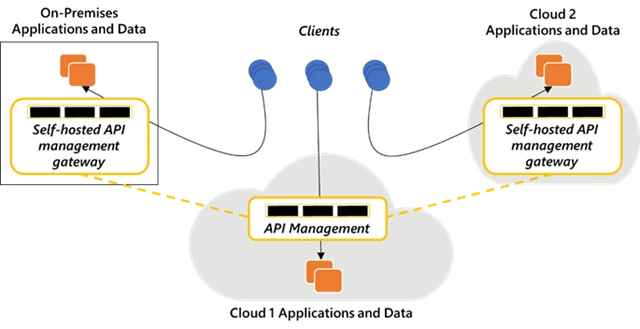
It adds a containerized version of the Azure API Management gateway you can host on-premises or another environment that supports the deployment of Docker containers. It enables more efficient call patterns for internal-only and internal and external APIs and is managed from a cloud-based Azure API Management instance. Azure Arc enabled API Management enables you to run the self-hosted API management gateway in your own on-premises datacenter or run the self-hosted API management gateway in another cloud.
Read the whitepaper we’ve released, API management in a hybrid and multi-cloud world, which goes into further detail technical detail on Azure Arc enabled API Management, as well as the strategic benefits you receive when adopting this approach.
Or, you can start a free trial of Microsoft Azure and check out API Management for yourself.
Heading into the future
APIs are the way that businesses will continue to communicate. The growth of APIs has continued to increase, and the rise of the API product is happening right now. Many different companies now offer API-first products and are a powerful reminder that a well thought out API strategy is going to be key to any business’ strategy moving forward.
To learn more about what APIs and API Management can do for you, you can visit API Management on Azure.
Azure. Invent with purpose.