We are coming together as a global community, looking for opportunities to act or perform small steps that drive change for the better. Many parts of the world are still in the first stage of responding, actively working through the immediate crisis with urgency. While other areas have started on recovery, looking at how to restart the economy, provide stability, and most importantly bring together our society. Amidst these goals are also questions, how do we make it safe for people to connect in person? To have a meal with friends, travel to see loved ones, or function as a community?
Top of mind for many organizations, and a theme prevalent at Microsoft’s inaugural virtual Inspire conference this week: how do we make it safe for people to return to the workplace? And how can the Internet of Things (IoT) play a role in supporting these phases of responding, recovering, and rebuilding?
Digital capabilities enabling business resilience
The COVID-19 outbreak has been a reminder of how interconnected humanity is globally—and how resilient the human spirit can be. But it has also shown that businesses using technology to stay connected have been more resilient than others.
In the world of IoT, we have the ability to transform analog and digital feeds, to reason over data and respond immediately. The response is important. In today’s increasingly connected world, we have seen organizations and industries respond to market demands and needs by putting technology at the center of their business. But more importantly, we are also seeing customers use technology built on the Microsoft platform to develop their own unique digital capabilities.
As we see these organizations build out their own digital capabilities—most recently with a focus on coming out stronger from this global outbreak—it is those that are able to quickly adapt to the changes around them that emerge resilient. At Microsoft, we built an edge and cloud methodology grounded by the principles of trust, responsibility, and inclusiveness. And organizational resilience is built upon cloud-enabled technologies that offer on-demand tools tailored to your needs, enable productivity enhancement, drive cost savings, and so much more.
Innovations leading the way to safer workplaces
It has been energizing to see the innovative strides being made by our partners and customers. To see how they are investing in digital capabilities and addressing our global challenge. And this use of technology has helped many of our customers as they were forced to adapt to new ways in an accelerated fashion. What would have taken years has happened in mere weeks.
As we enter this phase of recovery, many of our partners are using IoT solutions to solve the question of how we enable safer workplaces. Microsoft’s role as a platform provider is to empower our partner ecosystem with platforms upon which to build solutions to meet the evolving needs of their customers.
Employee health testing
One of the first areas we have come to re-examine as part of this global outbreak is how sick you should be before you avoid the workplace. We have also shown ourselves time and time again in the past few months that you do not need to be in the office to be productive, efficient, and connected.
However, as some of us slowly return to work in office or factory environments, we are all sensitive to how others around us are feeling. IoT partners are building solutions on the Microsoft platform to monitor public health in public spaces, including business offices. These IoT solutions use connected devices—such as thermal imaging cameras for temperature monitoring, smart sensors for promoting social distancing, and hand sanitizer dispensers to encourage recommended hygiene—and turn the data gathered at the intelligent edge into valuable insights that can help manage how people are interacting with their environment.
Employee wellbeing, proximity, and contact
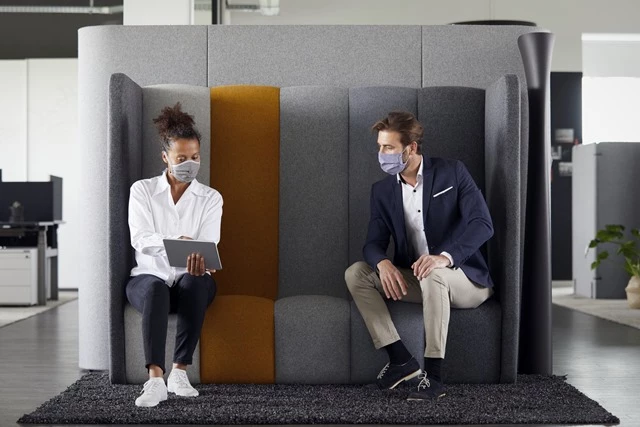
With the return to work, we anticipate how our work environments are structured will change. From office layouts and break rooms to the normal business handshake, some level of social distancing will be part of our daily routine.
Microsoft partners have developed IoT solutions that use proactive monitoring and real-time alerts to track employee proximity and ensure a safe, healthy working environment is being promoted. Microsoft partners have architected contactless UI systems that help minimize potential exposure by reducing touchpoints throughout the day.
Workplace sanitization
Even with reduced touchpoints and increased distancing, workplace sanitization will be more important than ever. BrainLit’s BioCentric Lighting™ (BCL) system is a dynamic, self-learning, IoT-based system that delivers disinfection through ultraviolet light in unoccupied spaces, to promote health and well-being and help kill viruses without disrupting business operations. This solution leverages Azure Sphere, which connects the BrainLit devices directly to the cloud for complete Azure-based security and the latest OS and app updates, ensuring an up-to-date and scientifically based lighting and disinfection system.
Just as important as hygienic workspaces will be, so will the use of personal protective equipment (PPE) as we return to work. Partners have built solutions with the Azure intelligent edge to increase visibility of adherence to face mask policies, so safety violations and concerns can be quickly addressed, and a safe work environment maintained.
The role of security in digital capabilities
With solutions like the above, we are capturing more and more data that is used to generate valuable insights and contribute to a safer, healthier workplace for our employees. Yet a key part of this conversation is the importance of building all these solutions on a foundation of security. Especially as we move to a more connected world where we realize our potential to work from anywhere, it is more essential than ever to also protect our companies and our employees from a cybersecurity perspective.
From democratized data to digitized processes, companies must ensure the necessary security practices and procedures are in place to manage disparate technologies and various attack vectors. Plus, with attackers becoming increasingly creative in how they try to infiltrate IoT deployments by identifying security weaknesses, building security into every part of your IoT platform helps minimize risks to your private data, business assets, and brand reputation.
As companies build out their digital capabilities, they must be thoughtful and implement security by design. It requires that protection be built-in at each stage of your solution’s deployment—including your cloud services and devices—and that security weaknesses are minimized where they exist. And it requires using technology built on decades of experience to make your threat detection and response smarter and faster with AI-driven security signals that modernize your security operations.
Just as critical is protecting people’s privacy, especially as companies focus on digital technologies used for tracking, tracing, and testing to fight the global outbreak. Here at Microsoft, we believe privacy and ethical concerns must be considered as we move forward to use data responsibly in creating safer workplaces. We have seven privacy principles that we believe everyone should consider using to ensure people are in control of their data and understand how it will be collected and used—from providing appropriate data safeguards to deleting data as soon as it’s no longer needed.
Learn more about creating safer workplaces
In this increasingly connected world, it is thrilling to see the variety of IoT solutions and devices that exist to help generate valuable insights. Yet these same solutions don’t always have the necessary digital capabilities due to legacy, inflexibility, or the need for human intervention to respond. The result of this is we fail to act on the very insights presented to us.
Now, more than ever, we can’t afford to fail. But even more importantly, we can’t afford to not act. The decisions we make now as individuals, leaders, societies, organizations, and countries will have both an immediate and long-lasting impact. And the decisions we don’t make—even more so.
As companies look to reopen, how they bring together technology and people will play a key role in creating safer, more resilient workplaces. And companies that enhance their digital capabilities, so they can act more quickly and make informed decisions, will be able to successfully navigate future changes and uncertainties.
Contact iotcovidsupport@microsoft.com to discuss how IoT solutions built on Azure can help you to return to the workplace safely.
Microsoft does not create technologies related to contact tracing, exposure notification, and case management and does not imply or expressly represent any vetting or endorsement of contact tracing, exposure notification, or case management technologies.