

Leaders are chasing the AI frontier, reimagining business systems as human-led and agent-operated. To do this, customers are on the hunt for smarter models, more capable agents, and market-ready solutions to operationalize AI workflows.
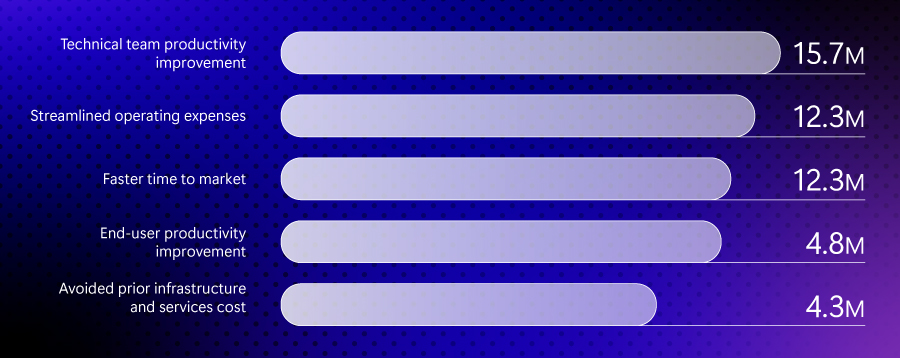
When Forrester modeled the economics of enterprise AI with Microsoft Foundry, the biggest driver behind the 327% ROI over three years1 was surprising: developer productivity, worth $15.7 million over the same period.
The study showed that the bottleneck to ROI can be removed by enabling developers to focus on what matters.
The hidden tax on your AI investment
In most organizations, senior engineers spend a third of their time on undifferentiated work: stitching together fragmented tools, recreating context pipelines, and navigating bespoke governance processes. None of that is competitive advantage for firms—it’s a tax on every AI initiative.
According to Forrester, organizations using Foundry avoided much of this work, improving technical team productivity up to 35%. Teams using Foundry to develop AI apps and agents saw payback in as few as six months and with benefits accelerating year over year1.
The details: What the Forrester study found

Forrester interviewed 10 decision-makers at five organizations and surveyed 154 other decision-makers and AI leaders across the U.S. and Europe with experience using Microsoft Foundry. They modeled a composite enterprise with $10 billion revenue, 25,000 employees, and 100 technical staff using Foundry. To model conservative estimates, benefits were adjusted downward and costs upward; the results reflect the composite enterprise.
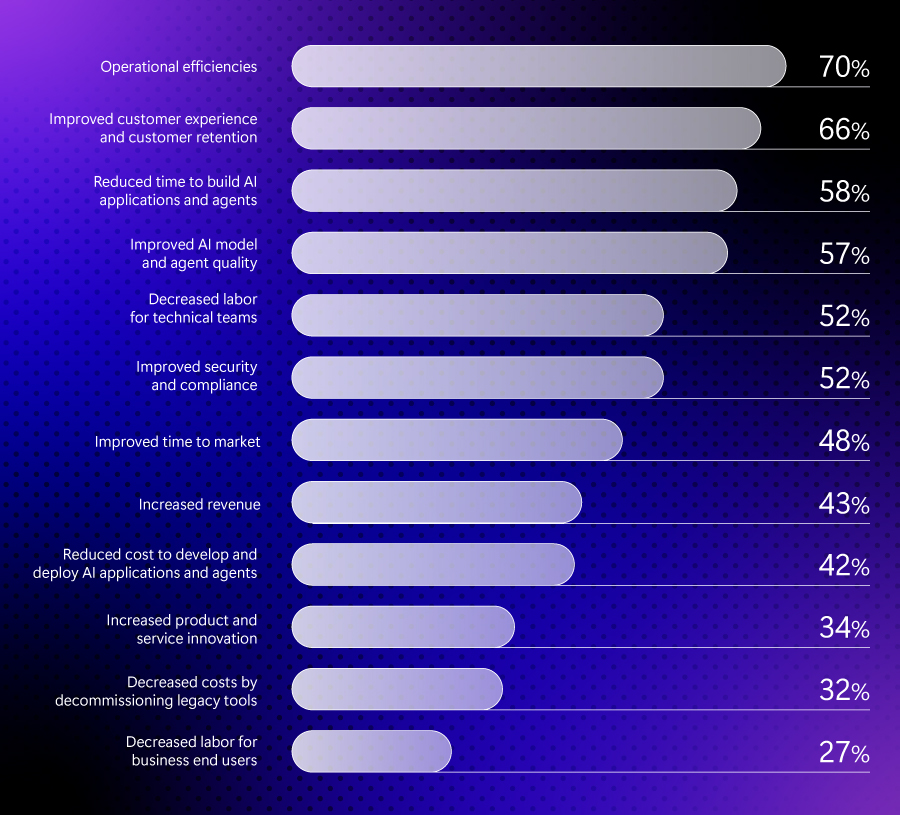
Figure 1: Survey results and reported benefits
When asked “What benefits has your organization experienced with Microsoft Foundry?”, respondents cited operational outcomes:
Forrester found that platform investments compound in value. For a team that invests $11.6M in resources, the three-year present value of quantified benefits for the composite organization totaled $49.5M: Year one delivered $10.0M, year two $21.1M, year three $30.5M.
Figure 2: Benefits breakdown
When every project starts from scratch
AI initiatives will require models, enterprise knowledge, tools, and governance. Without a shared platform, teams will encounter toil. With enterprise knowledge as the example, for every AI project, teams need to create vector databases, RAG pipelines, integrations, and access-control rules, creating internal infrastructure that does not directly influence business outcomes.
With Foundry, teams develop AI applications and agents on a unified, interoperable AI platform designed to enable agents to be intelligent and trustworthy: with reusable knowledge bases on data anywhere in the enterprise, protected by built-in evaluations, and agent controls. In Forrester’s TEI study, 75% of teams cited easier model grounding or knowledge source integration with Foundry IQ.
Over three years, the productivity gain alone was worth up to $15.7 million1. One Foundry customer said,
Our developers can go super fast because they can get what they need in Microsoft Foundry … We estimate that we reduce overall development time by 30%–40%.
—Global head of technology platforms, professional services
Organizations saw compounding returns when they built once and reuse everywhere with shared templates, knowledge bases, standardized evaluations, and consistent governance. This helps to explain a counterintuitive finding: organizations that focused energy consolidating on a unified platform outperformed those which did not. Their execution is simpler and therefore stronger.
The need for platform thinking
Point solutions develop in enterprises over time. Each solves a narrow problem, but each also introduces its own governance layer, context pipeline, and integration surface. The hidden cost here builds up in the stitching between these solutions.
In the Forrester study, 32% of surveyed organizations that adopted Foundry were able to decrease costs by decommissioning legacy AI tools, and the composite organization avoided up to $4.3M in infrastructure costs over three years by eliminating duplicative workflows, integrations, and operational overhead. For example, one customer shared they were able to decommission their container-based infrastructure and eliminate spending on previous AI model development tools since the functionality was included in the Foundry platform:
One of the benefits of using Foundry versus taking those models and running them in containers in the cloud is that then you don’t have to manage the container infrastructure.
—Managing director and global head of co-innovation, professional services
Department-level budgets favor point solutions, but enterprise-level outcomes require platform thinking. That mismatch is why AI spend often fails to translate into sustained value as organizations shift from isolated pilots to scaled deployments.
Trust unlocks higher-impact work
Most enterprises start with internal-facing AI use cases before they shift to customer-facing solutions. Two-thirds of AI agents today focus on process automation, while one-third support direct human assistance1. The ratio matters. Most enterprises need to trust AI with bounded, auditable tasks before they can trust it to enhance human judgment.
Foundry Control Plane enables organizations to govern the AI lifecycle with organization-wide observability and controls. This includes centrally managed policies for model deployment, configurable guardrails, and continuous evaluations to see what’s running, fix what’s failing, and prove compliance across any environment.
Model scanning done by Microsoft on the models … is a key requirement for us. … we want to make sure we understand what the model contains and whether it contains anything that is not in line with policy.
—Principal product manager, professional services
It’s no surprise that 67% of surveyed organizations cited concerns with AI security, privacy, or governance as a top reason for adopting Microsoft Foundry, ranking it higher than model access, capabilities, and cost inefficiencies. In essence, trust is a permission slip that enables organizations to expand from isolated process automation projects into higher-impact work at scale.
What leaders should do about AI now
The Forrester TEI study makes one thing unmistakable: enterprise AI ROI compounds when AI is treated as a platform, not a series of one-off projects.
The biggest gains come from giving technical teams a reusable foundation, including models, agents, and tools that scale across use cases and eliminate repetitive work. When AI development becomes repeatable, value accelerates and confidence follows.
Learn more about the benefits of AI workflows
- Read the full Forrester TEI Study.
- Build with Microsoft Foundry.
- Shift from ideas to outcomes faster with Microsoft Agent Factory.
The Forrester Total Economic Impact™ study on Microsoft Foundry was commissioned by Microsoft and conducted by Forrester Consulting.
1The Total Economic Impact™ Of Microsoft Foundry, a commissioned study conducted by Forrester Consulting, February 2026
2Represents results for the composite organization