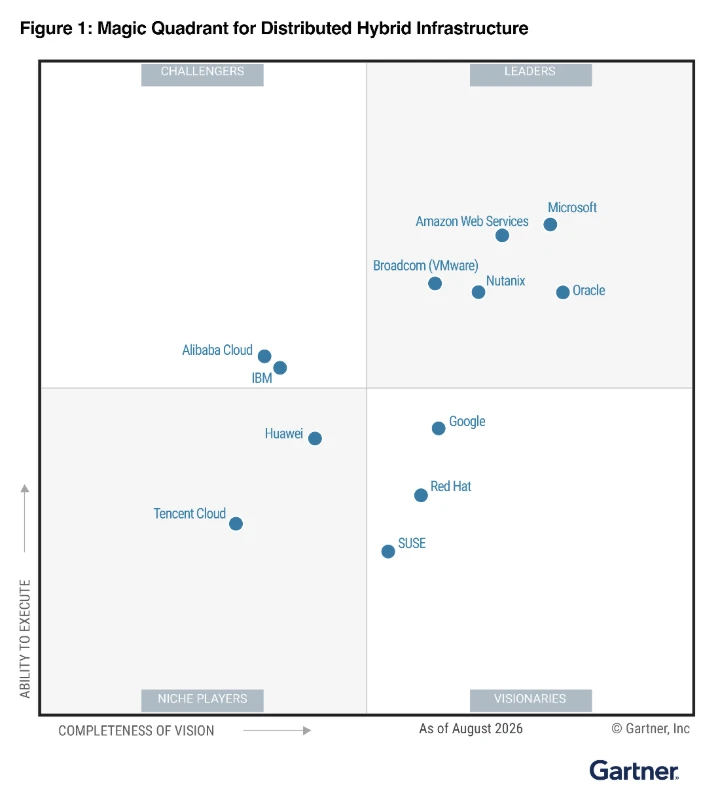
We’re proud to share that Microsoft has been recognized as a Leader in the 2026 Gartner® Magic Quadrant™ for Distributed Hybrid Infrastructure for the fourth consecutive year. Microsoft is positioned highest for Ability to Execute.
We believe this recognition reflects the strength of Microsoft’s unified approach to distributed infrastructure. With Azure Local and Azure Arc, organizations can manage infrastructure across datacenters, edge locations, multi-cloud environments, and sovereign deployments through a consistent Azure foundation.
One Azure platform for distributed infrastructure
Customers want the flexibility to run workloads where it makes the most sense for their business without taking on additional operational complexity. As infrastructure extends across datacenters, edge locations, and the cloud, Microsoft helps customers maintain consistency through common tools, processes, and management experiences, reducing fragmentation and allowing teams to focus on delivering business value.
Azure Arc extends Azure management and governance to resources running in data centers, at the edge, and across multi-cloud environments. Azure Local brings Azure infrastructure and services into customer-controlled locations so organizations can run cloud services and AI workloads closer to their applications and data.
Together, Azure Arc and Azure Local give organizations a common way to operate across environments without requiring every workload to run in the same place. Some applications are best suited for the public cloud. Others may need to remain in a corporate data center, operate at the edge, or run within a customer-controlled sovereign environment. While deployment locations differ, management and governance can remain consistent.
Microsoft continues to expand the environments Azure Local can support, from small-form-factor edge deployments to large scale data center environments. Azure Local supports both hyperconverged architectures and options for disaggregated compute and external storage, so infrastructure can be designed around the needs of the workload rather than a single deployment model.
Choice and operational control for sovereign workloads
The same workload-centric approach applies to digital sovereignty, an increasingly important consideration for organizations around the world. Microsoft Sovereign Cloud is not a single deployment model, but a continuum of choices and controls.
For many workloads, sovereignty requirements can be addressed in public cloud through capabilities for data residency, encryption, confidential computing, policy enforcement, and operational oversight. Other workloads need to run in customer-controlled locations or require greater separation from public cloud operations.
Built on Azure Local, Microsoft Sovereign Private Cloud supports these scenarios by giving customers greater control over infrastructure, data, operations, and access, while retaining a familiar Azure foundation. For environments where connectivity to the cloud is restricted or unavailable, disconnected operations on Azure Local bring a local control plane into the customer environment. This enables customers to deploy and manage Azure Local and supported capabilities without ongoing connectivity to the cloud.
Together, these options allow organizations to apply different levels of sovereignty and operational control to different workloads instead of forcing the entire estate into a single architecture.
Bringing AI closer to applications and data
The growing adoption of AI is making workload placement decisions even more important.
For some workloads, the scale and breadth of the public cloud are the right fit. Others need inference to happen where data is generated because of latency, connectivity, governance, or sovereignty requirements.
Foundry Local on Azure Local extends AI inference into Azure Local environments, allowing organizations to deploy and run models closer to their applications and data using Kubernetes-native operations.
Investing in what comes next
We see the 2026 Gartner recognition as validation of a clear direction: distributed infrastructure should provide customers with choice over where workloads run without requiring fragmented management, governance, and operational models.
We will continue investing in connected and disconnected operations, scalable infrastructure, data and AI capabilities, and consistent Azure management across distributed environments.
We are grateful for the trust our customers place in us and remain committed to delivering the flexible, consistent, and secure platform they need to power the next generation of distributed infrastructure.
- Learn more about Azure Local and Azure Arc
- Explore digital sovereignty at Microsoft
- Join us at Microsoft Ignite this November
Recognized as a Leader
2026 Gartner Magic Quadrant for Distributed Hybrid Infrastructure

Gartner, Magic Quadrant for Distributed Hybrid Infrastructure, [Julia Palmer, Elaine Zhang, Adrian Wong, Daniel Bowers; 7 September 2026].
Gartner does not endorse any company, vendor, product or service depicted in its publications, and does not advise technology users to select only those vendors with the highest ratings or other designation. Gartner publications consist of the opinions of Gartner’s business and technology insights organization and should not be construed as statements of fact. Gartner disclaims all warranties, expressed or implied, with respect to this publication, including any warranties of merchantability or fitness for a particular purpose.
Gartner and Magic Quadrant are a trademark of Gartner, Inc., and/or its affiliates.
This graphic was published by Gartner, Inc. as part of a larger research document and should be evaluated in the context of the entire document. The Gartner document is available upon request from Microsoft.