As organizations apply AI to more business-critical and data-intensive workloads, AI processing is moving closer to where data is created, decisions are made, and operations take place.
- Manufacturers can analyze confidential production data next to the systems that generate it.
- Pharmaceutical companies can apply AI to clinical trials within controlled environments.
- Government agencies can run AI applications on sensitive information while maintaining established security and operational boundaries.
This shift reflects ongoing innovation across the technology ecosystem to give organizations greater flexibility in where they run AI and process sensitive data, and it is changing the digital sovereignty conversation. It now encompasses where data is stored and processed, where workloads run, who can access and operate the systems around them, and how those systems remain secure and operational as requirements change. The next phase of digital sovereignty will take shape across the technology ecosystem, through closer alignment among silicon, infrastructure, cloud, security, data, and AI.
As AI extends into more sensitive and mission-critical workloads, sovereignty must be designed across the stack, from silicon and infrastructure to cloud, data, and AI. Microsoft and Intel® are working together to help organizations create a more consistent foundation for innovation, while retaining greater choice over where workloads run and how they are controlled.
A flexible sovereign architecture allows organizations to place each workload in the right environment, apply the controls it requires, and maintain a more consistent technology and operating foundation as requirements evolve.
Sovereignty must work across the technology stack
Sovereignty requirements vary by workload. The right level of control depends on factors such as data sensitivity, regulation, latency, connectivity, operational access, and resilience requirements. This creates a continuum, where organizations can apply different levels of control across public cloud, customer-controlled environments, and trusted partner solutions.
Delivering that flexibility requires the underlying technology layers to work together. The controls that shape where a workload runs, how data is protected, who can access it, and how the environment is verified extend across silicon, infrastructure, cloud, security, data, and AI.
This is where the Microsoft and Intel partnership comes into focus. Together, we are working to create a more consistent foundation across these layers, giving organizations greater choice in where workloads run and how they are controlled. This principle is central to the work between Microsoft and Intel. Azure Local, running on Intel® Xeon® 6 processors, brings distributed Azure infrastructure together with a common compute foundation for customer-controlled environments. Organizations can extend cloud and AI capabilities closer to their data and operations while maintaining consistent approaches to security, management, and governance.
Trust must be designed for and verified
For sensitive workloads, trust must be supported by technical protections and verifiable evidence. Organizations need to protect workloads across the technology stack and verify that systems are operating under the security conditions they have established.
That starts at the compute layer and extends through identity, encryption, governance, policy, and operations. For supported Azure Confidential VM configurations, Intel® Xeon® processors provide hardware-based protections, including Intel® Trust Domain Extensions (Intel TDX), which can help isolate workloads while they are in use. Hardware-backed attestation can provide evidence that helps organizations verify relevant security properties of the environment against their requirements. Microsoft extends this foundation through security and governance controls across cloud and customer-controlled environments.
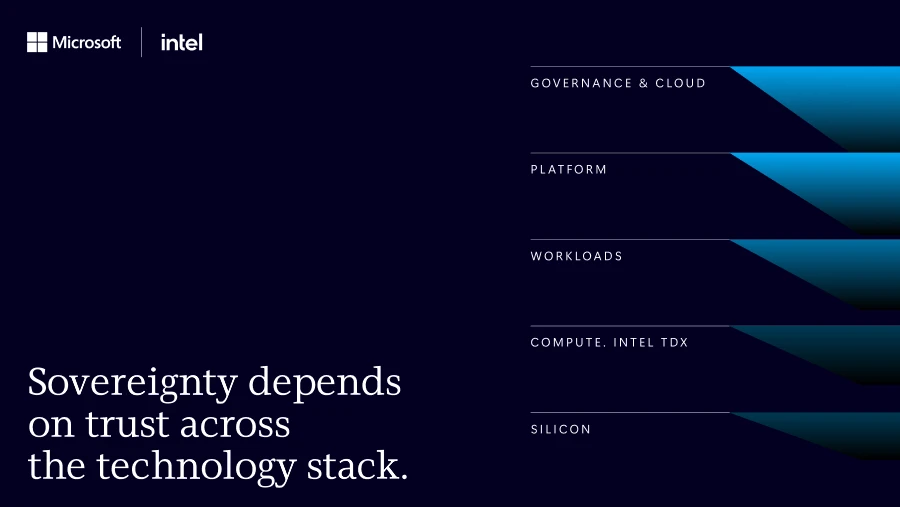
Together, these capabilities can help organizations verify relevant security properties of the environment against their requirements. This is particularly important as AI brings regulated, proprietary, and mission-critical data into new workloads.
Each workload should receive protections proportionate to its risk. Isolation, encryption, attestation, and operational controls can be applied where they provide meaningful value while preserving a manageable operating model across the broader environment.
Digital sovereignty requires trust across the technology stack. Together, Intel and Microsoft are combining hardware-based security and confidential computing with cloud, AI and distributed infrastructure to help customers protect sensitive workloads and verify the environments in which they run. This shared foundation gives organizations greater control, confidence and choice, with the performance and scale to continue innovating as AI moves into more regulated and mission-critical environments.
—Anand Pashupathy, Vice President and General Manager, Intel Product Assurance and Security
Sovereign AI brings intelligence closer to data
Much of the data with the greatest potential for AI must remain within defined operational, regulatory, or security boundaries. This includes data tied to industrial operations, government services, clinical environments, intellectual property, and proprietary research.
Workload placement has therefore become a practical AI decision. Organizations need the flexibility to run AI closer to their data, applications, and operations. Delivering that flexibility requires infrastructure, cloud platforms, AI software, and security capabilities to work as a connected foundation.
Microsoft Foundry helps organizations build and deploy AI applications and models, with options for where AI runs based on their requirements. Foundry Local enables organizations to run AI inference in their own environments, closer to the data and applications those models rely on. On the same infrastructure, Intel Xeon 6 processors with Intel® Advanced Matrix Extensions (Intel AMX) can accelerate AI workloads directly on the CPU. Intel® OpenVINO™ helps developers optimize and deploy models across supported infrastructure.
This approach extends across the broader application environment. Organizations may need to manage AI, applications, data, development, and productivity workloads within the same governance and operational boundary. Microsoft 365 Local and GitHub Enterprise Local extend customer-controlled options to collaboration, source code, and software development workflows.
Sovereign AI brings models, data, applications, development tools, and infrastructure together under the controls each workload requires. This approach allows organizations to apply AI within the operational and governance boundaries established for their most sensitive data.
Organizations want to apply AI to their most valuable data while maintaining the controls that data requires. On supported Azure confidential VM configurations, Intel TDX helps make that possible by running AI workloads in hardware-isolated trust domains, protecting models and data while in use and isolating them from the host and hypervisor. Hardware-backed attestation then gives organizations evidence they can check against their own requirements, so they can move from trusting their environment to verifying it.
—Anand Pashupathy, Vice President and General Manager, Intel Product Assurance and Security
Sovereignty architecture must be adaptable
Sovereignty requirements will continue to change. A workload that runs in a connected environment today may face different regulatory, resilience, or connectivity requirements tomorrow. AI models, applications, and infrastructure will also continue to evolve.
A sovereign architecture must therefore provide control without creating rigidity. Organizations should be able to adapt where workloads run, how they are secured, and how they connect without rebuilding their management and security model each time requirements change.
This is another reason partnership across the technology stack matters. Alignment across silicon, infrastructure, cloud, security, and AI software can give organizations a more stable foundation even as individual technologies and workload requirements evolve.
A well-designed sovereign architecture gives organizations room to respond as regulations, technologies, and operating conditions change.
Explore Microsoft Sovereign Cloud in Europe
Discover how Microsoft Sovereign Cloud in Europe helps organizations address evolving data sovereignty, security, and compliance requirements while accelerating cloud and AI innovation.

Three questions leaders should ask
Digital sovereignty can become abstract quickly. A better place to start is the workload.
1. What must remain under your control?
Consider the data, infrastructure, administrative access, software operations, and connectivity on which the workload depends. The answer may differ by application, even within the same organization.
2. Can you verify that those controls are working?
Policies and contractual commitments are important, but sensitive workloads may also require technical evidence. Consider how your architecture supports encryption, isolation, identity and access control, policy enforcement, attestation, and operational transparency.
3. Will the architecture leave you room to adapt?
AI capabilities, regulations, operating conditions, and workload requirements will continue to change. Your architecture should allow you to adopt new models, move processing closer to data, and adjust where workloads run without creating an entirely separate technology environment each time.
Digital sovereignty depends on cloud, infrastructure, security, AI, and silicon working together. Our collaboration with Intel gives customers a more consistent foundation across these layers, so they can apply stronger controls where needed while retaining the flexibility to innovate.
—Bernardo Caldas, CVP, Azure Edge Product Management
The strongest sovereignty strategy preserves choice
Digital sovereignty should give organizations greater control over the technology and data they depend on while preserving their capacity to innovate.
Achieving that outcome requires collaboration across the technology ecosystem. Microsoft and Intel are connecting silicon, infrastructure, cloud, security, and AI to give organizations greater flexibility in where workloads run, how they are protected, and how they evolve.
A strong sovereignty strategy meets today’s requirements while preserving tomorrow’s options.
Resources to learn more
- Dive deeper into digital sovereignty to learn how Microsoft is helping organizations address data residency, operational control, security, and regulatory requirements across cloud and customer-controlled environments.
- Learn more about Microsoft Sovereign Private Cloud.
- Join us at Microsoft Ignite in November to hear the latest on Microsoft Sovereign Cloud, Azure Local, AI, security, and infrastructure innovation.
Azure Local
Learn how organizations can run distributed infrastructure and applications with a consistent Azure experience