


Enterprise digital transformation is entering a new phase. The challenge is no longer just connecting systems. It is about making those systems intelligent, able to reason, respond, and act in real time across the business.
As AI moves from experimentation into production, a clear pattern is emerging. Models and agents do not create value on their own. Value is created when AI can reliably access enterprise data, invoke APIs, trigger workflows, and operate within the guardrails of security, compliance, and governance. This makes integration essential to realizing AI value.
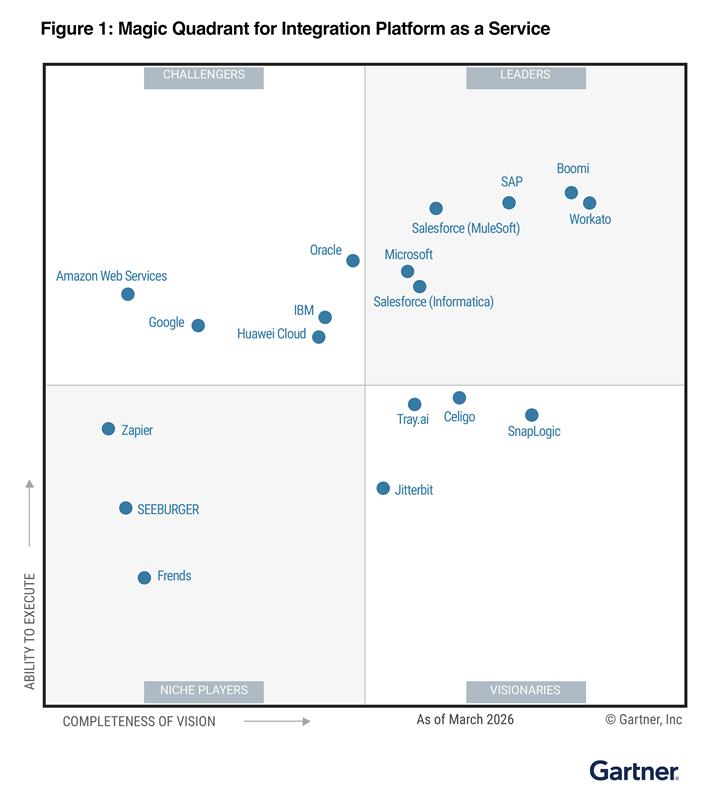
We are proud to share that Microsoft has been named a Leader in the 2026 Gartner® Magic Quadrant™ for Integration Platform as a Service, marking the eighth consecutive year of recognition. We believe this reflects both the strength of Azure Integration Services today and our conviction that integration must evolve to meet the demands of the AI era.
From integration to intelligent operations
For years, integration platforms have helped organizations connect applications and synchronize data. AI is changing what organizations expect from these platforms.
AI systems do not operate in isolation. They depend on APIs to take action, events to respond in real time, workflows to orchestrate decisions, and governance to ensure trust. Without strong integration, AI remains isolated.
This shift fundamentally redefines the role of integration.
Azure Integration Services provides a unified platform to connect applications, data, APIs, and events while operationalizing AI across the enterprise. This allows organizations to move beyond point-to-point connectivity and build systems that coordinate actions in real time.
The rise of agentic workflows
As integration evolves, workflows are evolving with it.
Static, predefined automations are giving way to adaptive processes that combine APIs, real-time data, and AI-powered decisioning. This is driving the rise of agentic workflows, where AI agents and deterministic logic operate together within orchestrated systems.
With Azure Logic Apps, organizations can design workflows that incorporate AI agents alongside business rules. These workflows are context-aware, responsive, and continuously improving.
They can invoke models, integrate human approvals, react to real-time signals, and execute across distributed systems. The result is a shift from traditional automation to intelligent operations that adapt as conditions change.
AI at scale demands governance by design
As AI systems gain the ability to act, governance becomes non-negotiable.
AI can access sensitive data, call downstream systems, and trigger business actions at speed. Without strong controls, this introduces real risk across security, compliance, cost, and trust.
Azure Integration Services addresses this by embedding governance into how AI interacts with the enterprise. With AI Gateway capabilities in Azure API Management, organizations can define and enforce how AI systems access APIs, models, and data. This includes applying policies, managing usage, enforcing access controls, and ensuring AI-powered interactions comply with regulatory and organizational requirements.
This approach allows organizations to scale AI confidently while maintaining control.
From experimentation to real-world impact
Organizations are already using these capabilities to drive measurable outcomes.
In cybersecurity, Cyderes processes more than 10,000 security alerts each day. By combining AI-powered analysis with automated, integrated workflows, the team has reduced noise and transformed how investigations are handled. Investigation cycles are now five times faster, enabling analysts to focus on high-value signals while keeping pace with increasingly sophisticated, AI-powered cyberthreats.
In life sciences, Vertex Pharmaceuticals addressed the challenge of knowledge fragmented across dozens of systems, including ServiceNow, internal documentation, and training platforms. By orchestrating AI within integrated workflows, they built a solution that can search, summarize, and route information seamlessly across tools like Microsoft Teams and Outlook. Tasks that once took hours are now completed in minutes, improving productivity while maintaining compliance and supporting global teams.
Organizations are also applying these patterns to govern AI at scale. Access Group, for example, uses Azure API Management to govern how AI systems interact with enterprise APIs and services. By introducing centralized policies, access controls, and observability, they can securely expose capabilities to AI applications while maintaining control over usage, cost, and compliance. This approach ensures that AI-powered interactions remain consistent, auditable, and aligned with business requirements.
These examples reflect a broader shift. Integration is no longer just about connecting systems. It is enabling new ways of working, where AI is embedded directly into business processes and governed as part of the enterprise platform.
Looking ahead
Integration will play a central role as organizations scale their use of AI. As organizations adopt AI agents, event-driven architectures, and real-time decisioning, the ability to orchestrate and govern these interactions becomes increasingly important.
We are honored to be recognized as a Leader in the 2026 Gartner® Magic Quadrant™ for Integration Platform as a Service and look forward to helping customers build what comes next.
Ready to explore further?
Download your complimentary copy of the 2026 Gartner® Magic Quadrant™ for Integration Platform as a Service to learn why Microsoft was named a Leader.
Explore how Azure Integration Services helps organizations operationalize AI across applications, data, and workflows.
Gartner and Magic Quadrant are trademarks of Gartner, Inc. and/or its affiliates. Gartner does not endorse any company, vendor, product or service depicted in its publications, and does not advise technology users to select only those vendors with the highest ratings or other designation. Gartner publications consist of the opinions of Gartner’s business and technology insights organization and should not be construed as statements of fact. Gartner disclaims all warranties, expressed or implied, with respect to this publication, including any warranties of merchantability or fitness for a particular purpose.