Today, we are expanding our GPT-6 series by welcoming GPT-6 Sol and GPT-6 Luna to our generally available lineup in Microsoft Foundry. Building on the exceptional customer momentum of GPT-5.6 Sol and GPT-6 Astra, this launch continues our work to deliver transformative capabilities in Microsoft Foundry that produce less noise and are more capable at completing full tasks with agents.
Astra brings advanced reasoning, software engineering and computer use to demanding work that requires both judgment and action. Azure customers report a step-change in capabilities, and strong cost-to-performance with the model using fewer, higher-value tokens to drive agents.
Completing the lineup, GPT-6 Sol is excellent for general-purpose use, while Luna brings efficient intelligence to high-volume data and preparatory work.
Put the right intelligence behind every agent
The right model for a job should be determined through evaluations: an agent handling a complex business decision and one routing routine requests have different needs. Microsoft recommends customers start with GPT-6 Astra for demanding work. For higher-volume workloads, GPT-6 Sol and Luna carry that progress forward, giving you a complementary choice built for production and scale.
GPT-6 Sol for production AI agents and complex workflows
GPT-6 Sol, and its proven predecessor—GPT-5.6 Sol—offer slightly more cost-effective intelligence with frontier efficiency. They support enterprise agents, coding and complex knowledge work, including reasoning across multiple steps, long-context analysis, and workflows that use tools. For teams evaluating their next production workload or migrating off a legacy model, Sol is a strong starting point.
GPT-6 Luna for efficient, high-volume AI workloads
GPT-6 Luna is Sol’s smaller, faster sibling, built for high-volume work. Use it for extraction, summarization, request routing, and routine customer interactions. Reserve deeper reasoning for the steps that need it, rather than applying the same model to every task.
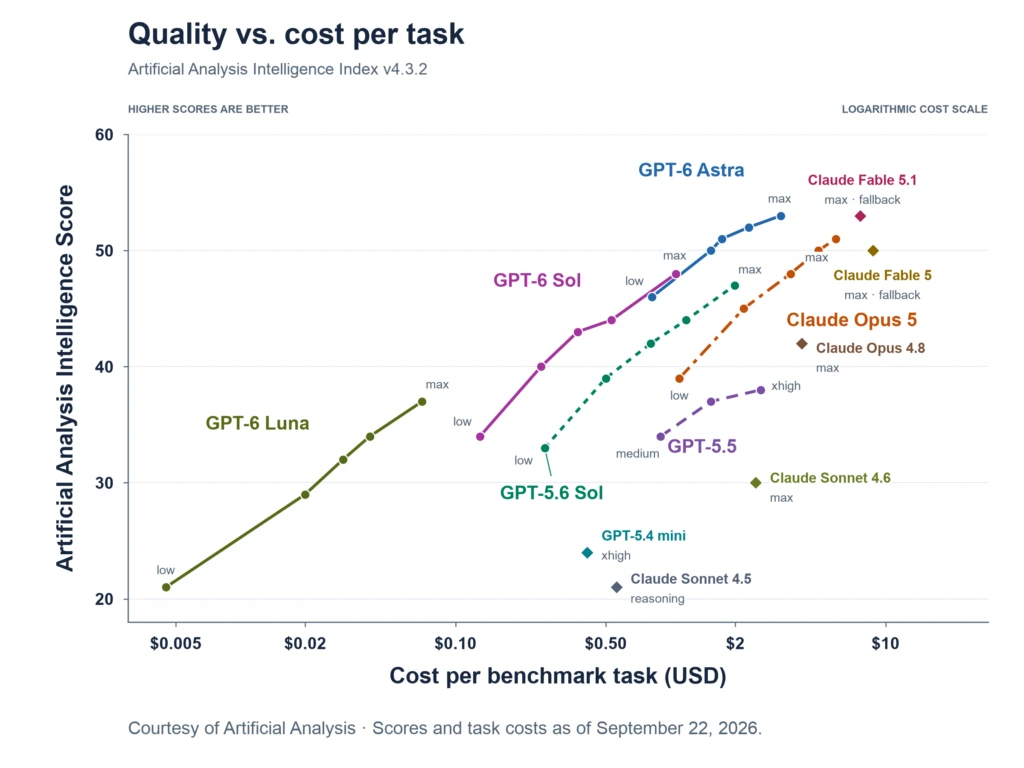
As the GPT-6 lineup expands, the opportunity is not simply to choose a newer model, but to improve what your agents can accomplish while saving money. Customers should look beyond pricing per token and seek to understand cost per task, which is a better measure for understanding the ROI of AI.
The accompanying chart illustrates why enterprise customers on Microsoft Foundry are switching to GPT-5.6 Sol and the latest GPT-6 offerings.
Foundry brings evaluation and monitoring together so teams can make those decisions with evidence. The real measure of that progress is what customers can do in production, which is why Foundry has always encouraged model choice and an open, interoperable stack.
The Foundry advantage, in customers’ words
Access to frontier models is only the starting point. Foundry pairs GPT-6 intelligence with the breadth of deployment options enterprise production demands. Today, Standard deployment is available for Astra, Sol and Luna across all 28 Global regions, and US and EU Data Zones; Provisioned Throughput for Astra and Sol across Global regions and US and EU Data Zones; and Priority Processing for Sol across Global regions and US Data Zones. The breadth and performance of Azure is why OpenAI continues to launch first on Azure, and why sophisticated customers like Manus choose Foundry.
Azure OpenAI models provide a core layer of intelligence powering Manus. Through Azure, we reliably integrate advanced models into our agentic workflows, enabling Manus to understand user intent, plan tasks, and execute complex work. Responsive Microsoft technical support and rapid access to new model capabilities help us iterate quickly and deliver a leading, reliable AI experience for our users.
—Tao Zhang, Co-Founder & Product Partner, Manus
For customers getting started with AI on Azure: choose Global for flexible, pay-per-token capacity, or supported Data Zone deployments for processing-location requirements. Priority Processing is a priority lane for responsive, pay-as-you-go experiences, with Provisioned Throughput providing reserved capacity and superior latency for critical production demand. Match the serving option to the workload, from interactive agents to high-throughput business processes.
That is the Foundry advantage: not just frontier intelligence, but the platform to put it to work. Teams can match each workload to the right model, deployment option, and controls, balancing capability, responsiveness, and cost as adoption grows. By bringing these choices together on Azure, Foundry helps customers focus on delivering business value, with the operational foundation to move from a promising agent to production at scale.
Our customers work in domains where getting an answer isn’t enough, it has to be the right answer, and it has to hold up to scrutiny. The latest Azure OpenAI frontier models reason through a problem in steps we can follow, which is what makes it viable for the research and compliance workflows our professionals depend on. Building on Microsoft Foundry lets us take those agentic workflows into production on infrastructure and services that already meet our governance, data residency, and security obligations.
—Brian Diffin, CTO of Wolters Kluwer Tax & Accounting
GPT-6 pricing and deployment options**
| Model | Deployment | Context Length | Pricing (USD $/million tokens) | |||
| Input | Cached Input | Cached Writes | Output | |||
| GPT-6 Astra | Global Standard | Short context | $10.00 | $1.00 | $12.50 | $50.00 |
| Long context | $20.00 | $2.00 | $25.00 | $75.00 | ||
| Data Zone Standard (US) | Short context | $11.00 | $1.10 | $13.75 | $55.00 | |
| Long context | $22.00 | $2.20 | $27.50 | $82.50 | ||
| Data Zone Standard (EU) | Short context | $12.00 | $1.20 | $15.00 | $60.00 | |
| Long context | $24.00 | $2.40 | $30.00 | $90.00 | ||
| GPT-6 Sol | Global Standard | Short context | $2.00 | $0.20 | $2.50 | $10.00 |
| Long context | $4.00 | $0.40 | $5.00 | $15.00 | ||
| Data Zone Standard (US) | Short context | $2.20 | $0.22 | $2.75 | $11.00 | |
| Long context | $4.40 | $0.44 | $5.50 | $16.50 | ||
| Data Zone Standard (EU) | Short context | $2.40 | $0.24 | $3.00 | $12.00 | |
| Long context | $4.80 | $0.48 | $6.00 | $18.00 | ||
| GPT-6 Luna | Global Standard | Short context | $0.10 | $0.01 | $0.125 | $0.50 |
| Long context | $0.20 | $0.02 | $0.25 | $0.75 | ||
| Data Zone Standard (US) | Short context | $0.11 | $0.011 | $0.1375 | $0.55 | |
| Long context | $0.22 | $0.022 | $0.275 | $0.825 | ||
| Data Zone Standard (EU) | Short context | $0.12 | $0.012 | $0.15 | $0.60 | |
| Long context | $0.24 | $0.024 | $0.30 | $0.90 | ||
**Pricing for both Provisioned Throughput and Priority Processing varies by deployment type. For each offer, U.S. Data Zone is priced at a 10% premium to Global. For current rates and terms, see the Azure OpenAI pricing page.
Build safer AI agents with Microsoft Foundry
GPT-6 models running on Azure have multiple layers of safety and security built directly into the model and around it. At the core, the model itself carries the alignment and safety training built in, while the prompts and outputs around it are protected by content filters and guardrails that govern what the agent can say. Beyond that, tool calls and responses are protected by controls and prompt injection mitigation that govern what the agent can do, and identity and access are protected by enterprise policies that govern what it can reach.
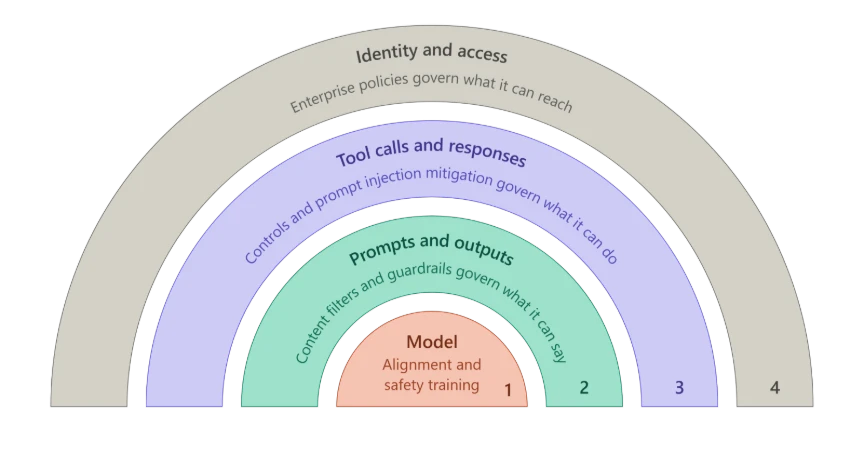
Foundry helps teams continuously strengthen safety layers as risks evolve. It applies guardrails at key checkpoints, including prompts, outputs, tool calls, and tool responses. Identity and access controls govern what agents can do and reach. Microsoft Purview applies enterprise data policies. Evaluation, tracing, and monitoring give teams the evidence to optimize those controls over time, with human checkpoints at every phase.
Move to GPT-6. Build your next generation of agents.
Build your next agentic workloads in Microsoft Foundry. Start with GPT-6 Astra for demanding reasoning, Sol for general production use, and scale high-volume tasks with GPT-6 Luna. For customers of legacy models, we recommend evaluating an upgrade to GPT-5.6 Sol and above.
Your next agent needs more than a powerful model. Foundry brings an open intelligence stack, deployment flexibility, and Azure enterprise controls together so you can build with confidence and scale from your first workload to production.
Start building in Foundry today
Access GPT-6 models, evaluate the right fit for your workload, and scale from experimentation to production.