
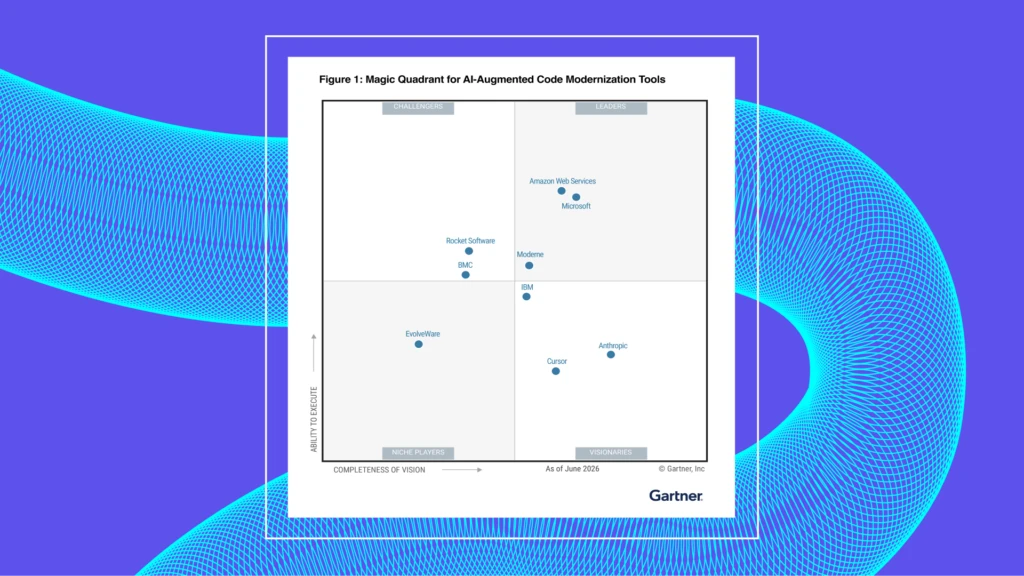
Microsoft has been named a Leader in the inaugural 2026 Gartner® Magic Quadrant™ for AI-Augmented Code Modernization Tools, which recognizes software solutions that use specialized AI agents, generative AI, and deterministic analysis to accelerate the transformation of legacy systems. We are proud of our placement as a Leader in this first edition of the report.
Cloud-native modernization
Microsoft’s conviction from the start has been that modernization should become one of the fastest, most trusted, and most predictable workflows organizations undertake, and agentic AI is what finally makes that possible. For years, modernization and innovation competed for the same budget, and modernization usually lost. Now the math has changed: modernization is no longer the tax teams pay before they can innovate, it is the fastest path to it, and the gateway to AI. Eliminating decades of technical debt is what lets teams embed intelligence directly into the proven, high-value systems that already run their business. This modern foundation turns the assets they depend on most into the platform for what comes next.
None of this is on the horizon; it is happening now. Modernization is shifting from a multi-year program into something teams finish in days or weeks.
Today, organizations are not just moving to the cloud or reducing technical debt, they are fundamentally rethinking their applications, their data, and their infrastructure because they know the decisions they make today will determine whether they are AI-ready tomorrow. Every modernization decision is now an AI decision.
Microsoft Azure was built for this moment. It provides the agentic foundation and engine for modernization and AI transformation, along with the governance and trust enterprises require, so modernization lowers security, data, and operational risk as much as it accelerates AI readiness. With agentic tooling and an end-to-end modernization solution powered by GitHub Copilot and Azure Copilot, Microsoft is accelerating the shift, not just leading it.
The problem we set out to solve
Every enterprise carries code it cannot afford to rewrite and cannot afford to ignore. Legacy .NET Framework applications, Java runtimes, aging dependencies, and accumulated security debt power critical business processes while also limiting an organization’s ability to move forward. For decades, modernization meant large teams, months of manual effort, and a real risk of breaking what already works. As a result, it got deferred, repeatedly, while technical debt compounded and the distance to the cloud grew.
We feel Gartner frames the opportunity perfectly: software engineering leaders can meaningfully reduce the time, effort, and risk of modernization by using AI-powered tools rather than manual approaches. That distance, between the cost of standing still and the cost of moving, is exactly where we put our focus. The goal was never to help teams modernize a little faster. It was to fundamentally change the economics of modernization.
How it works
The engine behind this is GitHub Copilot modernization, an agentic, end-to-end approach that helps teams assess, upgrade, and migrate applications to Azure, with AI handling repetitive tasks while developers remain firmly in control.
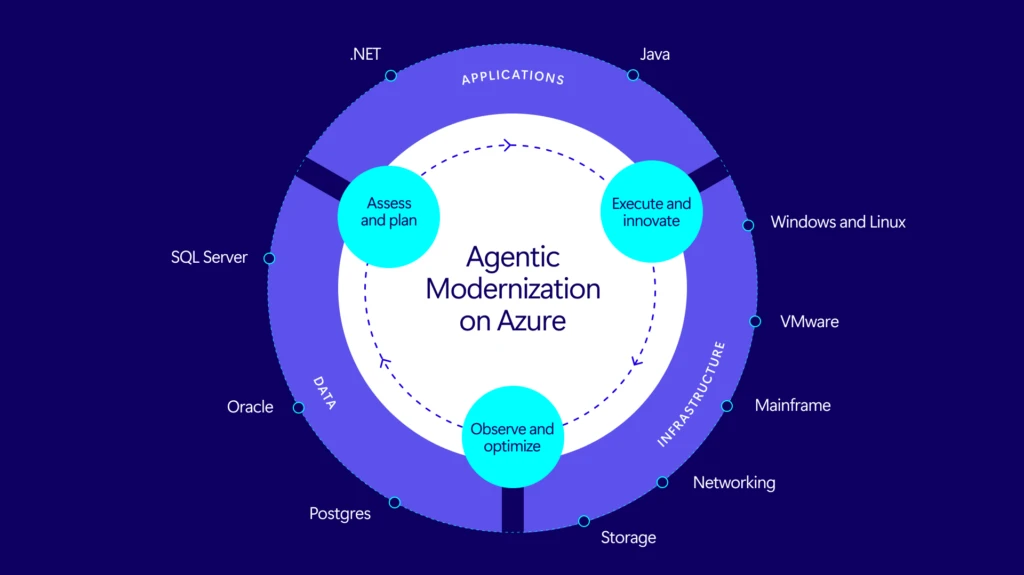
We deliver it through two layers that work together. The modernization agent, available through the Modernize CLI, enables architects and application owners to orchestrate assessment, planning, and framework-upgrade automation across many applications at once, then delivers robust application-specific plans to developers. Inside the IDE, developers use GitHub Copilot to execute those plans: upgrading runtimes and frameworks, migrating dependencies to Azure services, generating infrastructure-as-code, and deploying to production. Assessment, planning, transformation, validation, and deployment become one continuous, guided journey rather than a dozen disconnected steps.
What we chose not to automate matters just as much, and that is human judgment. Every recommendation is transparent, every change is reviewable, and every step is validated against your own tests and pipelines. This is modernization at machine speed, with the accountability enterprises require.
Where we believe we stand apart
- Breadth: Github Copilot modernization spans the languages that actually run the enterprise—.NET, Java, C++, and Python—rather than a single stack, so platform teams can standardize on one approach.
- Repeatable expertise: Predefined tasks capture best practices for common migration patterns, such as adopting managed identities, Azure Key Vault, Blob and File storage, or Microsoft Entra ID. Then custom skills let teams turn their own proven code changes into reusable patterns, applying them consistently across projects and ensuring institutional knowledge stays within the organization.
- Trust built in: Security is part of the workflow, not a phase bolted on at the end. Copilot validates builds, migrates unit tests, scans for CVEs after upgrades, and applies fixes in agent mode—strengthening your security posture as you modernize, not after.
- Enterprise readiness: Modernizing one application is a project; modernizing an entire estate is a business imperative. What makes the difference at scale is consistency: the patterns that work become reusable tasks and skills any team can apply again, so a proven approach spreads across the portfolio instead of being reinvented app by app. It is what turns modernization from a string of one-off wins into a repeatable, governable practice.
- The destination, not just the journey: Modernization is continuous. Applications land on Azure—Azure App Service, Azure Container Apps, Azure Kubernetes Service—and become ready to tap into the full system from silicon to software. This includes Microsoft Foundry’s catalog of more than 11,000 models and Microsoft IQ, the enterprise intelligence layer that grounds AI agents in your organization’s own data and knowledge. Teams don’t just retire technical debt; they unlock what’s next.
The results that make it real
The numbers coming back from teams already doing this work are what change the conversation. Customers using GitHub Copilot modernization capabilities report up to 70% less time spent on migration efforts and 50% less effort to upgrade applications. Some have moved more than 500,000 lines of code in a matter of weeks, work that once would have consumed quarters. Adoption tracks the same story: more than 1.4 million developers have already installed the experience.
GitHub Copilot’s modernization agent significantly saved time on our Java modernization effort from days down to mere hours at SAP Labs. It runs seamlessly at scale, significantly reducing manual complications for our developers. The modernization agent is now an essential pillar of our modernization effort.
—Dr Richard Cai, Managing Director, SAP Labs China
This is the starting line
Being named a Leader in this Magic Quadrant is an honor for us, and candidly it is an obligation. The teams that adopt AI-powered modernization now will spend the next decade building on modern, secure foundations, in the cloud or hybrid, while others are still untangling the past. We intend to keep widening that gap with deeper language and framework coverage, richer agentic automation, and an ever-shorter path from legacy code to production on Azure.
To every customer and partner who has modernized alongside us, thank you. You shaped this, and you are the reason for the recognition.
If you are ready to see what is possible, explore agentic modernization and start with a single application this week. You can also read a complimentary copy of the report to see why Microsoft was named a Leader.
Microsoft named a Leader
Learn more about the 2026 Gartner® Magic Quadrant™ for AI-Augmented Code Modernization Tools

Gartner ® Magic Quadrant™ for AI-Augmented Code Modernization Tools, Prasanna Lakshmi Narasimha, Erin Khoo, Deacon D.K Wan, Wei Jin, 3 August 2026
Gartner does not endorse any company, vendor, product or service depicted in its publications, and does not advise technology users to select only those vendors with the highest ratings or other designation. Gartner publications consist of the opinions of Gartner’s business and technology insights organization and should not be construed as statements of fact. Gartner disclaims all warranties, expressed or implied, with respect to this publication, including any warranties of merchantability or fitness for a particular purpose.
Gartner and Magic Quadrant are trademarks of Gartner, Inc., and/or its affiliates.
This graphic was published by Gartner, Inc. as part of a larger research document and should be evaluated in the context of the entire document. The Gartner document is available upon request from: https://www.gartner.com/reprints/?id=00ThR000008k1rGUAQ&ct=260804&st=sb