In June 2020, we announced general availability of Azure general purpose and memory optimized Virtual Machines based on the 2nd generation Intel Xeon Platinum 8272CL (Cascade Lake) to deliver up to ~20 percent CPU performance improvement compared to their predecessors, the Dv3 and Ev3 VM, depending on the workload.
Today, we are expanding our SAP HANA certifications, enabling you to run production SAP HANA workloads on the Edsv4 virtual machines sizes outlined in the following table. Customers benefit from improved price/performance when running SAP workloads on these Azure virtual machines.
VM type | vCPUs | Memory (GiB) | SAP HANA workload |
E20ds_v4 | 20 | 160 | OLAP & OLTP |
E32ds_v4 | 32 | 256 | OLAP & OLTP |
E48ds_v4 | 48 | 386 | OLAP & OLTP |
E64ds_v4 | 64 | 504 | OLAP & OLTP |
For more detailed scenario descriptions, please refer to SAP’s Certified IaaS Platforms webpage.
Benefits of the newly SAP-HANA certified Edsv4 sizes
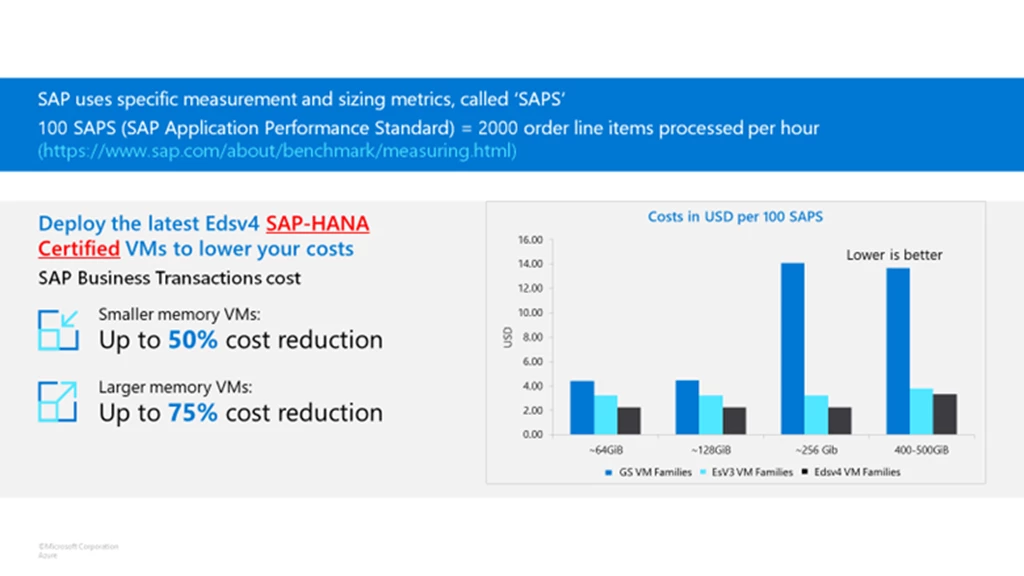
We know SAP is at the core of many of your business processes and is a mission critical application for your enterprise. SAP measurement and sizing metrics, called SAPS, define100 SAPS = 2000 order lines items processed per hour. With the latest SAP HANA-certified Edsv4 VMs, you are now able to further the costs associated with your SAP environment. As you can see in the chart below, the latest generation smaller memory VMs can achieve the same number of SAPS with up to 50 percent cost reduction compared to the previous Azure VM families. Additionally, larger memory VM sizes can provide up to 75 percent cost savings compared to previous VMs.
We were also able to demonstrate the new D64ds_v4 achieved 100,500 SAPS1 (official SD-benchmark result). As you can see, we achieved a throughput of 1570 SAPS per (v)CPU, which beats the per CPU throughput compared to the previous Dv3 version.
New D-sv4 and E-sv4 Azure Virtual Machines available on Dedicated Hosts
The Azure Ddsv4, Edsv4, Dsv4, and Esv4 virtual machines can also run on Azure Dedicated Hosts. Dedicated Hosts provide physical servers that host one or more Azure virtual machines. Your server is dedicated to your organization and your workloads—and the server capacity is not shared with other customers. As you provision the host, you gain more visibility into the underlying infrastructure and you have control over the host maintenance operations that are performed by Microsoft to avoid any unexpected downtime on your VMs.
Learn more
- Check SAP’s certification site where you can find the full list of our SAP HANA certifications on Azure.
- Review more about running SAP applications on Azure.
- Get details on Azure Dedicated Hosts.
- Learn how you can run a broad range of business-critical applications on Azure.
- Learn more about Ddsv4, Edsv4, Dsv4, and Esv4.
1. Two-tier SAP Standard SD Benchmark on SAP Business Suite SAP enhancement package 5 for SAP ERP 6.0 using SQL Server 2012 and Windows Server 2012 on Microsoft Azure Virtual Machine Services VM type D64ds_v4 with 17,800 users achieving a throughput of 100,500 SAPS. For more details: SAP Standard Application Benchmarks.