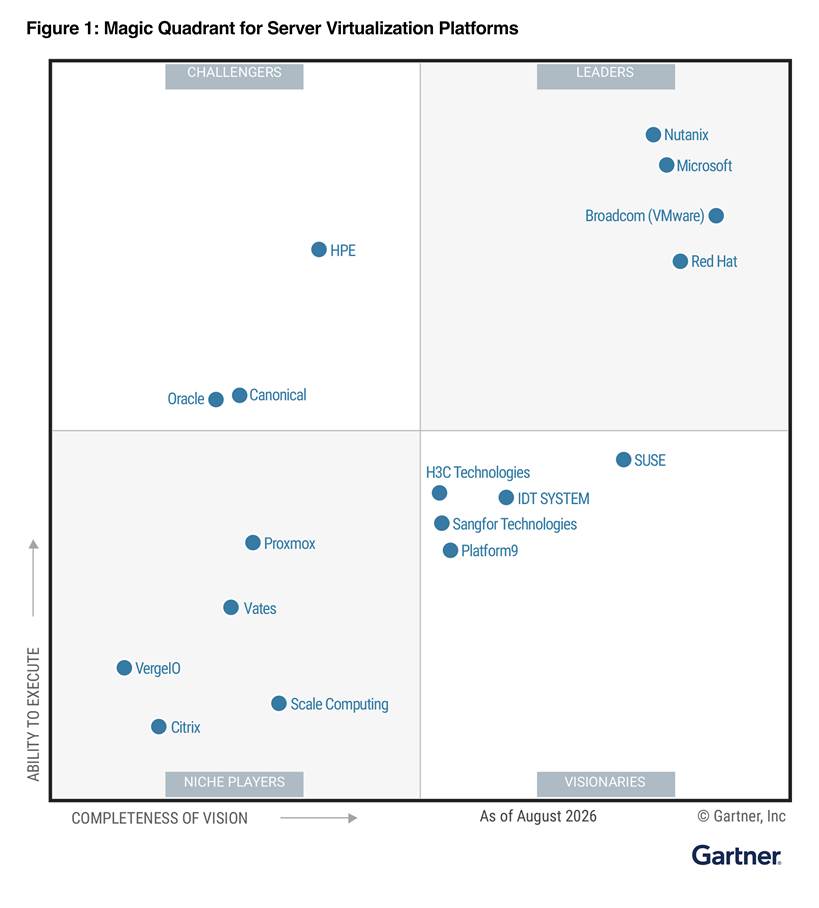
We’re proud to share that Microsoft has been named a Leader in the 2026 Gartner® Magic Quadrant™ for Server Virtualization Platforms. We believe this recognition comes at an important moment for enterprise infrastructure. The question is no longer simply which hypervisor to run. It is how to create a consistent operating model across cloud, datacenter, edge, and sovereign environments. Microsoft addresses that challenge at two levels: operational consistency through Azure and Azure Arc, and infrastructure consistency through Hyper-V.
From choosing a hypervisor to choosing an operating model
For years, the primary virtualization decision was which hypervisor to run. Today, the more consequential decision is how infrastructure will be operated across every environment the business depends on. Virtualization remains a critical foundation, but the value of the platform increasingly depends on how infrastructure is managed, governed, secured, updated, and connected across environments. As infrastructure becomes more distributed, how it is operated becomes as important as where it runs.
Microsoft delivers that consistency at two complementary levels:
- Operational consistency: Azure provides common management, governance, and security across cloud, datacenter, and edge environments. Azure Arc extends those capabilities to distributed infrastructure, giving organizations a unified way to operate diverse environments.
- Infrastructure consistency: Hyper-V provides a common virtualization foundation across Azure, Azure Local, and Windows Server, helping organizations maintain a consistent infrastructure layer wherever workloads run.
Together, these layers help organizations preserve choice without multiplying operational models. Workloads can move, environments can evolve, and new technologies can be adopted without requiring a separate operating model for every environment.
Ready for what comes next
Operational and infrastructure consistency will become even more important as AI reshapes enterprise IT. Models, agents, applications, and data will increasingly span cloud, datacenter, edge, and sovereign environments. AI alone will not reduce the complexity of distributed infrastructure; in many cases, it will increase the need for common management, governance, security, and infrastructure foundations.
Being named a Leader in this Magic Quadrant is an honor for us. More importantly, we believe it reflects a direction many organizations are pursuing: operational consistency across increasingly distributed environments. We remain committed to helping customers combine the flexibility to run workloads where they choose with the consistency required to manage them as one environment.
Recognized as a Leader
in the 2026 Gartner® Magic Quadrant™ for Server Virtualization Platforms

Gartner, Magic Quadrant for Server Virtualization Platforms, Tony Harvey, Daniel Bowers, Paul Delory, Tony Iams, Owen Marino, 14 September 2026.
Gartner does not endorse any company, vendor, product or service depicted in its publications, and does not advise technology users to select only those vendors with the highest ratings or other designation. Gartner publications consist of the opinions of Gartner’s business and technology insights organization and should not be construed as statements of fact. Gartner disclaims all warranties, expressed or implied, with respect to this publication, including any warranties of merchantability or fitness for a particular purpose.
Gartner and Magic Quadrant are trademarks of Gartner, Inc., and/or its affiliates. This graphic was published by Gartner, Inc. as part of a larger research document and should be evaluated in the context of the entire document. The Gartner document is available upon request from Microsoft here.