Skip to main content Explore View all products (200+) Microsoft Foundry Azure Copilot GitHub Copilot Azure Kubernetes Service (AKS) Azure Cosmos DB Azure Database for PostgreSQL Azure Arc Microsoft Fabric Linux virtual machines in Azure Foundry Models Foundry Agent Service Foundry IQ Foundry Tools Foundry Control Plane Observability in Foundry Control Plane Azure OpenAI in Foundry Models Azure Speech in Foundry Tools Azure Machine Learning View all databases Azure Cosmos DB Azure DocumentDB Azure SQL Azure Database for PostgreSQL Azure Managed Redis Microsoft Fabric Azure Databricks Linux virtual machines in Azure Windows Server on Azure Azure Functions Azure Virtual Machine Scale Sets Azure API Management Azure Container Apps Azure Kubernetes Service (AKS) Azure Kubernetes Fleet Manager Azure Container Registry Azure Red Hat OpenShift Azure Container Instances Azure Container Storage Azure Arc Azure Local Microsoft Defender for Cloud Azure Monitor Microsoft Sentinel Azure Migrate View all solutions (40+) Cloud solutions for small and medium businesses Cloud migration and modernization center Data analytics for AI Azure Databases AI apps and agents Microsoft Marketplace Microsoft Sovereign Cloud AI apps and agents Responsible AI with Azure AI Infrastructure Data analytics for AI Machine learning operations (MLOps) Low-code application development on Azure Integration Services Serverless computing DevOps Migration and modernization center .NET apps migration Databases on Azure Linux on Azure Oracle on Azure SAP on the Microsoft Cloud Adaptive cloud High-performance computing (HPC) Infrastructure as a service (IaaS) Resiliency Azure Essentials Frontier Accelerate for Azure FinOps on Azure Microsoft Marketplace Azure pricing overview Create an Azure account Free Azure services Flexible purchase options Pricing calculator FinOps on Azure Maximize ROI from AI Azure savings plans Azure reservations Azure Hybrid Benefit Virtual Machines Azure SQL Microsoft Foundry Microsoft Fabric Azure Kubernetes Service (AKS) Microsoft Defender for Cloud View more Software Development Companies Microsoft Marketplace Find a partner Resources for Azure partners Get started with Azure Customer stories Analyst reports, white papers, and e-books Videos Learn more about cloud computing Documentation Explore Azure portal Developer resources Quickstart templates Resources for startups Developer community Students Azure for partners Blog Events and Webinars Learn Support Contact Sales Get started with Azure Sign in

How do you go about answering those perplexing questions such as what secure hardware to use? How do I gauge the level of security? How much security do I really need and hence how much premium should I place on secure hardware? We’ve published a new whitepaper to shed light on this subject matter.

In our relentless commitment to securing IoT deployments worldwide, we continue to raise awareness to the true nature of security—that it is a journey and never an endpoint. Challenges emerge, vulnerabilities evolve, and solutions age thereby triggering the need for renewal if you are to maintain a desired level of security.

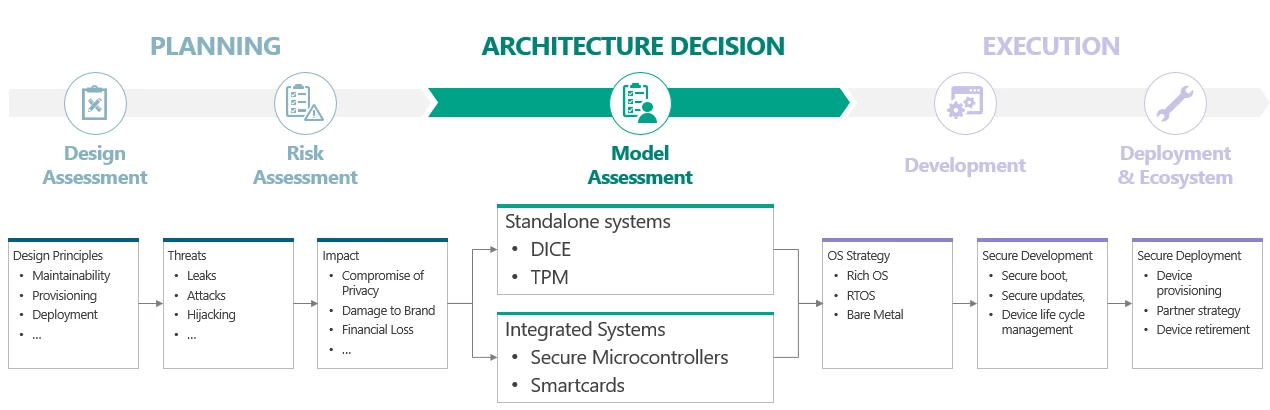
Securing your deployment as desired comprises planning, architecture, and execution main phases. For IoT, these are further broken down into sub-phases to include design assessment, risk assessment, model assessment, development, and deployment as shown in Figure 1. The decision process at each phase is equally important, the process must take all other phases into consideration for optimal efficacy. This is especially true when choosing the right secure hardware, also known as secure silicon or Hardware Secure Module(HSM), to secure an IoT deployment.

image

Figure 1: The IoT Security Lifecycle

Choosing the right secure hardware for securing an IoT deployment requires that you understand what you are protecting against (risk assessment), which drives part of the requirements for the choice. The other part of the requirements entails logistical considerations like provisioning, deployment and retirement, as well as tactical considerations like maintainability. These requirements in turn drive architecture and development strategies which then allow you to make the optimal choice of secure hardware. While this prescription is not an absolute guarantee for security, following these guidelines allows one to comfortably claim due diligence for a holistic consideration towards the choice of the right secure hardware, and hence the greatest chance of achieving security goals.

The choice itself requires knowledge of available secure hardware options as well as corresponding attributes such as protocol and standards compliances. We’ve developed a whitepaper, The Right Secure Hardware for Your IoT Deployment, to highlight the secure hardware decision process. This whitepaper educates on the Architecture Decision phase of the IoT security lifecycle. It comprises the second whitepaper for the IoT security lifecycle decision making series following previously published whitepaper, Evaluating Your IoT Security, which offers education on the Planning phase.

Download IoT Security Lifecycle whitepaper series:

  1. Evaluating Your IoT Security.
  2. The Right Secure Hardware for Your IoT Deployment.

What strategies do you use in selecting the right hardware to secure your IoT devices and deployment? We invite you to share your thoughts in comments below.

WE ARE MICROSOFT

Explore Microsoft Foundry

The future of AI starts here. Envision your next great AI app with the latest technologies. Get started with Azure.