Today, I’ll be talking to a global community of attendees at the 2017 Open Compute Project (OCP) U.S. Summit about the exciting disruptions we see in the processor ecosystem, and how Microsoft is embracing the innovation created by these disruptions for the future of our cloud infrastructure.
The demand for cloud services continues to grow at a dramatic pace and as a result we are always innovating and looking out for technology disruptions that can help us scale more rapidly. We see one such disruption taking shape in the silicon manufacturing industry. The economic slowdown of Moore’s Law and the tremendous scale of the high-end smart phone market has expanded the number of processor suppliers leading to a “Cambrian” explosion of server options.
We’re announcing that we are driving innovation with ARM server processors for use in our datacenters. We have been working closely with multiple ARM server suppliers, including Qualcomm and Cavium, to optimize their silicon for our use. We have been running evaluations side by side with our production workloads and what we see is quite compelling. The high Instruction Per Cycle (IPC) counts, high core and thread counts, the connectivity options and the integration that we see across the ARM ecosystem is very exciting and continue to improve.
Also, due to the scale required for certain cloud services, i.e. the number of machines allocated to them, it becomes more economically feasible to optimize the hardware to the workload instead of the other way around, even if that means changing the Instruction Set Architecture (ISA).
When we looked at the variety of server options, ARM servers stood out for us for a number of reasons:
- There is a healthy ecosystem with multiple ARM server vendors which ensures active development around technical capabilities such as cores and thread counts, caches, instructions, connectivity options, and accelerators.
- There is an established developer and software ecosystem for ARM. We have seen ARM servers benefit from the high-end cell phone software stacks, and this established developer ecosystem has significantly helped Microsoft in porting its cloud software to ARM servers.
- We feel that ARM is well positioned for future ISA enhancements because its opcode sets are orthogonal. For example, with out-of-order execution running out of steam and with research looking at novel data-flow architectures, we feel that ARM designs are much more amenable to handle those new technologies without disrupting their installed software base.
We have been working closely with multiple ARM suppliers, including Qualcomm and Cavium, on optimizing their hardware for our datacenter needs. One of the biggest hurdles to enable ARM servers is the software. Rather than trying to port every one of our many software components, we looked at where ARM servers are applicable and where they provide value to us. We found that they provide the most value for our cloud services, specifically our internal cloud applications such as search and indexing, storage, databases, big data and machine learning. These workloads all benefit from high-throughput computing.
To enable these cloud services, we’ve ported a version of Windows Server, for our internal use only, to run on ARM architecture. We have ported language runtime systems and middleware components, and we have ported and evaluated applications, often running these workloads side-by-side with production workloads.
During the OCP US Summit, Qualcomm, Cavium, and Microsoft will be demonstrating the version of Windows Server ported for our internal use running on ARM-based servers.
The Qualcomm demonstration will run on the Qualcomm Centriq 2400 ARM server processor, their recently announced 10nm, 48-core server processor with Qulacomm’s most advanced interfaces for memory, network, and peripherals.
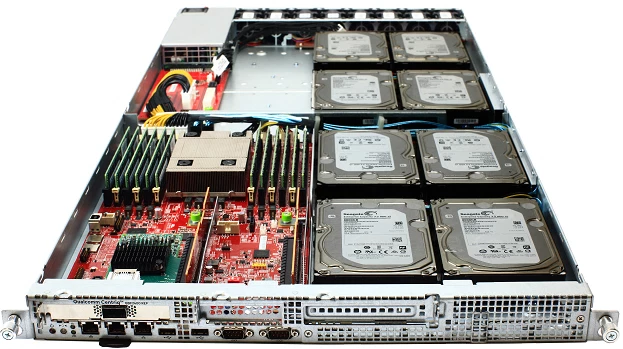
The demonstration with Cavium runs on their flagship 2nd generation 64-bit ThunderX2 ARMv8-A server processor SoCs for datacenter, cloud and high performance computing applications.
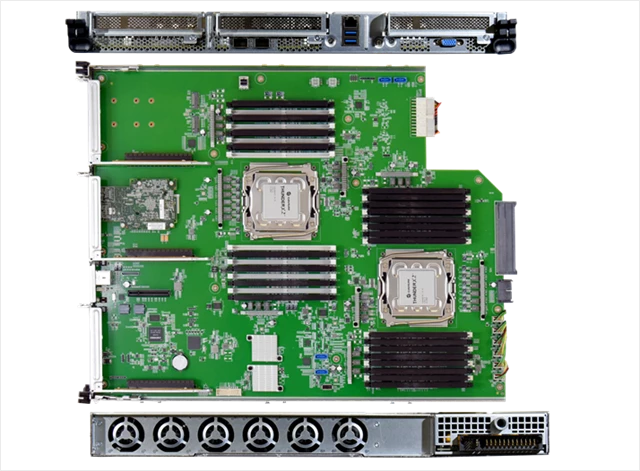
Cavium, who collaborated with leading server supplier Inventec, and Qualcomm have each developed an Open Compute-based motherboard compatible with Microsoft’s Project Olympus that allows us to seamlessly deploy these new servers in our datacenters.
We feel ARM servers represent a real opportunity and some Microsoft cloud services already have future deployment plans on ARM servers. We are working with ARM Limited on design specifications and server standard requirements and we are committed to collaborate with the community on open standards to advance ARM64 servers for cloud services applications.
You can read about our other announcements during the 2017 Open Compute Project Summit at this blog.