By Jason Zander, Executive Vice President, Microsoft Azure
A few hours ago, Scott Guthrie and Satya Nadella talked about Microsoft’s strategy for cloud computing, announcing several important technology and partnership updates to Microsoft Azure – including:
The G-series, offering the largest VM size in the public cloud
Premium Storage, high performance storage disks
A new Azure Marketplace to better connect startups, partners and our enterprise customers
Exciting industry partnerships with CoreOS and Cloudera
The Microsoft Cloud Platform System
This comes on the heels of our announcement earlier this week to bring Docker to Windows Server and Azure.
G-Series VM Sizes
We announced a new series of Virtual Machine sizes, called the G-series, which will provide extraordinary performance for your most demanding applications. The G-series will provide more memory and more local Solid State Drive (SSD) storage than any current VM size in the public cloud. The largest G-series will offer 448 GB RAM and 6.5 TB of local SSD storage. Alongside this massive memory and local SSD storage, the G-series will also provide unparalleled computational performance, using the latest Intel® Xeon® processor E5 v3 family.
VM Size
Cores
RAM (in GB)
Local SSD Storage (in GB)
Standard_G1
2
28
406
Standard_G2
4
56
812
Standard_G3
8
112
1,630
Standard_G4
16
224
3,250
Standard_G5
32
448
6,500
We expect to make the G-series generally available later this year. If you are interested in these new sizes then please complete the following short survey to express your interest.
Premium Storage
Azure Premium Storage is a new type of SSD-based storage, designed to support I/O intensive workloads. With Premium Storage, you can provision a persistent disk and configure the size and performance characteristics that will meet your requirements. You can then attach several persistent disks to a VM, stripe across them and deliver to your applications up to 32 TB of storage per VM with more than 50,000 IOPS per VM at less than one millisecond latency for read operations.
Once available, with Premium Storage and the G-Series VMs, Azure offers the ability to truly lift-and-shift your demanding enterprise applications – including SQL Server, Dynamics AX, Dynamics CRM, Exchange Server, MySQL, and Oracle Database – to the cloud.
Azure Marketplace to connect startups and partners with enterprise customers
We also announced the Azure Marketplace, an application and services experience that connects the richness and strength of our partner and start-up ecosystem to our Azure enterprise customers, anywhere in the world. With just a couple clicks, you can quickly discover, purchase, and deploy the solution you want directly into Azure. We announced the addition of CoreOS and Cloudera to the Marketplace, with details below:
CoreOS
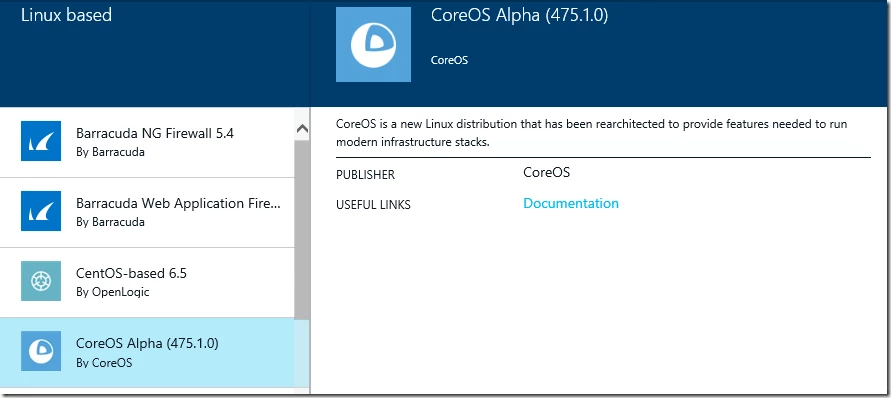
One of the partners announced in the new Marketplace is CoreOS. This modern and minimal Linux distro provides an easy way to run containers, manage clusters and seamlessly update your servers – all components that enable warehouse-scale compute. We are excited to announce that CoreOS is now certified for Azure and will be available as a Virtual Machine image in the Azure Marketplace.
Today, 1 out of 5 Virtual Machines on Azure are running Linux. CoreOS adds to the expanding list of Linux-based VM options we have and delivers on the promise of building the broadest ecosystem (Windows and Linux) for the benefit of our customers.
Cloudera
Cloudera is a leader in enterprise analytics and data management. In today’s announcement, Mike Olsen, Co-Founder and Chief Strategy Officer at Cloudera, demonstrated a Cloudera Enterprise deployment on Azure connected to Microsoft Power BI. With this integrated application deployment support in the Azure Marketplace, you will be able to quickly create a complete Cloudera Enterprise solution in minutes.
40% of Azure revenue today, comes from startups and ISV’s. The release of the Azure Marketplace will connect the Microsoft enterprise customer base with the growing count of ISVs and start-up partners on the Azure cloud. In addition to the opportunity for partners, it will offer more choice to enterprises to deploy solutions that fit their environment and needs. It is great for everyone.
Later this month, we will be announcing additional partners and solutions available in the Azure Marketplace, growing the Azure ecosystem even further.
Cloud Platform System, powered by Dell
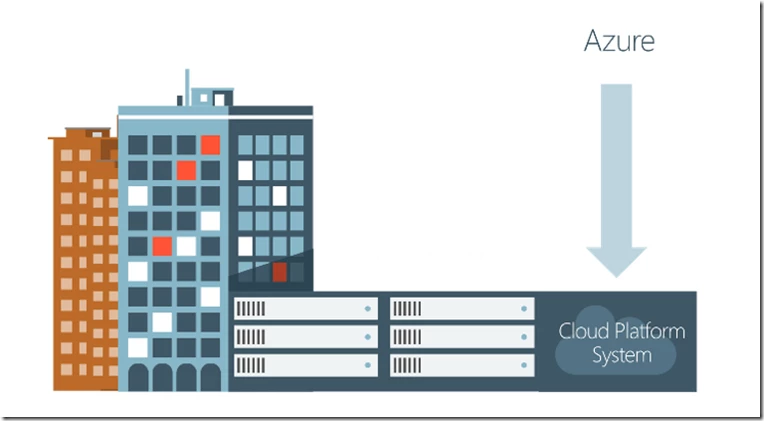
Finally, Scott announced a significant advancement in hybrid technology called the Cloud Platform System (CPS). CPS is an Azure-consistent “cloud-in-a-box” that takes our learnings from running Azure in the public cloud and builds that into a pre-integrated solution with hardware from Dell and software from Microsoft so that you and your partners can get many of Azure benefits in your datacenter, on your terms.
More details on the Cloud Platform System can be found here.
Docker
As announced last week, Microsoft will be delivering container capabilities as part of the next release of Windows Server. Developers and organizations who want to create distributed, multi-container applications using Docker will be able to use Linux or Windows Server allowing developers to connect with the growing Docker ecosystem of users and tools.
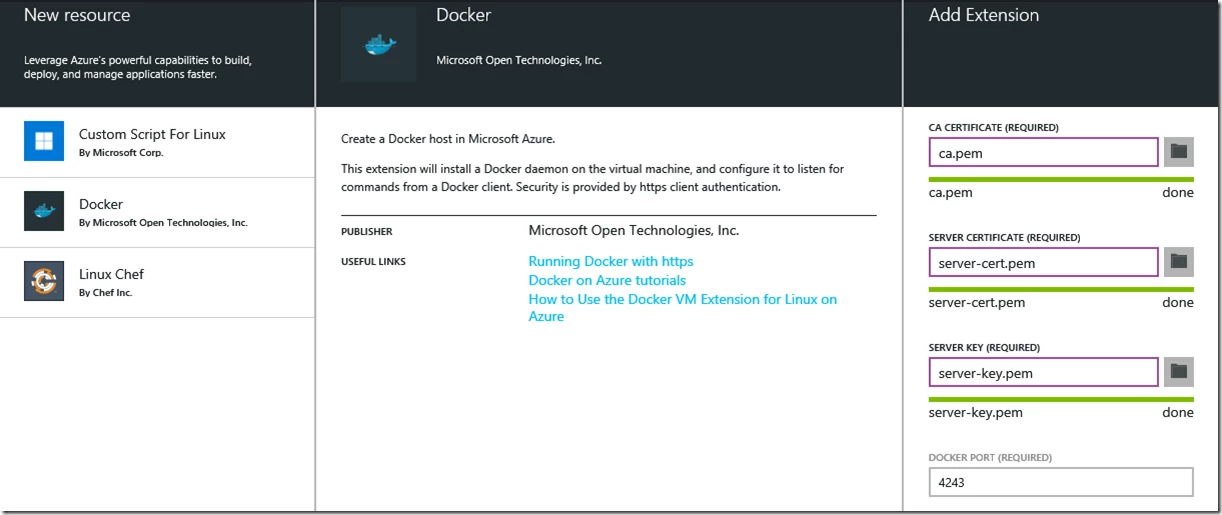
In the next few days, we will release support to deploy the Docker Engine on to Linux VMs directly in the Azure Management portal. Back in June, at DockerCon, Microsoft Open Technologies (MS Open Tech) announced simplified setup and deployment of the Docker Engine on Linux VMs using the Azure extension model. We are expanding this extension support for the Docker Engine with direct integration into the Azure management portal, offering a first-class experience to deploy Docker on to Linux VMs in Azure. We expect to release this integration later this month.
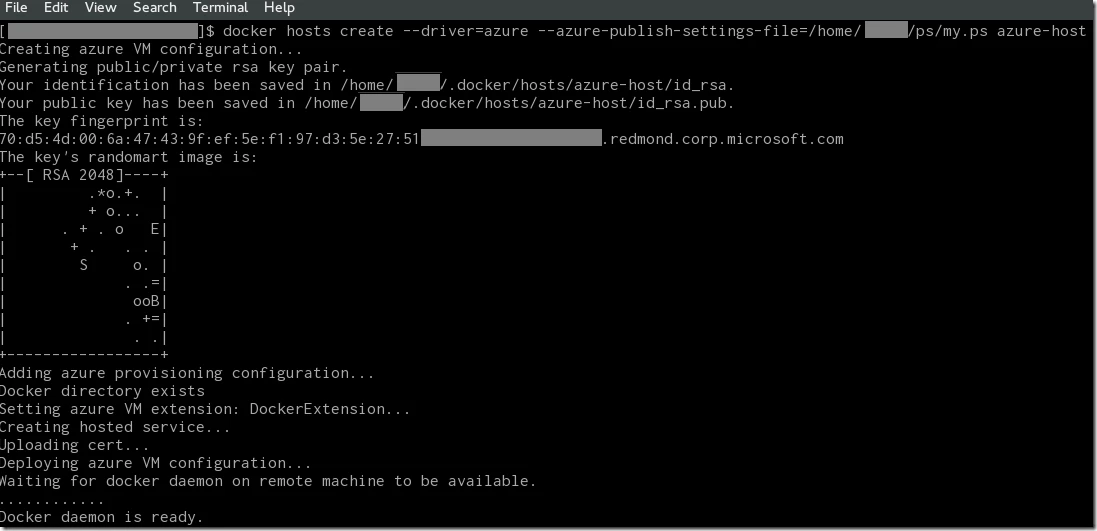
Finally, MS Open Tech made a recent contribution delivering Azure support into the new Docker hosts functionality, available as part of the next version of Docker. We are excited to be collaborating closely on the next wave of Docker tools.
Azure Customers and Partners
During his talk, Scott shared how customers like Accuweather, Mazda North America, and Lufthansa Systems are using the Azure platform to drive their business forward. Milliman, one of the world’s largest independent actuarial and consulting firms, is using Azure’s hyper-scale capabilities for large-scale actuarial and financial analysis. In the past 12 months, they’ve doubled their cloud customers and have clocked more than 45 million compute hours. First American Financial is using Datastax Enterprise on Azure Virtual Machines to store billions of recorded property records and allow users to search for relevant details. Datastax is in the process of helping First American Financial in a nationwide roll-out, planning to store the largest number of real estate property documents in the industry. Scott also talked about Panzura, a new storage partner for Microsoft, who is helping one of the largest energy companies in the world store their Seismic data while making it easily accessible to engineers around the world using Active Directory and Panzura’s technology. From Mazda North America, to Milliman to Lufthansa Systems, Azure is helping companies stay competitive in today’s technology-focused business landscape.
With so much cloud innovation and global reach, including larger memory, bigger disks, more partners, 19 datacenter regions, and the latest in hybrid cloud, our Cloud Platform System, it is no surprise Azure has had 198% growth since last year.