The advent of generative AI has ushered in a new era of intelligent applications that can understand natural language, generate human-like content, and augment human capabilities. However, as companies across industries begin to recognize the potential of AI to revolutionize their operations, a crucial first step is often overlooked: modernizing their on-premises application infrastructure.
If your organization aspires to harness the power of AI to enhance customer experiences and drive growth, cloud migration far outpaces on-premises alternatives. Many of the early-adopter customers such as H&R Block and TomTom have reiterated that what set them up for success in the AI era was the fact that they had already begun modernizing their app infrastructure on Azure. A commissioned study by IDC, “Exploring the Benefits of Cloud Migration and Modernization for the Development of Intelligent Applications,” based on interviews with 900 IT leaders worldwide about their experiences migrating apps to the cloud, threw up additional insights to connect these dots. In this blog, I will walk you through some of the takeaways.
Azure AI
Lead your market with multimodal and generative AI

Modernize or fall behind: The AI-driven urgency for cloud migration
Let’s state the obvious: AI is a powerful technology, capable of creating content, code, and even entire applications. The rapid advancements in generative AI technologies, such as OpenAI’s GPT-4, have transformed how businesses operate and interact with customers.
But generative AI models, like those powering ChatGPT or image-generating tools, are data-hungry beasts. They require massive computing resources, flexible scaling, and access to vast datasets to deliver their transformative capabilities. On-premises legacy systems and siloed data stores simply cannot keep pace with the compute and data demands of modern AI workloads.
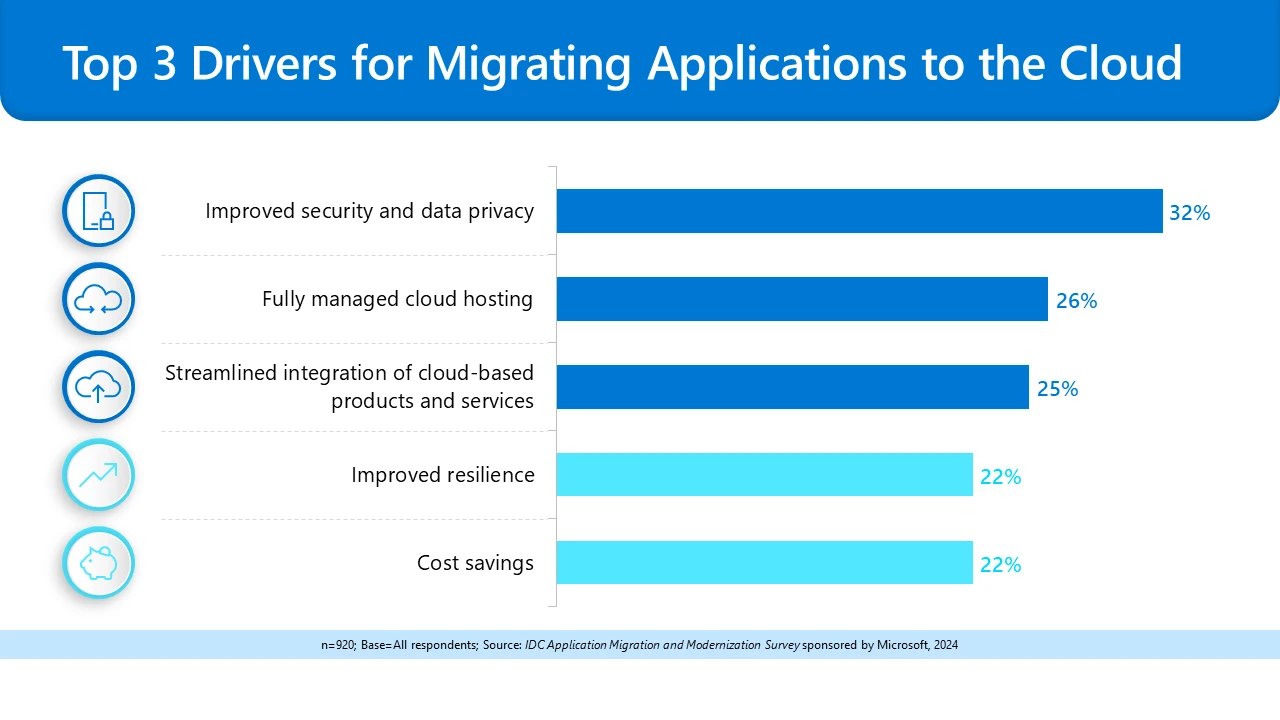
Cloud platforms provide the robust infrastructure and storage solutions necessary to support AI workloads, all fully managed by the provider. They offer virtually unlimited scalability, ensuring applications can handle fluctuating demand and deliver consistent performance. The IDC study’s key finding revealed that organizations were primarily motivated to migrate applications to the cloud by numerous business advantages, including improved security and data privacy, streamlined integration of cloud-based services, and cost savings. Additionally, the cloud’s inherent agility allows businesses to experiment, iterate, and deploy AI models quickly, accelerating innovation.
The .NET platform, with its latest version, is equipped to leverage AI in cloud environments. Developers can integrate AI functionality into their applications using tools like the Semantic Kernel and libraries such as OpenAI, Qdrant, and Milvus. The integration with .NET Aspire ensures that applications can be deployed to the cloud with optimal performance and scalability. For example, H&R Block’s AI Tax Assistant, developed using .NET and Azure OpenAI, demonstrates how businesses can create scalable, AI-driven solutions to enhance user experiences and operational efficiency. By incorporating .NET into your cloud migration strategy, you can streamline development and accelerate the realization of AI’s potential across your business operations.
Migrating and refactoring legacy on-premises applications to be cloud-optimized unlocks the ability to exploit AI services, vast data repositories, and scale compute seamlessly. This can enable your company to not only create generative AI apps, but to fully integrate generative AI across all facets of their intelligent systems and data pipelines.
Accelerate your AI ambitions in the cloud
The recent IDC study makes clear a strong correlation between a company’s desire to leverage generative AI and the realization of its full value through cloud migration. Let’s break down some key considerations:
- Data accessibility: Cloud environments make it easier to consolidate and access data from various sources, providing AI models with the information they need for training and refinement.
- Computational power: The cloud’s elastic computing resources can be dynamically allocated to meet the demands of complex AI algorithms, ensuring optimal performance and cost efficiency.
- Collaboration: Cloud-based tools facilitate seamless collaboration among data scientists, developers, and business stakeholders, streamlining the AI development and deployment process.
Beyond just enabling generative AI, cloud migration also accelerates overall innovation velocity. Cloud platforms provide a wealth of ready-to-use services like machine learning, IoT, serverless computing, and more that allow companies to rapidly develop and deploy new intelligent capabilities into their apps.
Embrace AI in the cloud to outpace the competition
The urgency to migrate and modernize applications isn’t just about keeping up with the times—it’s about gaining a competitive edge. Businesses that embrace the cloud and AI are better positioned to:
- Attract top talent: The most talented data scientists and developers are drawn to organizations with cutting-edge technology stacks.
- Adapt to change: The cloud’s flexibility allows businesses to pivot quickly in response to evolving market conditions or customer needs.
- Drive revenue growth: AI-powered applications can open new revenue streams and deliver exceptional customer experiences.
Spark AI-powered innovation by modernizing your cloud
To maintain a competitive edge, cloud migration must go beyond simply lifting and shifting applications. It’s about modernization—rearchitecting and optimizing applications for the cloud to unlock new levels of agility, scalability, and innovation. By modernizing your applications to cloud-native architectures, your business can:
- Enhance functionality: Integrate AI-powered features like chatbots, personalized recommendations, and intelligent automation into existing applications.
- Improve performance: Leverage cloud-native technologies to optimize application speed, responsiveness, and scalability.
- Reduce costs: Pay only for the resources you use, eliminating the need for costly on-premises infrastructure.
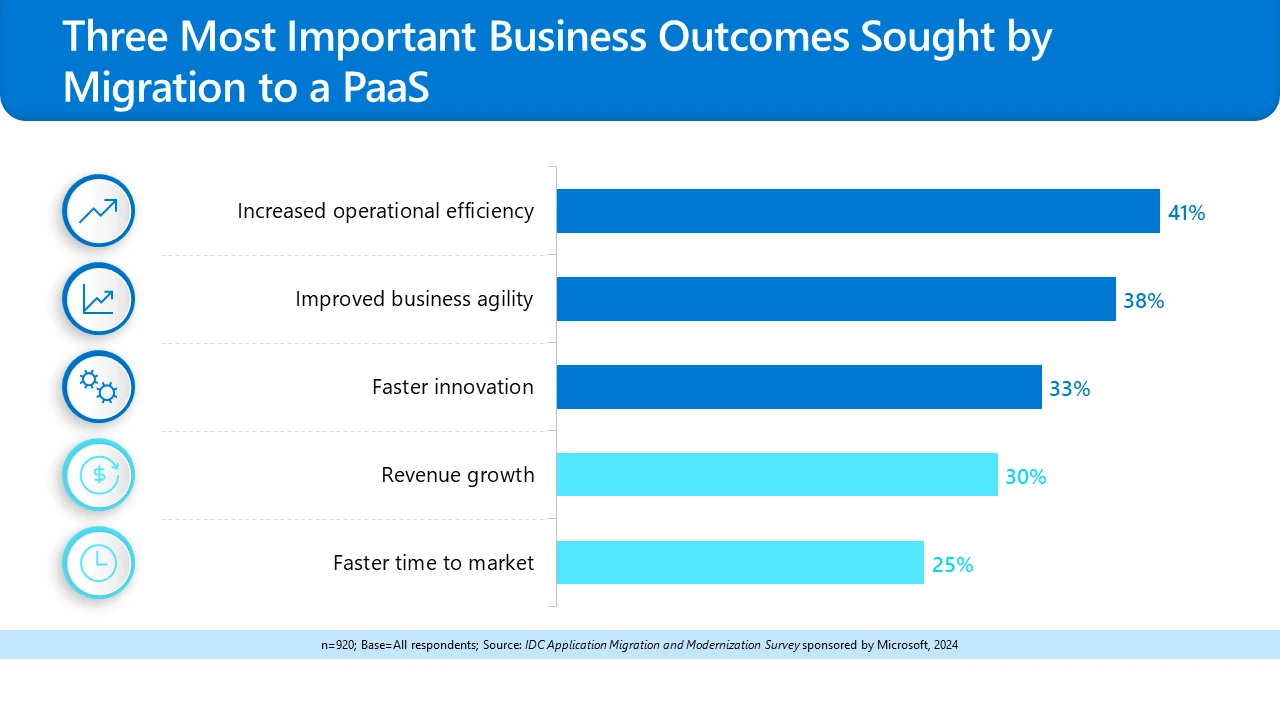
The majority of respondents in the IDC survey chose to migrate applications to the cloud because it empowered them to innovate on application development and realize a multitude of commercial benefits as a result more rapidly.
Fuel your intelligent app development with a cloud-powered AI transformation
The migration and modernization of applications to the cloud is not just an option but a necessity in the era of generative AI. Companies that act swiftly to embrace this transformation will be well-positioned to harness the full potential of intelligent applications, driving innovation, operational efficiency, and customer engagement. The synergy between cloud computing and generative AI is creating unparalleled opportunities for businesses to redefine their strategies and achieve sustained growth in a competitive landscape.
By recognizing the urgency and quantifying the benefits, companies can make informed decisions about their cloud migration and modernization journeys, ensuring they remain at the forefront of technological advancement and market relevance.
Get the full rundown of the IDC’s survey by downloading the whitepaper
Exploring the benefits of cloud migration and modernization