A major hurdle for quantum algorithms for linear systems of equations, and for quantum simulation algorithms, is the difficulty to find simple circuits for arithmetic.
QCoDeS is an open source data acquisition framework that was created by distilling the homegrown solutions used in Station Q’s experimental labs, and infused with all the best practices from the open source software world.
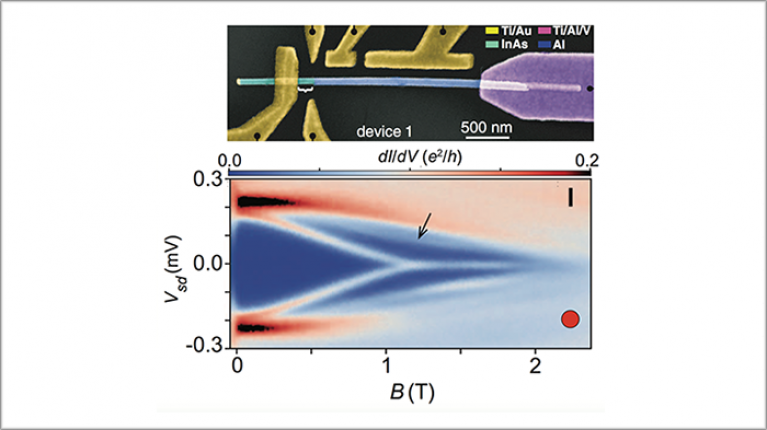
As its name implies, the poisoning of Majorana devices by normal electrons is fatal to topological computation, so much effort is now focused on characterizing the degree of poisoning either by the creation of quasiparticle pairs within the device, or by electrons entering the device through the leads.
Majorana devices will generally be much more complicated than the single-junction or single quantum dot Majorana devices that have been realized in the literature so far.
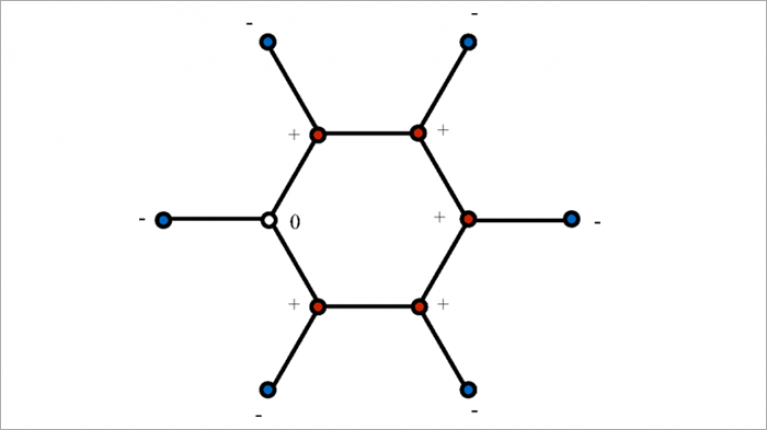
In the paper, “Double semions in arbitrary dimension,” published in Communications in Mathematical Physics, Michael Freedman and Matthew Hastings present a new construction of topological phases of matter in higher dimensions, generalizing the double semion theory in two dimensions.
In this paper, we show by computer simulations that a new material, which is a specific combination of the two semiconductors InAs and InSb (both are currently used in experimental setups on Majorana zero modes), has vastly improved properties compared to InAs or InSb alone, making it ideally suited for future devices.
In this paper, published in Physical Review A, we show how to greatly improve success at solving Constraint Satisfaction Problems on a quantum computer by using a learned schedule, instead of the standard linear ramps.
Topological materials can yield quasiparticles that behave in a manner similar to elementary particles that are part of the standard model of particle physics.
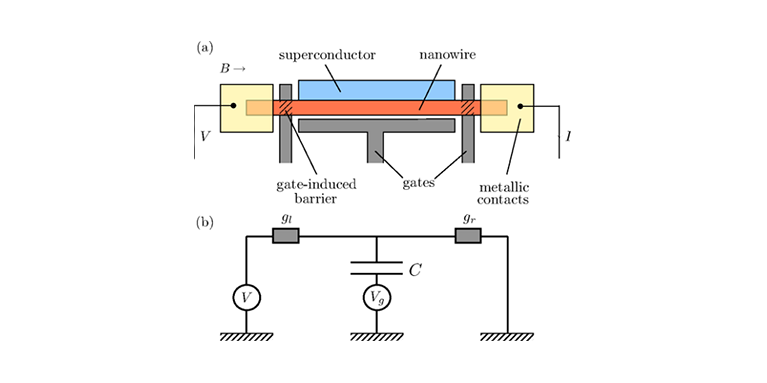
In this paper, which was just published in Physical Review B, a quantitative theory for the two-terminal conductance of a proximitized nanowire in the Coulomb blockade regime is developed.