Skip to main content Explore View all products (200+) Microsoft Foundry Azure Copilot GitHub Copilot Azure Kubernetes Service (AKS) Azure Cosmos DB Azure Database for PostgreSQL Azure Arc Microsoft Fabric Linux virtual machines in Azure Foundry Models Foundry Agent Service Foundry IQ Foundry Tools Foundry Control Plane Observability in Foundry Control Plane Azure OpenAI in Foundry Models Azure Speech in Foundry Tools Azure Machine Learning View all databases Azure Cosmos DB Azure DocumentDB Azure SQL Azure Database for PostgreSQL Azure Managed Redis Microsoft Fabric Azure Databricks Linux virtual machines in Azure Windows Server on Azure Azure Functions Azure Virtual Machine Scale Sets Azure API Management Azure Container Apps Azure Kubernetes Service (AKS) Azure Kubernetes Fleet Manager Azure Container Registry Azure Red Hat OpenShift Azure Container Instances Azure Container Storage Azure Arc Azure Local Microsoft Defender for Cloud Azure Monitor Microsoft Sentinel Azure Migrate View all solutions (40+) Cloud solutions for small and medium businesses Cloud migration and modernization center Data analytics for AI Azure Databases AI apps and agents Microsoft Marketplace Microsoft Sovereign Cloud AI apps and agents Responsible AI with Azure AI Infrastructure Data analytics for AI Machine learning operations (MLOps) Low-code application development on Azure Integration Services Serverless computing DevOps Migration and modernization center .NET apps migration Databases on Azure Linux on Azure Oracle on Azure SAP on the Microsoft Cloud Adaptive cloud High-performance computing (HPC) Infrastructure as a service (IaaS) Resiliency Azure Essentials Frontier Accelerate for Azure FinOps on Azure Microsoft Marketplace Azure pricing overview Create an Azure account Free Azure services Flexible purchase options Pricing calculator FinOps on Azure Maximize ROI from AI Azure savings plans Azure reservations Azure Hybrid Benefit Virtual Machines Azure SQL Microsoft Foundry Microsoft Fabric Azure Kubernetes Service (AKS) Microsoft Defender for Cloud View more Software Development Companies Microsoft Marketplace Find a partner Resources for Azure partners Get started with Azure Customer stories Analyst reports, white papers, and e-books Videos Learn more about cloud computing Documentation Explore Azure portal Developer resources Quickstart templates Resources for startups Developer community Students Azure for partners Blog Events and Webinars Learn Support Contact Sales Get started with Azure Sign in
a screenshot of a computer
1 min read

A clear view of emerging and hybridizing Majorana zero modes using epitaxial InAs-Al nanowires


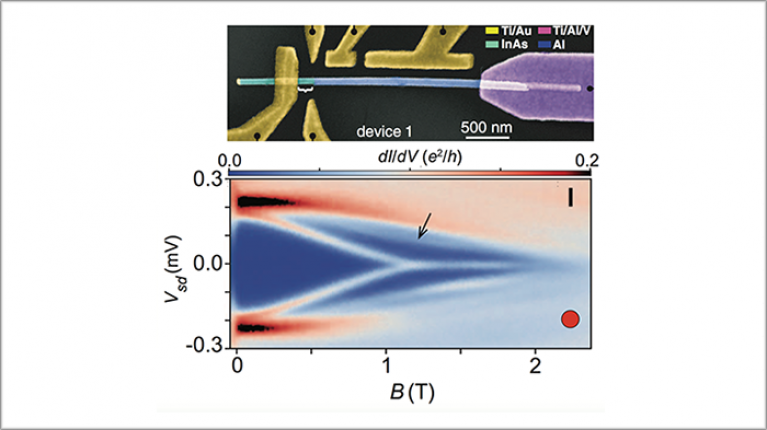
The first signature of Majorana physics, identified experimentally at TU Delft in 2012, focused on a characteristic conductance peak at zero voltage. It bore many signatures of Majorana zero modes, but had a sizable background signal that obscured how the peak arose out of coalescing Andreev bound states. Recently, Mingtang Deng and a Station Q Copenhagen (QDev) team considered a similar geometry—now fabricated with epitaxial semiconductor-superconductor nanowires grown by Peter Krogstrup, also of QDev.

Published in Science (December 2016), this new material system provides a clearer view of how Majorana zero modes emerge, adding support for the Delft interpretation and exploring new, previously unconsidered regimes, including how the Majorana zero mode hybridizes with a quantum dot at the end of the wire. The measurements, led by postdoctoral fellow Mingtang Deng, along with a team of experimentalists and theorists, are complemented by extensive numerical simulations, showing very good agreement between theory and experiment. The case for Majoranas is stronger now, and furthers our understanding of the relationship between Andreev states and Majorana zero modes in proximitized nanowires.

Read the Science article.