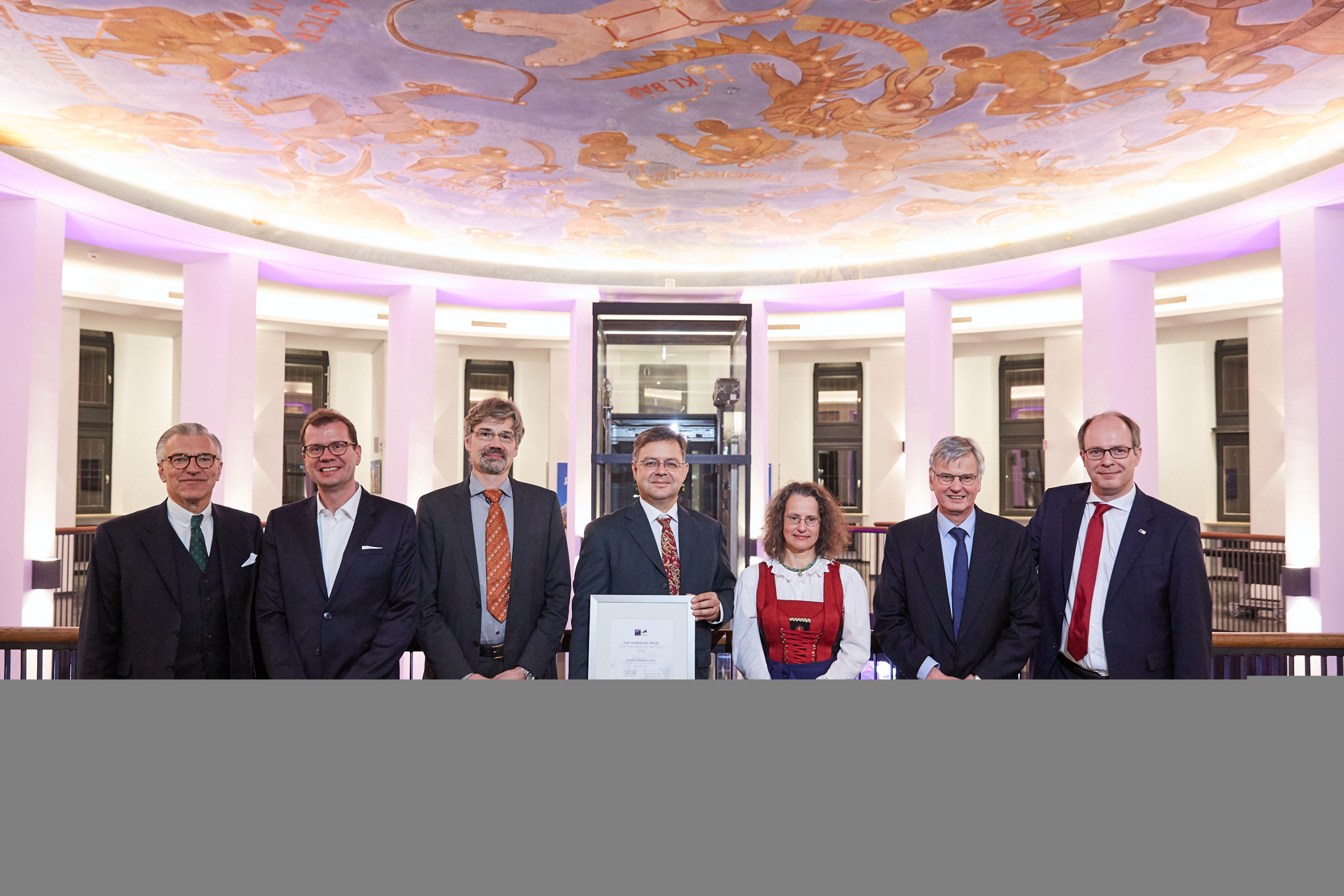
This week, Dr. Matthias Troyer, a Distinguished Scientist at Microsoft, accepted the 2019 Hamburg Prize for Theoretical Physics – one of the most valuable German prizes in the field – for his groundbreaking contributions to the development of quantum Monte Carlo algorithms.
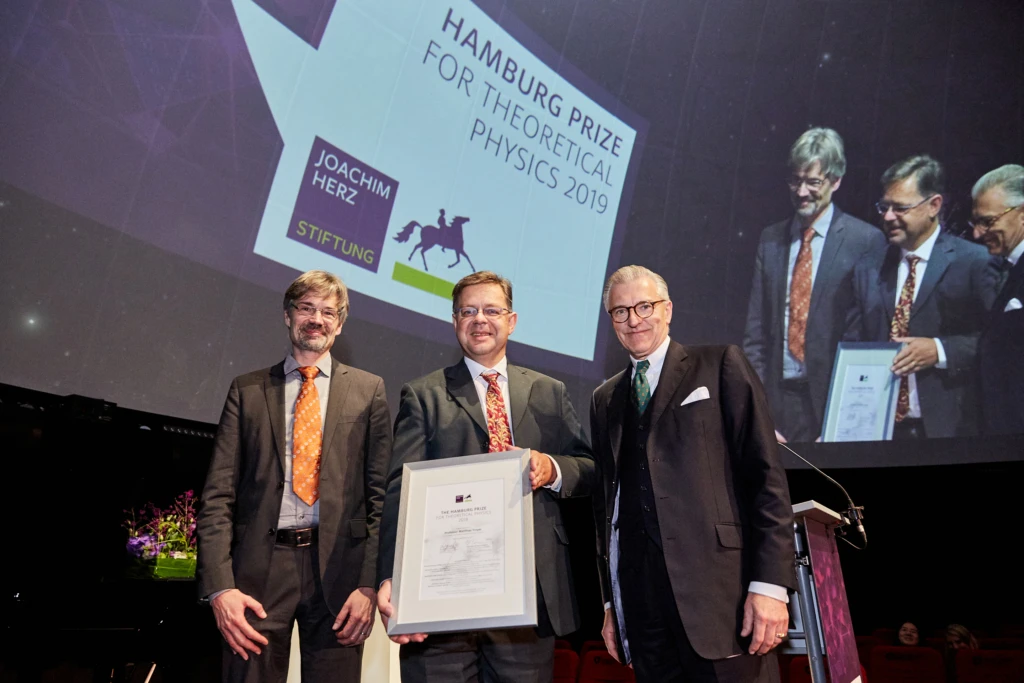
“In Professor Troyer, we are honoring a scientist whose work connects myriad areas of physics and computer science. On account of his current research in the field of quantum computing, he partners with universities and companies in the US and around the world. He has also set up an open-source platform in order to share his knowledge. By awarding the prize to Professor Troyer, we also wish to recognize this contribution to collaborative research,” explained Dr. Nina Lemmens, Member of the Executive Board of the Joachim Herz Stiftung.
Dr. Troyer works at the interface between computer science and theoretical physics and is one of just a handful of leading international researchers in this field. Monte Carlo algorithms can predict how tiny particles will interact within quantum mechanical many-body systems such as atoms and molecules, and Dr. Troyer’s work in this area is playing a key role in the research and ongoing development of quantum computers and superconducting materials.
When asked about what this honor means to him, Dr. Troyer said, “One reason I came to Microsoft and why I want to build a quantum computer is that when inventing these Monte Carlo methods, we made big breakthroughs, but we also encountered a fundamental problem of Monte Carlo simulations of quantum systems, the so-called ‘sign problem.’ The workaround becomes exponentially difficult; a quantum computer will help us move past these barriers.”
With the recent Microsoft announcement of Azure Quantum, teams will soon be able to experiment running algorithms like Monte Carlo against both classical hardware in Azure and quantum hardware from partners, knowing these solutions will scale to future quantum systems as well.
The prize not only comes with a grant, but also entails research visits to Hamburg that will see Dr. Troyer give talks and work closely with doctoral candidates, postdocs, and other colleagues.
Dr. Troyer continued, “I’m looking forward to engaging the academic community in discussing and further advancing what we can do with quantum computing. As we think of quantum algorithms for material science, what problems can we solve now with quantum simulations? And how do we develop quantum algorithms to run once we have a fully scalable quantum computer?”
“The connection to Hamburg means that we can engage with the academic and scientific communities, and with that, I look forward to talking to the people in Hamburg – and around the world – about applying quantum systems and quantum computing to make an impact on material science problems.”
Microsoft and the Azure Quantum team congratulate Dr. Troyer on this significant recognition, and we look forward to supporting his important work in making an impact in solving some of the world’s toughest challenges with quantum computing.