Skip to main content Explore View all products (200+) Microsoft Foundry Azure Copilot GitHub Copilot Azure Kubernetes Service (AKS) Azure Cosmos DB Azure Database for PostgreSQL Azure Arc Microsoft Fabric Linux virtual machines in Azure Foundry Models Foundry Agent Service Foundry IQ Foundry Tools Foundry Control Plane Observability in Foundry Control Plane Azure OpenAI in Foundry Models Azure Speech in Foundry Tools Azure Machine Learning View all databases Azure Cosmos DB Azure DocumentDB Azure SQL Azure Database for PostgreSQL Azure Managed Redis Microsoft Fabric Azure Databricks Linux virtual machines in Azure Windows Server on Azure Azure Functions Azure Virtual Machine Scale Sets Azure API Management Azure Container Apps Azure Kubernetes Service (AKS) Azure Kubernetes Fleet Manager Azure Container Registry Azure Red Hat OpenShift Azure Container Instances Azure Container Storage Azure Arc Azure Local Microsoft Defender for Cloud Azure Monitor Microsoft Sentinel Azure Migrate View all solutions (40+) Cloud solutions for small and medium businesses Cloud migration and modernization center Data analytics for AI Azure Databases AI apps and agents Microsoft Marketplace Microsoft Sovereign Cloud AI apps and agents Responsible AI with Azure AI Infrastructure Data analytics for AI Machine learning operations (MLOps) Low-code application development on Azure Integration Services Serverless computing DevOps Migration and modernization center .NET apps migration Databases on Azure Linux on Azure Oracle on Azure SAP on the Microsoft Cloud Adaptive cloud High-performance computing (HPC) Infrastructure as a service (IaaS) Resiliency Azure Essentials Frontier Accelerate for Azure FinOps on Azure Microsoft Marketplace Azure pricing overview Create an Azure account Free Azure services Flexible purchase options Pricing calculator FinOps on Azure Maximize ROI from AI Azure savings plans Azure reservations Azure Hybrid Benefit Virtual Machines Azure SQL Microsoft Foundry Microsoft Fabric Azure Kubernetes Service (AKS) Microsoft Defender for Cloud View more Software Development Companies Microsoft Marketplace Find a partner Resources for Azure partners Get started with Azure Customer stories Analyst reports, white papers, and e-books Videos Learn more about cloud computing Documentation Explore Azure portal Developer resources Quickstart templates Resources for startups Developer community Students Azure for partners Blog Events and Webinars Learn Support Contact Sales Get started with Azure Sign in
a screenshot of a computer
1 min read

Test your quantum programming skills in the Microsoft Q# Coding Contest – Winter 2019

Whether you’re new to quantum computing and want to improve your skills, or have done quantum programming before and need a new challenge, we have just the thing for you: The second Microsoft Q# Coding Contest. Designed to help developers ramp up quickly in quantum computing and quantum programming, this contest will help participants build the expertise they’ll need to be ready for the advent of true quantum computing.

Organized in collaboration with Codeforces.com, the contest will be held March 1-4, 2019. It will offer the participants a selection of quantum programming problems of varying difficulty. In each problem, you’ll write Q# code to implement a transformation on qubits, or perform a more challenging task. The top 50 participants will win a Microsoft Quantum T-shirt.

This contest is the second in a series that began last July. The first contest offered problems on introductory topics in quantum computing: Superposition, measurement, quantum oracles, and simple algorithms. This second contest will take some of these topics to the next level as well as introduce some new ones.

For those eager to get a head start in the competition, a warm-up round will be held February 22-25, 2019. It will feature a set of relatively problems and focus on helping participants become familiar with the contest environment, the submission system, and the problem format. The warm-up round is a great introduction to quantum programming, both for those new to Q# or those looking to refresh their skills.

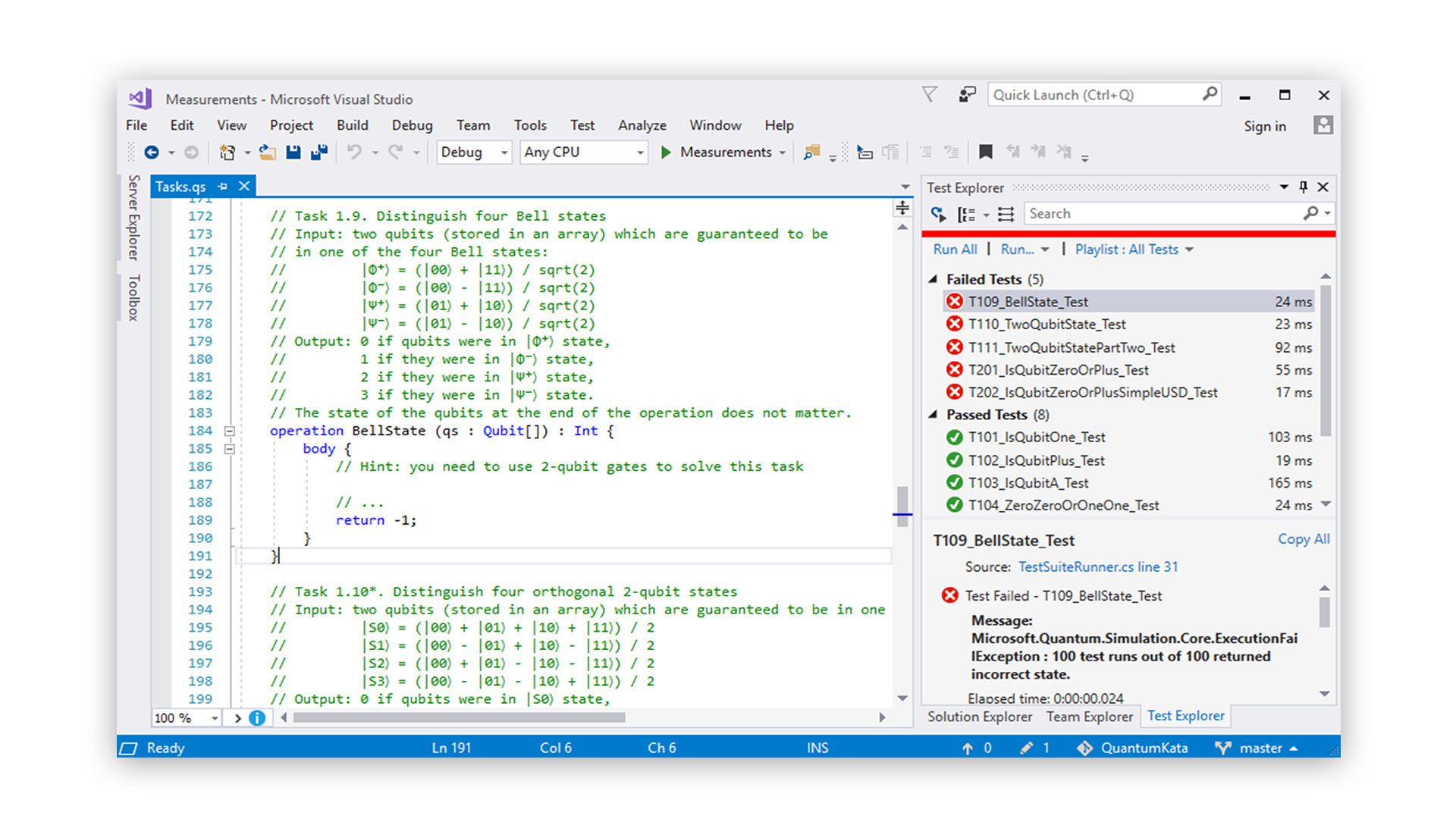
Another great way to prepare for the contest is to work your way through the Microsoft Quantum Development Kit katas. The katas allow you to test and debug your solutions locally, giving you immediate feedback on your code.
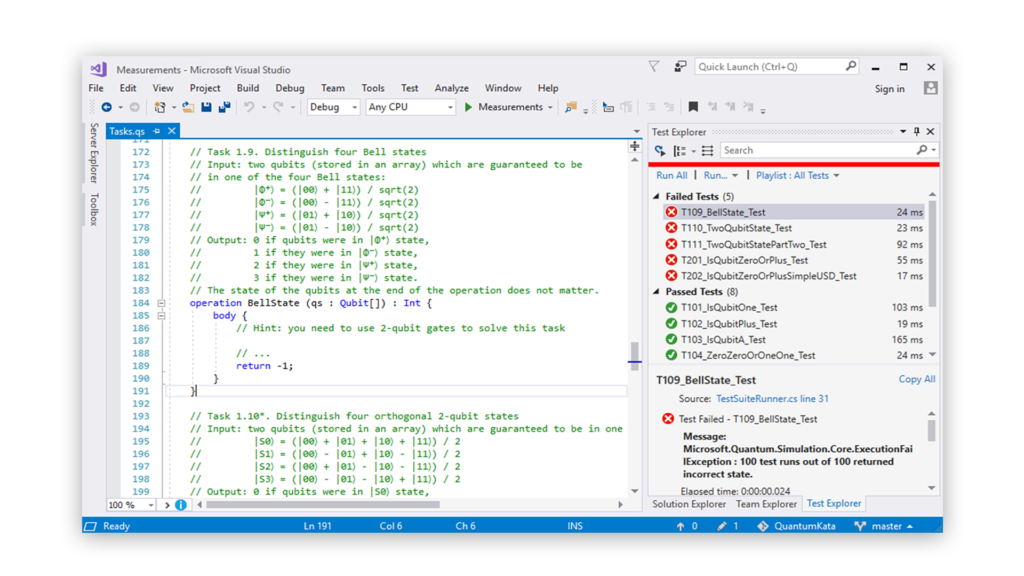
Katas measurements in Visual Studio

Q# can be used with Visual Studio, Visual Studio Code or command line, on Windows, macOS or Linux, providing an easy way to start with quantum programming. Any of these platforms can be used in the contest.

We hope to see you at the second global Microsoft Q# Coding Contest!