Skip to main content Explore View all products (200+) Microsoft Foundry Azure Copilot GitHub Copilot Azure Kubernetes Service (AKS) Azure Cosmos DB Azure Database for PostgreSQL Azure Arc Microsoft Fabric Linux virtual machines in Azure Foundry Models Foundry Agent Service Foundry IQ Foundry Tools Foundry Control Plane Observability in Foundry Control Plane Azure OpenAI in Foundry Models Azure Speech in Foundry Tools Azure Machine Learning View all databases Azure Cosmos DB Azure DocumentDB Azure SQL Azure Database for PostgreSQL Azure Managed Redis Microsoft Fabric Azure Databricks Linux virtual machines in Azure Windows Server on Azure Azure Functions Azure Virtual Machine Scale Sets Azure API Management Azure Container Apps Azure Kubernetes Service (AKS) Azure Kubernetes Fleet Manager Azure Container Registry Azure Red Hat OpenShift Azure Container Instances Azure Container Storage Azure Arc Azure Local Microsoft Defender for Cloud Azure Monitor Microsoft Sentinel Azure Migrate View all solutions (40+) Cloud solutions for small and medium businesses Cloud migration and modernization center Data analytics for AI Azure Databases AI apps and agents Microsoft Marketplace Microsoft Sovereign Cloud AI apps and agents Responsible AI with Azure AI Infrastructure Data analytics for AI Machine learning operations (MLOps) Low-code application development on Azure Integration Services Serverless computing DevOps Migration and modernization center .NET apps migration Databases on Azure Linux on Azure Oracle on Azure SAP on the Microsoft Cloud Adaptive cloud High-performance computing (HPC) Infrastructure as a service (IaaS) Resiliency Azure Essentials Azure Accelerate FinOps on Azure Microsoft Marketplace Azure pricing overview Create an Azure account Free Azure services Flexible purchase options Pricing calculator FinOps on Azure Maximize ROI from AI Azure savings plans Azure reservations Azure Hybrid Benefit Virtual Machines Azure SQL Microsoft Foundry Microsoft Fabric Azure Kubernetes Service (AKS) Microsoft Defender for Cloud Software Development Companies Microsoft Marketplace Find a partner Get started with Azure Customer stories Analyst reports, white papers, and e-books Videos Learn more about cloud computing Documentation Explore Azure portal Developer resources Quickstart templates Resources for startups Developer community Students Azure for partners Blog Events and Webinars Learn Support Contact Sales Get started with Azure Sign in
  • 2 min read

Premium Block Blob Storage – a new level of performance

Premium Blob Storage, which is currently in limited public preview, unlocks a new level of performance in public cloud object storage. It uses a combination of solid-state drives in our storage clusters and enhancements to our blob storage software to provide very fast response times.

On March 25, 2019, Azure Premium Block Blob Storage became generally available. For more information, please refer to the blog post, “Azure Premium Block Blob Storage is now generally available.”

Premium Block Blob Storage, which is currently in limited public preview, unlocks a new level of performance in public cloud object storage. It uses a combination of solid-state drives in our storage clusters and enhancements to our blob storage software to provide high throughput and very fast response times. In this blog post we will take a closer look at some of these performance enhancements.

Low and consistent latency

Many enterprise applications and the users that use them require very fast response times. Storage response time, also known as latency, is often a significant portion of the overall time users must wait for a response.

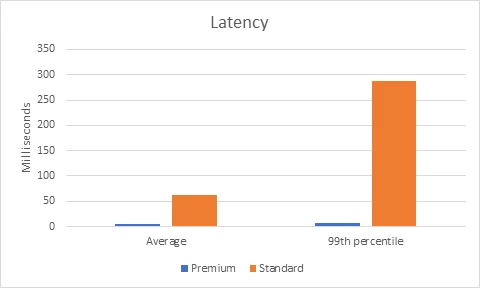
At Microsoft Ignite 2018, I did a storage latency demonstration, comparing Premium Blob Storage to our Standard Blob Storage. The demo reads a random selection of 10,000 objects from a population of 1,000,000 64KB objects measuring time to last byte. Each object is a binary random byte array.
Latency

In the demo, the average latency for Standard is 61.4ms compared to Premium at 5.3ms, which is more than an order of magnitude better.

It is equally important to consistently provide low latency, which we measure by looking at the 99th percentile. In the demo, the 99th percentile for the standard is 287.3ms compared to 6.9ms for Premium, which is a whopping 40 times better.

Throughput for small objects

Premium Blob Storage also provides better throughput, especially for smaller object sizes. I used AzCopy v10 to measure upload and download of 100,000 64KB objects. I used a Standard D32v3 VM with a 100GB RAM disk to minimize the impact of local VM storage performance.


Time to upload

Time to download

Premium

20.5 seconds

24.1 seconds

Standard

107.3 seconds

118.8 seconds

In this measurement both upload and download of 100,000 64KB objects completed ~5x faster on Premium Blob Storage.

List Object

Finally, I compared List Object performance using the same 100,000 64KB objects, completing ~2.5x faster on Premium Blob Storage.


Time to list

Premium

10.7 seconds

Standard

26.3 seconds

List Object completed ~2.5x faster on Premium Blob Storage.

We are very excited about the performance capabilities of Premium Blob Storage and we hope you are, too.

The limited public preview is currently available in North Europe, US East, US East 2, US Central, and US West. You can find out more details on how to sign up. We look forward to hearing your feedback, which you can send to premiumblobfeedback@microsoft.com.


English (United States)
Your Privacy Choices Opt-Out Icon Your Privacy Choices
Consumer Health Privacy Sitemap Contact Microsoft Privacy Manage cookies Terms of use Trademarks Safety & eco Recycling About our ads