
Digital sovereignty is no longer a niche requirement. For organizations operating across borders, regulated industries, and complex supply chains, sovereignty is now table stakes for cloud strategy.
That’s why we’re pleased that Microsoft has been named a Leader in The Forrester Wave TM: Sovereign Cloud Platforms, Q2 2026 – an evaluation that assessed the most significant sovereign cloud providers based on current offerings, strategy, and customer feedback.
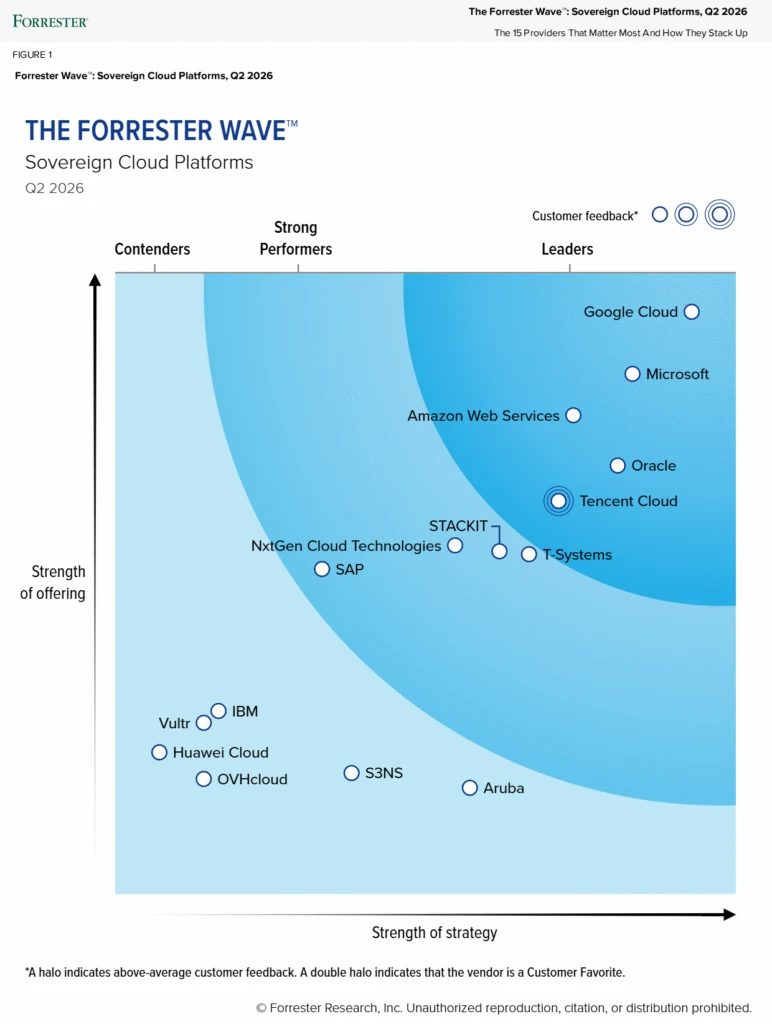
We believe this recognition reflects Microsoft’s long-term commitment to helping organizations adopt cloud and AI without compromising on control, compliance, operational independence, or innovation.
Why this recognition matters
Forrester’s research highlights a key reality of sovereign clouds: there is no single deployment model that fits every sovereignty requirement. Instead, organizations combine public cloud, private cloud, and disconnected environments to achieve the level of sovereignty they need – balancing risk, regulations, functionality, and cost.
In this context, leadership isn’t about offering a single “sovereign cloud.” The goal is not isolation, but it’s about providing consistent sovereign controls across multiple environments to maintain access to modern cloud capabilities.
Forrester places Microsoft in the Leaders category based on its scores in the current offering and strategy categories. The report also notes Microsoft’s vision to offer sovereign controls across cloud, AI and productivity services. Specifically, Microsoft’s ability to extend sovereignty across AI, productivity, security, and cloud platform.
A platform approach to sovereignty
The Forrester report notes that Microsoft’s sovereign capabilities are available consistently for both private and public cloud. In practice, digital sovereignty is achieved through a combination of technical controls, operational practices, and contractual commitments applied consistently across deployment models.
Microsoft Sovereign Cloud brings together:
- Public cloud with data residency and access controls, including region-specific residency controls such as EU Data Boundary.
- Private cloud with hybrid deployments, enabled through Azure Local and consistent policy and management via Azure Arc.
- Partner-operated national clouds, with Bleu and Delos Cloud, where infrastructure is independently owned and operated to meet national requirements.
This approach allows organizations to grow their sovereign IT posture over time, adapting to evolving regulatory, operational, or geopolitical conditions without having to abandon the Microsoft cloud ecosystem.
Consistency across sovereign environments
One of the differentiators cited in the evaluation is Microsoft’s ability to make key capabilities available across sovereign public and sovereign private cloud. Forrester specifically calls out Microsoft’s container and Kubernetes capabilities, including the use of Azure Arc and Azure Local to run Kubernetes clusters in connected or disconnected environments, supported by infrastructure-as-code and GitOps tooling.
This consistency matters because sovereign cloud isn’t just about where data resides, but about whether organizations can:
- Operate and secure workloads the same way across environments.
- Maintain development and operation standards.
- Avoid fragmenting teams, tools, and processes.
By extending common management, governance, and deployment models across environments, Microsoft Sovereign Cloud helps reduce complexity while giving organizations control.
Looking ahead
Sovereign cloud platforms are evolving quickly, especially as customers look to apply AI, analytics, and modern application services across different environments. Forrester notes that customers don’t “buy” sovereignty as a standalone product, they architect for it over time.
Microsoft’s recognition as a Leader in this evaluation underscores our commitment to keep investing in sovereign cloud innovation such as:
- Advanced AI development and runtime capabilities.
- Increasing consistency and parity across deployment models.
- Supporting customers as sovereignty requirements continue to mature and evolve.
We’re grateful to our customers and partners who continue to shape our approach and we remain focused on helping organizations adopt cloud and AI with confidence, flexibility, and transparency wherever their workloads need to run.
Forrester does not endorse any company, product, brand, or service included in its research publications and does not advise any person to select the products or services of any company or brand based on the ratings included in such publications. Information is based on the best available resources. Opinions reflect judgment at the time and are subject to change. For more information, read about Forrester’s objectivity here.