We are excited to share the winners of the first Microsoft Azure AI Hackathon, hosted on Devpost. Developers of all backgrounds and skill levels were welcome to join and submit any form of AI project, whether using Azure AI to enhance existing apps with pre-trained machine learning (ML) models or by building ML models from scratch. Over 900 participants joined in, and 69 projects were submitted. A big thank you to all who participated and many congratulations to the winners.
First place—Trashé
Submitted by Nathan Glover and Stephen Mott, Trashé is a SmartBin that aims to help people make more informed recycling decisions. What I enjoyed most was watching the full demo of Trashé in action! It’s powerful when you see not just the intelligence, but the end-to-end scenario of how it can be applied in a real-world environment.
This team used many Azure services to connect the hardware, intelligence, and presentation layers—you can see this is a well-researched architecture that is reusable in multiple scenarios. Azure Custom Vision was a great choice in this case, enabling the team create a well performing model with very little training data. The more we recycle, the better the model will get. It was great to see the setup instructions included to build unique versions of Trashé so users can contribute to helping the environment by recycling correctly within their local communities—this community approach is incredibly scalable.
Second place—AfriFarm
Niza Siwale’s app recognizes crop diseases from images using Azure Machine Learning service and publicly publishes the findings so anyone can track disease breakouts. This also provides a real-time update for government agencies to act quickly and provide support to affected communities. As quoted by Niza, this project has an incredible reach to a possible 200 million farmers whose livelihoods depend on farming in Africa.
Creating a simple Android application where users can take photos of crops to analyze if each farmer is getting information when they need it, users can also contribute their own findings back to the community around them keeping everyone more informed and connected. Using the popular Keras framework along with the Azure Machine Learning service, this project built and deployed a good plant disease recognition model which could be called from the application. Any future work or improved versions of models can be monitored and deployed in a development cycle. From this, the progression of the model can be tracked over time.
Third place—Water Level Anomaly Detector
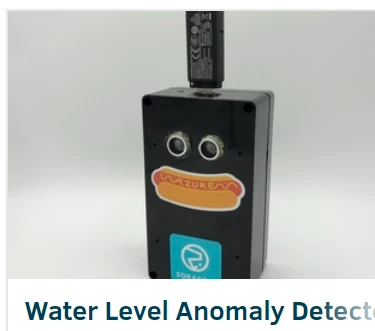
Roy Kincaid’s project identifies drastic changes in water levels using an ultrasonic sensor that could be useful for detecting potential floods and natural disasters. This information can then be used to provide adequate warning for people to best prepare to major changes in their environment. Water Level Anomaly Detector could also be beneficial for long-term analysis of the effects of climate change. This is another great example of an end-to-end intelligent solution.
Roy is well skilled in the hardware and connection parts of this project, so it was brilliant to see the easy integration of the Anomaly Detector API from Azure Cognitive Services and to hear how quickly Roy could start using the service. Many IoT scenarios have a similar need for detecting rates and levels, and I hope to see Roy’s hinted at coffee level detector in the future (sign me up for one of those!). In a world where we all want to do our part to help the environment, it’s a great example of how monitoring means we can measure changes over time and be alerted when issues arise.
Getting involved
We’d like to thank everyone involved in the Azure AI Hackathon, including our participants, judges, and Devpost. We’re very eager to watch how these projects continue to progress and look forward to possibly hosting another Hackathon in the future.
Get involved with the Global AI Community and join our upcoming Global AI Bootcamp.
For more information, please reference Microsoft Azure AI Hackathon Official Rules.