Skip to main content Explore View all products (200+) Microsoft Foundry Azure Copilot GitHub Copilot Azure Kubernetes Service (AKS) Azure Cosmos DB Azure Database for PostgreSQL Azure Arc Microsoft Fabric Linux virtual machines in Azure Foundry Models Foundry Agent Service Foundry IQ Foundry Tools Foundry Control Plane Observability in Foundry Control Plane Azure OpenAI in Foundry Models Azure Speech in Foundry Tools Azure Machine Learning View all databases Azure Cosmos DB Azure DocumentDB Azure SQL Azure Database for PostgreSQL Azure Managed Redis Microsoft Fabric Azure Databricks Linux virtual machines in Azure Windows Server on Azure Azure Functions Azure Virtual Machine Scale Sets Azure API Management Azure Container Apps Azure Kubernetes Service (AKS) Azure Kubernetes Fleet Manager Azure Container Registry Azure Red Hat OpenShift Azure Container Instances Azure Container Storage Azure Arc Azure Local Microsoft Defender for Cloud Azure Monitor Microsoft Sentinel Azure Migrate View all solutions (40+) Cloud solutions for small and medium businesses Cloud migration and modernization center Data analytics for AI Azure Databases AI apps and agents Microsoft Marketplace Microsoft Sovereign Cloud AI apps and agents Responsible AI with Azure AI Infrastructure Data analytics for AI Machine learning operations (MLOps) Low-code application development on Azure Integration Services Serverless computing DevOps Migration and modernization center .NET apps migration Databases on Azure Linux on Azure Oracle on Azure SAP on the Microsoft Cloud Adaptive cloud High-performance computing (HPC) Infrastructure as a service (IaaS) Resiliency Azure Essentials Frontier Accelerate for Azure FinOps on Azure Microsoft Marketplace Azure pricing overview Create an Azure account Free Azure services Flexible purchase options Pricing calculator FinOps on Azure Maximize ROI from AI Azure savings plans Azure reservations Azure Hybrid Benefit Virtual Machines Azure SQL Microsoft Foundry Microsoft Fabric Azure Kubernetes Service (AKS) Microsoft Defender for Cloud View more Software Development Companies Microsoft Marketplace Find a partner Resources for Azure partners Get started with Azure Customer stories Analyst reports, white papers, and e-books Videos Learn more about cloud computing Documentation Explore Azure portal Developer resources Quickstart templates Resources for startups Developer community Students Azure for partners Blog Events and Webinars Learn Support Contact Sales Get started with Azure Sign in

Spring Cloud Stream Binder for Azure Event Hubs is now generally available. It is simple to build highly scalable event-driven Java apps using Spring Cloud Stream with Event Hubs, a fully managed, real-time data ingestion service on Azure that is resilient and reliable service for any situation. This includes emergencies, thanks to its geo-disaster recovery and geo-replication features.

Spring Cloud Stream provides a binder abstraction for popular message broker implementations. It provides a flexible programming model built on already established and familiar Spring idioms and best practices, including support for persistent pub/sub semantics, consumer groups, and stateful partitions.Now, developers can use the same patterns for building Java apps with Event Hubs.
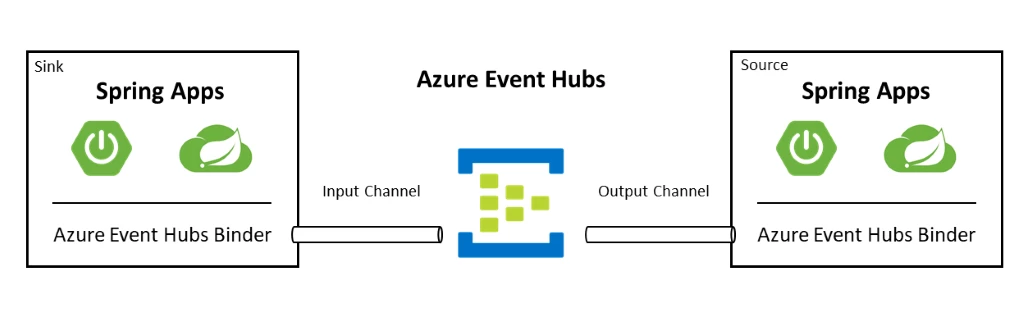
Azure Event Hubs and Spring Apps graphic

Getting started 

Check out the tutorial, “How to create a Spring Cloud Stream Binder application with Azure Event Hubs,” and build 

     com.microsoft.azure
     spring-cloud-azure-eventhubs-stream-binder
     1.1.0.RC4

Publish messages

Use @EnableBinding(Source.class) to annotate a source class and publish messages to Event Hubs with Spring Cloud Stream patterns. You can customize the output channel for the Source with configurations.

  • Destination: Specify which Event Hub to connect with the output channel.
  • Sync/Async: Specify the mode to produce the messages.

Subscribe to messages 

Use @EnableBinding(Sink.class) to annotate a sink class and consume messages from Event Hubs. You can also customize the input channel with configurations. For the full list, please refer to the documentation, “How to create a Spring Cloud Stream Binder application with Azure Event Hubs.”

  • Destination: Specify an Event Hub to bind with the input channel.
  • Customer Group: Specify a Consumer Group to receive messages.

Try building event-driven Java apps using Spring Cloud Stream Binder for Event Hubs 

Try out a Java app using Spring Cloud Stream Binder on Azure Event Hubs and let us know what you think via email or comments below.

Additional resources


WE ARE MICROSOFT

Explore Microsoft Foundry

The future of AI starts here. Envision your next great AI app with the latest technologies. Get started with Azure.