
I’ve had a front-row seat to a few major technology advancements—the internet, then cloud, and now agentic AI. Before joining Microsoft, I founded a systems integration business, which means I sat on the other side of the table—the side where you’re trying to figure out which wave is real, what it means for your organization, and whether you’re moving fast enough.
That experience shapes how I think about moments like this one.
Every year, Microsoft Build delivers dozens of news and updates that developers follow closely. Most years, the story is about new capabilities for technical teams to explore. What’s different this year is that these capabilities feel less about exploration and more about meeting expectations to reshape how organizations operate, compete, and deliver results.
If you’re not a developer, Build can feel pretty technical, and it’s not always immediately obvious how the announcements can translate into business growth or savings. So I want to share a few of my takeaways for business leaders wanting a fast pass understanding of what matters most.
1. Your AI is only as good as what it knows about your business
Models matter, but lasting advantage increasingly comes from how well AI understands your business—your unique data, your processes, and how your organization operates.
Every time a team deploys a new AI project, they run into the same problem—the AI starts without that context. It doesn’t know your customers the way your sales team does. It doesn’t understand your definitions of revenue, risk, or success. And as a result, every new project starts from scratch.
That’s why context has become a scaling issue. If every AI project has to rebuild the same foundation, organizations lose time, consistency, and momentum. That’s the gap we focused on closing at Build.
What this looks like in practice: A shared intelligence foundation for your entire organization.
Microsoft IQ introduces an enterprise intelligence layer where your data, processes, and organizational knowledge have live connections across every AI system, so new agents can start with an understanding of your business and improve as usage grows.
That shared intelligence layer moved from vision to reality with general availability. Work IQ helps AI understand how people work and how the business operates. Fabric IQ connects business data across systems and Power BI. Foundry IQ extends that grounding into deployed applications in Azure, unstructured data, and custom sources. Together, they help agents work from the same business context across the systems your organization relies on.
We also introduced Web IQ in limited preview as the newest member of the layer, bringing real-world context from outside the organization.
Together, these layers help agents work from the same business context across the systems your organization relies on. With that shared context in place, the next step is making the models themselves reflect your business.
And, with capabilities like Frontier Tuning, organizations can fine-tune models using their own data and workflows, reducing costs by up to 10x while improving response speed.
This is especially significant because we’re moving from AI that knows a lot about the world to AI that knows a lot about your world. For business leaders, that’s the difference between a generic tool and a system that reflects how your organization actually operates—maximizing your own data and expertise with AI systems for competitive advantage.
2. Tools don’t transform organizations. Systems do.
Most organizations have accumulated a collection of AI tools. A pilot here, an assistant there, a proof of concept that worked well enough to expand. What they haven’t built yet is an industrialized system designed for end-to-end production at scale.
The distinction matters. Individual tools produce individual results. A system that shares context, enforces governance, and gets smarter the longer it runs.
This was front and center at Build this year, and its core to how we’ve built Azure.
What this looks like in practice: An integrated platform for building, running, and governing agents at scale.
Built on Azure, the Microsoft Agent Platform brings together what organizations need to build, run, govern, and scale agents across the business. It’s the foundation for moving agents out of pilots and into production—and it’s designed to solve three challenges that consistently slow that transition down.
The first challenge is speed: moving from a promising prototype to something the business can actually run. Rayfin helps close that gap by making it easier to go from concept to enterprise-grade deployment, with security, data management, and governance built in from the start.
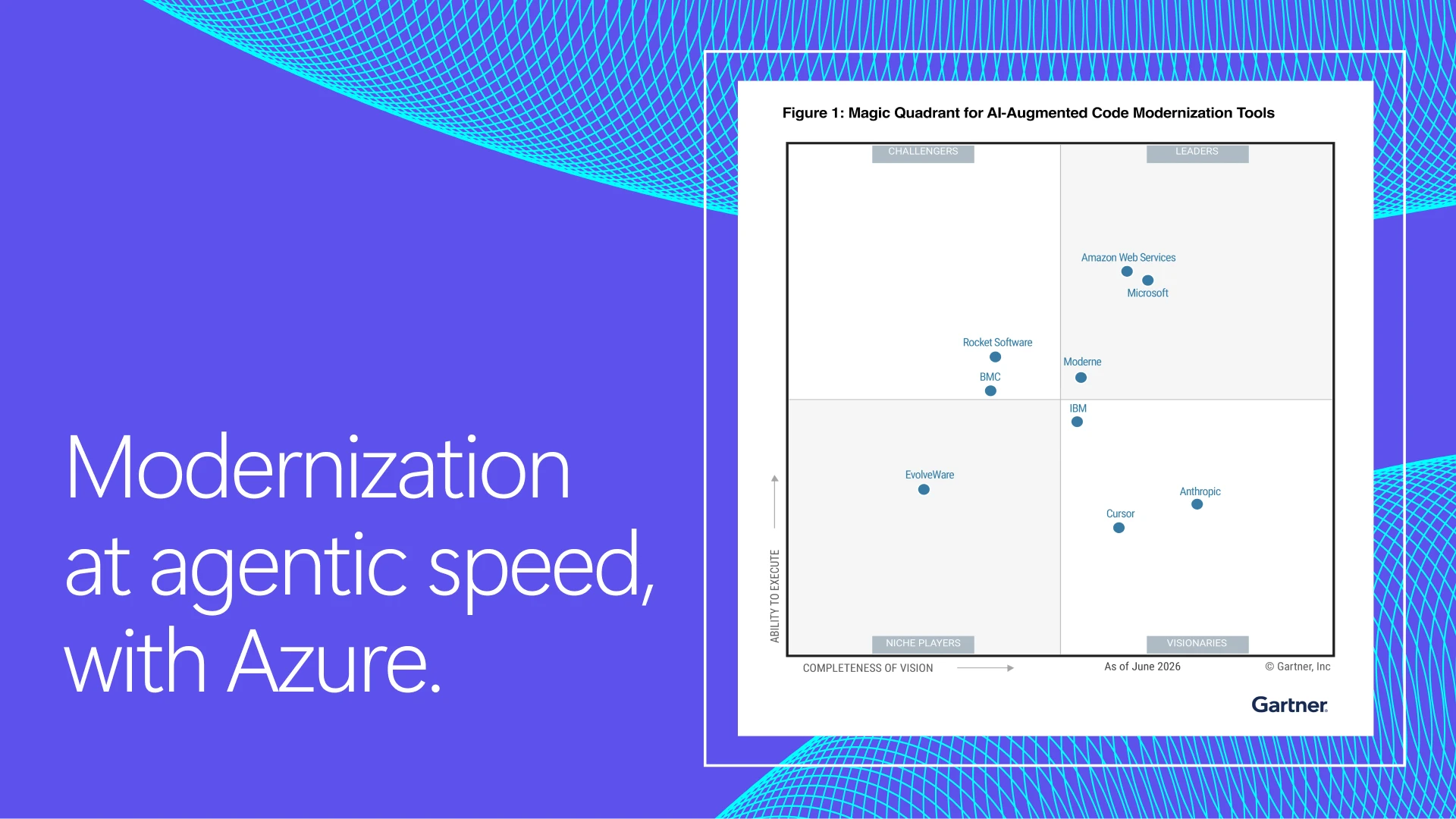
The second challenge is modernization. Once AI starts touching core business systems, those systems need to evolve continuously, not through large, disruptive transformation cycles. New agentic capabilities in Azure help teams update, integrate, and improve applications in parallel and on an ongoing basis, so systems can keep pace with the business without slowing operations down.
And the third challenge is trust at scale. As more agents move into production, governance and security need to be part of the system from the beginning. That’s why Azure brings together Microsoft Foundry, Agent 365, Azure Container Apps, and the broader Microsoft Security stack to help organizations run agents with controls built in from the moment they start operating.
The winners of this era won’t be the organizations with the most AI tools. They’ll be the ones that build the best system around them.
3. The bar has moved. AI is expected to deliver real business outcomes.
It would be easy to read the Build announcements as something to watch from the sidelines. But your board or C-Suite might have other ideas. There’s a version of this moment where business leaders read the Build announcements and think, interesting, I’ll keep watching. Your board or C-suite might already be several steps ahead.
Why? Because the question organizations were asking a year ago, does AI actually work?, has been answered. The question now is different: why isn’t it running significant parts of our business yet?
In other words, AI is now expected to deliver measurable outcomes—like faster cycle times, lower costs, and improved customer experiences—not just insights or experimentation.
What this looks like in practice: Enterprise-ready choice, control, and resilience.
Foundry now offers the broadest selection of frontier models in the industry—from OpenAI’s GPT-5 series to the latest from Anthropic and Fireworks AI’s open-weight lineup—all with security and governance built in. We also entered the frontier model space at Build with a new family of enterprise-ready MAI models, giving organizations more control over cost, performance, and how AI is applied to specific business scenarios. The business point is not simply model choice. It’s the ability to shape AI around your own data, workflows, and needs so it can deliver better outcomes at lower cost.
Microsoft Discovery helps BHP’s copper innovation
That control matters most when AI moves beyond assistance and into deep, scientific, and engineering work. Microsoft Discovery, our agentic AI platform for scientific research and complex problem-solving, is now generally available. It uses specialized AI agents to dig through research, generate hypotheses, run simulations, and refine results in continuous loops—compressing timelines that used to take years into months. This is the shift business leaders should pay attention to: AI is beginning to compress the timeline for work that used to take long cycles of research, analysis, and iteration.
To support that shift, the infrastructure is also changing. GPU-accelerated Fabric Data Warehouse delivers up to 7x faster query performance for AI-scale workloads, relative to three comparable external vendors for reporting and application workloads at 64-user. Azure Cobalt 200 VMs bring purpose-built cloud infrastructure for AI-native workloads.
And Azure Infrastructure Resiliency Manager helps organizations plan for resilience when AI is running real operations.
The net is production readiness: giving organizations the control, speed, compute, and resilience they need to run AI in the parts of the business where performance matters.
Your next step to build an AI-powered business
For me, the throughline is how expectation has replaced experimentation.
AI is now embedded in workflows, connected across systems, and expected to deliver meaningful outcomes.
For business leaders, the implication is strategic and immediate. The question is no longer whether AI works, but where and how it should be running in your business right now. That means using the next planning cycle to ask a more operational set of questions:
- Where are we still treating AI as an isolated pilot instead of connecting it to core workflows?
- Where do we need shared data and context before another tool or model will make a difference?
- Which prototypes are ready to move into production, where value can actually be realized?
- Which AI initiatives are tied directly to business outcomes like cost reduction, speed, and customer impact?
- Where should AI be running meaningful parts of the business today, not next year?
Your competitive advantage won’t come from experimenting with AI. It will come from how quickly you put it to work with a solid system that’s grounded in your own intelligence and run on a foundation you can trust.
Related Build headlines
- Microsoft Build 2026: Be yourself at work
- AI alone won’t change your business. The system running it will.
- Microsoft Build 2026: Building agentic apps with Microsoft Fabric and Microsoft Databases
- Building a hill-climbing machine: Launching seven new MAI models
- Majorana 2, made more reliable with Microsoft Discovery agentic AI
Build and scale AI systems with Azure
From Microsoft IQ and Foundry IQ to HorizonDB, find out what you can do with Azure.