Large language models are quickly becoming an essential platform for people to innovate, apply AI to solve big problems, and imagine what’s possible. Today, we are excited to announce the general availability of Azure OpenAI Service as part of Microsoft’s continued commitment to democratizing AI, and ongoing partnership with OpenAI.
With Azure OpenAI Service now generally available, more businesses can apply for access to the most advanced AI models in the world-including GPT-3.5, Codex, and DALL-E 2-backed by the trusted enterprise-grade capabilities and AI-optimized infrastructure of Microsoft Azure, to create cutting-edge applications. Customers will also be able to access ChatGPT-a fine-tuned version of GPT-3.5 that has been trained and runs inference on Azure AI infrastructure-through Azure OpenAI Service soon.
Empowering customers to achieve more
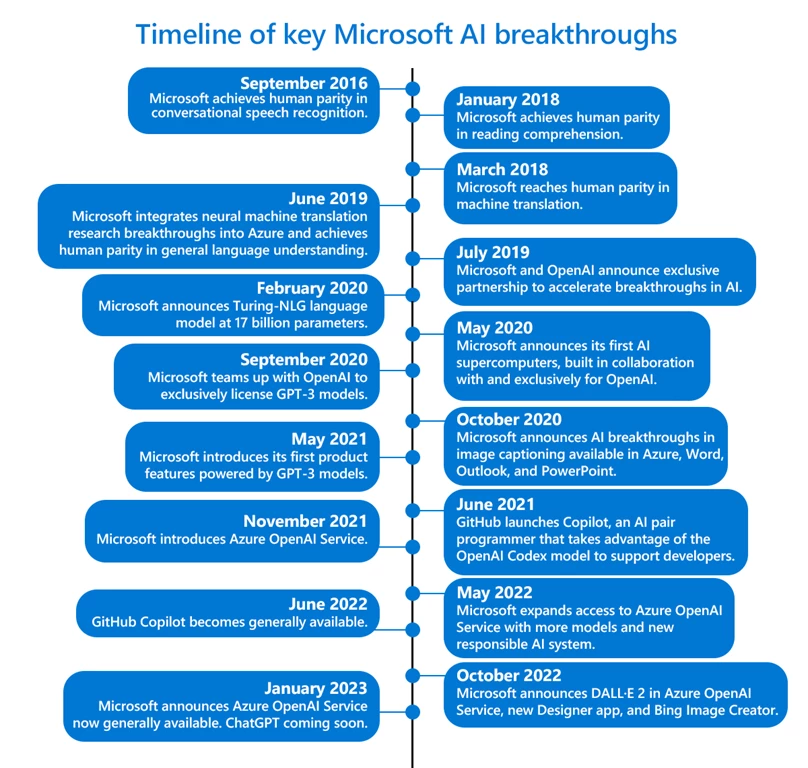
We debuted Azure OpenAI Service in November 2021 to enable customers to tap into the power of large-scale generative AI models with the enterprise promises customers have come to expect from our Azure cloud and computing infrastructure-security, reliability, compliance, data privacy, and built-in Responsible AI capabilities.
Since then, one of the most exciting things we’ve seen is the breadth of use cases Azure OpenAI Service has enabled our customers-from generating content that helps better match shoppers with the right purchases to summarizing customer service tickets, freeing up time for employees to focus on more critical tasks.
Customers of all sizes across industries are using Azure OpenAI Service to do more with less, improve experiences for end-users, and streamline operational efficiencies internally. From startups like Moveworks to multinational corporations like KPMG, organizations small and large are applying the capabilities of Azure OpenAI Service to advanced use cases such as customer support, customization, and gaining insights from data using search, data extraction, and classification.
“At Moveworks, we see Azure OpenAI Service as an important component of our machine learning architecture. It enables us to solve several novel use cases, such as identifying gaps in our customer’s internal knowledge bases and automatically drafting new knowledge articles based on those gaps. This saves IT and HR teams a significant amount of time and improves employee self-service. Azure OpenAI Service will also radically enhance our existing enterprise search capabilities and supercharge our analytics and data visualization offerings. Given that so much of the modern enterprise relies on language to get work done, the possibilities are endless-and we look forward to continued collaboration and partnership with Azure OpenAI Service.”–Vaibhav Nivargi, Chief Technology Officer and Founder at Moveworks.
“Al Jazeera Digital is constantly exploring new ways to use technology to support our journalism and better serve our audience. Azure OpenAI Service has the potential to enhance our content production in several ways, including summarization and translation, selection of topics, AI tagging, content extraction, and style guide rule application. We are excited to see this service go to general availability so it can help us further contextualize our reporting by conveying the opinion and the other opinion.”–Jason McCartney, Vice President of Engineering at Al Jazeera.
“KPMG is using Azure OpenAI Service to help companies realize significant efficiencies in their Tax ESG (Environmental, Social, and Governance) initiatives. Companies are moving to make their total tax contributions publicly available. With much of these tax payments buried in IT systems outside of finance, massive data volumes, and incomplete data attributes, Azure OpenAI Service finds the data relationships to predict tax payments and tax type-making it much easier to validate accuracy and categorize payments by country and tax type.”–Brett Weaver, Partner, Tax ESG Leader at KPMG.
Azure-the best place to build AI workloads
The general availability of Azure OpenAI Service is not only an important milestone for our customers but also for Azure.
Azure OpenAI Service provides businesses and developers with high-performance AI models at production scale with industry-leading uptime. This is the same production service that Microsoft uses to power its own products, including GitHub Copilot, an AI pair programmer that helps developers write better code, Power BI, which leverages GPT-3-powered natural language to automatically generate formulae and expressions, and the recently-announced Microsoft Designer, which helps creators build stunning content with natural language prompts.
All of this innovation shares a common thread: Azure’s purpose-built, AI-optimized infrastructure.
Azure is also the core computing power behind OpenAI API’s family of models for research advancement and developer production.
Azure is currently the only global public cloud that offers AI supercomputers with massive scale-up and scale-out capabilities. With a unique architecture design that combines leading GPU and networking solutions, Azure delivers best-in-class performance and scale for the most compute-intensive AI training and inference workloads. It’s the reason the world’s leading AI companies-including OpenAI, Meta, Hugging Face, and others-continue to choose Azure to advance their AI innovation. Azure currently ranks in the top 15 of the TOP500 supercomputers worldwide and is the highest-ranked global cloud services provider today. Azure continues to be the cloud and compute power that propels large-scale AI advancements across the globe.

Source: TOP500 The List: TOP500 November 2022, Green500 November 2022.
A responsible approach to AI
As an industry leader, we recognize that any innovation in AI must be done responsibly. This becomes even more important with powerful, new technologies like generative models. We have taken an iterative approach to large models, working closely with our partner OpenAI and our customers to carefully assess use cases, learn, and address potential risks. Additionally, we’ve implemented our own guardrails for Azure OpenAI Service that align with our Responsible AI principles. As part of our Limited Access Framework, developers are required to apply for access, describing their intended use case or application before they are given access to the service. Content filters uniquely designed to catch abusive, hateful, and offensive content constantly monitor the input provided to the service as well as the generated content. In the event of a confirmed policy violation, we may ask the developer to take immediate action to prevent further abuse.
We are confident in the quality of the AI models we are using and offering customers today, and we strongly believe they will empower businesses and people to innovate in entirely new and exciting ways.
The pace of innovation in the AI community is moving at lightning speed. We’re tremendously excited to be at the forefront of these advancements with our customers, and look forward to helping more people benefit from them in 2023 and beyond.
Getting started with Azure OpenAI Service
- Learn more about Azure OpenAI Service and more about all the latest enhancements.
- Apply for access to Azure OpenAI Service. Once approved for use, customers can log in to the Azure portal to create an Azure OpenAI Service resource and then get started either in our Studio website or via code:
- Read the blog: AI and the need for purpose-built cloud infrastructure.
- Watch a video with tips on how to get started with Azure OpenAI Service: