Java developers on Azure and Azure Stack can build and run production Java applications using Azul Systems Zulu Enterprise builds of OpenJDK without incurring additional support costs. If you’re currently running Java apps on-premise or with other JDKs, consider moving it to Zulu on Azure for free support and maintenance. Go to Java on Azure and give it try today!
- Microsoft is making fully compatible and compliant commercial builds of Java SE available for Java developers on Microsoft Azure via a new strategic partnership with Azul Systems.
- Azul Systems will provide fully-supported Zulu Enterprise builds of OpenJDK for Microsoft Azure for all long-term support (LTS) versions of Java, starting with Java SE 7, 8, and 11. More information can be found in the Azul press release.
- This new Java offering is designed to make Azure-based Java deployments worry-free by incorporating quarterly security updates and bug fixes as well as critical out-of-band updates and patches as needed.
The Java SE landscape is undergoing a change in release cadence and support availability. In September 2017, Oracle announced the end of free public security updates and platform bug fixes for Java SE 8 by January 2019 and Java SE 11 by March 2019. Fear not.
Microsoft reaffirms our commitment to make everything available for Java developers to build and scale apps on Azure without any performance or cost disruptions. Azure customers are entitled to security updates and platform bug fixes for their Java apps without incurring any unplanned Java SE subscription fees, newly introduced by third parties.
We know that Java developers will continue to make heavy use of Java 7 and 8 for years to come. This motivated us to work with Azul Systems in order to deliver a seamless remedy for a looming concern on so many people’s minds. Java developers using Azure can migrate to new versions of Java at their own pace and with peace of mind.
Java developers on Azure will continue to receive production updates for Java SE, including security patches and bug fixes for Java SE 7, 8, 11 and beyond for a very long time. We are delivering this through a strategic partnership with Azul.
“We have been delivering certified builds of OpenJDK to Microsoft for more than five years”, said Scott Sellers, Azul Systems president and CEO. “With today’s announcement we extend our partnership by standing with Microsoft to deliver fully-supported builds of Zulu Enterprise to the community of Azure-based Java developers, at no additional cost to them, for both development and production use.”
Azul’s Zulu Enterprise builds of OpenJDK are compatible and compliant builds of OpenJDK that have been extensively tested and certified by Azul Systems. As with Oracle’s Java SE products, Azul’s builds of OpenJDK have quarterly security updates and bug fixes, which are also an integral part of Azul’s offering for Azure. In addition, Azul makes out-of-band security and stability updates and bug fixes available for Azure users, ensuring a rapid resumption of production for Java applications. Azul then contributes any fixes back to the OpenJDK community.
The chart below highlights the announced support for Zulu Enterprise on Microsoft Azure for Java developers:
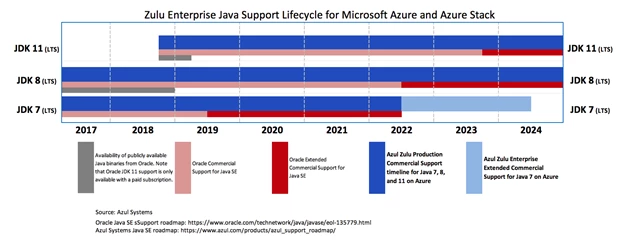
Azul Zulu Enterprise builds of OpenJDK are free for Java developers to deploy on Azure and Azure Stack.
Availability
Java developers on Azure can consume these production-ready, Zulu Enterprise builds of OpenJDK from multiple locations and in a variety of packaging types – today!
- You can run Zulu Enterprise builds of OpenJDK in Windows or Linux virtual machines in Azure or Azure Stack. You can also download them for Java development on Windows, Linux, and MacOS:
- Downloadable ZIP, MSI, DMG and tar bundles are available on the Azul Systems website.
- Zulu packages in Azul hosted APT and YUM repositories for Azure are available.
- You can build unlimited Docker images using Zulu Enterprise builds of OpenJDK on any distros of your choice. Zulu Docker images are in the Microsoft Container Registry.
For example
$ docker pull mcr.microsoft.com/java/jdk:8u181-zulu-ubuntu
Related Zulu Docker files are available in a Microsoft GitHub repository.
- If you are starting from Azure Marketplace images, see Zulu Enterprise images.
- You can extend your app deployments with Azure platform services such as App Service, Functions, Service Fabric and HDInsight which are built using Zulu Enterprise builds of OpenJDK with built-in auto-patching of minor releases of Java with security patches and bug fixes.
Support
What does fully supported Java on Azure really mean? You can call Azure Support for help starting with Java on Azure (including JDK and JRE issues) and all the way to deploying business-critical Java workloads on Azure and Azure Stack. Support will also help you with migrating on-premise workloads to Azure.
As always, Java developers can bring their own Java runtimes, including Oracle JDK and Red Hat JDK, to Azure and leverage the secure infrastructure and feature-rich services. Production edition of Oracle Java SE continues to be available to Java developers for running Java workloads in Windows or Linux virtual machines on Azure.
Go to Java on Azure and give it try today!