Skip to main content Explore View all products (200+) Microsoft Foundry Azure Copilot GitHub Copilot Azure Kubernetes Service (AKS) Azure Cosmos DB Azure Database for PostgreSQL Azure Arc Microsoft Fabric Linux virtual machines in Azure Foundry Models Foundry Agent Service Foundry IQ Foundry Tools Foundry Control Plane Observability in Foundry Control Plane Azure OpenAI in Foundry Models Azure Speech in Foundry Tools Azure Machine Learning View all databases Azure Cosmos DB Azure DocumentDB Azure SQL Azure Database for PostgreSQL Azure Managed Redis Microsoft Fabric Azure Databricks Linux virtual machines in Azure Windows Server on Azure Azure Functions Azure Virtual Machine Scale Sets Azure API Management Azure Container Apps Azure Kubernetes Service (AKS) Azure Kubernetes Fleet Manager Azure Container Registry Azure Red Hat OpenShift Azure Container Instances Azure Container Storage Azure Arc Azure Local Microsoft Defender for Cloud Azure Monitor Microsoft Sentinel Azure Migrate View all solutions (40+) Cloud solutions for small and medium businesses Cloud migration and modernization center Data analytics for AI Azure Databases AI apps and agents Microsoft Marketplace Microsoft Sovereign Cloud AI apps and agents Responsible AI with Azure AI Infrastructure Data analytics for AI Machine learning operations (MLOps) Low-code application development on Azure Integration Services Serverless computing DevOps Migration and modernization center .NET apps migration Databases on Azure Linux on Azure Oracle on Azure SAP on the Microsoft Cloud Adaptive cloud High-performance computing (HPC) Infrastructure as a service (IaaS) Resiliency Azure Essentials Frontier Accelerate for Azure FinOps on Azure Microsoft Marketplace Azure pricing overview Create an Azure account Free Azure services Flexible purchase options Pricing calculator FinOps on Azure Maximize ROI from AI Azure savings plans Azure reservations Azure Hybrid Benefit Virtual Machines Azure SQL Microsoft Foundry Microsoft Fabric Azure Kubernetes Service (AKS) Microsoft Defender for Cloud View more Software Development Companies Microsoft Marketplace Find a partner Resources for Azure partners Get started with Azure Customer stories Analyst reports, white papers, and e-books Videos Learn more about cloud computing Documentation Explore Azure portal Developer resources Quickstart templates Resources for startups Developer community Students Azure for partners Blog Events and Webinars Learn Support Contact Sales Get started with Azure Sign in

The AzureCAT patterns & practices team has published nine new design patterns on the Azure Architecture Center. These nine patterns are particularly useful when designing and implementing microservices. The increased interest in microservices within the industry was the motivation for documenting these patterns.

The following diagram illustrates how these patterns could be used in a microservices architecture.
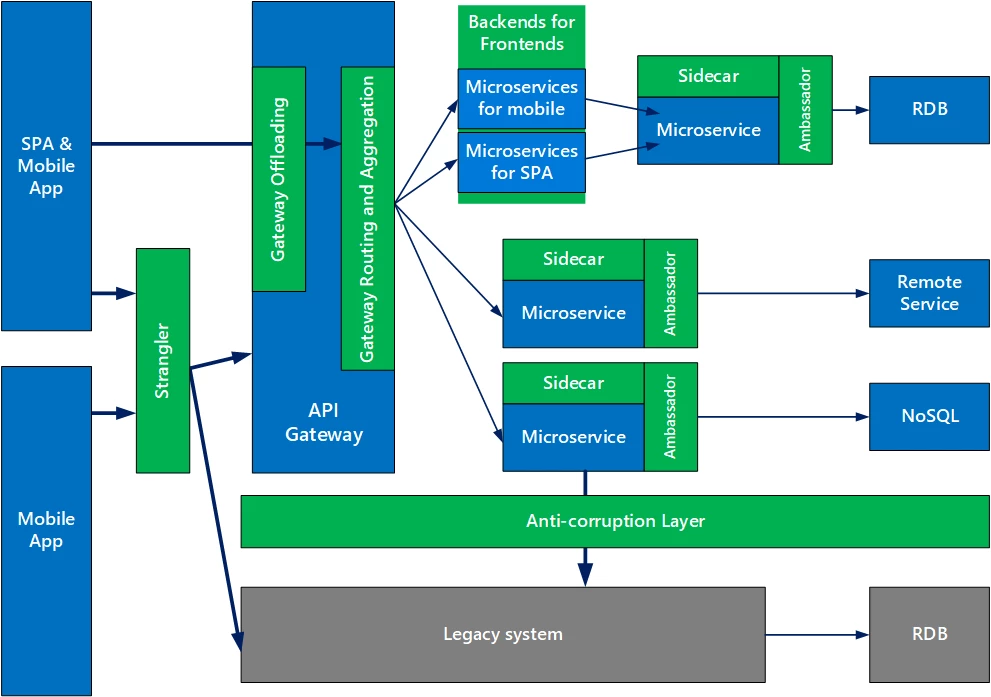
MSA patterns

For each pattern, we describe the problem, the solution, when to use the pattern, and implementation considerations.

Here are the new patterns:

  • Ambassador can be used to offload common client connectivity tasks such as monitoring, logging, routing, and security (such as TLS) in a language agnostic way.
  • Anti-corruption layer implements a façade between new and legacy applications, to ensure that the design of a new application is not limited by dependencies on legacy systems.
  • Backends for Frontends creates separate backend services for different types of clients, such as desktop and mobile. That way, a single backend service doesn’t need to handle the conflicting requirements of various client types. This pattern can help keep each microservice simple, by separating client-specific concerns.
  • Bulkhead isolates critical resources, such as connection pool, memory, and CPU, for each workload or service. By using bulkheads, a single workload (or service) can’t consume all of the resources, starving others. This pattern increases the resiliency of the system by preventing cascading failures caused by one service.
  • Gateway Aggregation aggregates requests to multiple individual microservices into a single request, reducing chattiness between consumers and services.
  • Gateway Offloading enables each microservice to offload shared service functionality, such as the use of SSL certificates, to an API gateway.
  • Gateway Routing routes requests to multiple microservices using a single endpoint, so that consumers don’t need to manage many separate endpoints.
  • Sidecar deploys helper components of an application as a separate container or process to provide isolation and encapsulation.
  • Strangler supports incremental migration by gradually replacing specific pieces of functionality with new services.

The goal of microservices is to increase the velocity of application releases, by decomposing the application into small autonomous services that can be deployed independently. A microservices architecture also brings some challenges, and these patterns can help mitigate these challenges. We hope you will find them useful in your own projects. As always, we greatly appreciate your feedback.


WE ARE MICROSOFT

Explore Microsoft Foundry

The future of AI starts here. Envision your next great AI app with the latest technologies. Get started with Azure.