Skip to main content Explore View all products (200+) Microsoft Foundry Azure Copilot GitHub Copilot Azure Kubernetes Service (AKS) Azure Cosmos DB Azure Database for PostgreSQL Azure Arc Microsoft Fabric Linux virtual machines in Azure Foundry Models Foundry Agent Service Foundry IQ Foundry Tools Foundry Control Plane Observability in Foundry Control Plane Azure OpenAI in Foundry Models Azure Speech in Foundry Tools Azure Machine Learning View all databases Azure Cosmos DB Azure DocumentDB Azure SQL Azure Database for PostgreSQL Azure Managed Redis Microsoft Fabric Azure Databricks Linux virtual machines in Azure Windows Server on Azure Azure Functions Azure Virtual Machine Scale Sets Azure API Management Azure Container Apps Azure Kubernetes Service (AKS) Azure Kubernetes Fleet Manager Azure Container Registry Azure Red Hat OpenShift Azure Container Instances Azure Container Storage Azure Arc Azure Local Microsoft Defender for Cloud Azure Monitor Microsoft Sentinel Azure Migrate View all solutions (40+) Cloud solutions for small and medium businesses Cloud migration and modernization center Data analytics for AI Azure Databases AI apps and agents Microsoft Marketplace Microsoft Sovereign Cloud AI apps and agents Responsible AI with Azure AI Infrastructure Data analytics for AI Machine learning operations (MLOps) Low-code application development on Azure Integration Services Serverless computing DevOps Migration and modernization center .NET apps migration Databases on Azure Linux on Azure Oracle on Azure SAP on the Microsoft Cloud Adaptive cloud High-performance computing (HPC) Infrastructure as a service (IaaS) Resiliency Azure Essentials Frontier Accelerate for Azure FinOps on Azure Microsoft Marketplace Azure pricing overview Create an Azure account Free Azure services Flexible purchase options Pricing calculator FinOps on Azure Maximize ROI from AI Azure savings plans Azure reservations Azure Hybrid Benefit Virtual Machines Azure SQL Microsoft Foundry Microsoft Fabric Azure Kubernetes Service (AKS) Microsoft Defender for Cloud View more Software Development Companies Microsoft Marketplace Find a partner Resources for Azure partners Get started with Azure Customer stories Analyst reports, white papers, and e-books Videos Learn more about cloud computing Documentation Explore Azure portal Developer resources Quickstart templates Resources for startups Developer community Students Azure for partners Blog Events and Webinars Learn Support Contact Sales Get started with Azure Sign in

Azure IoT Edge is built on open container technologies which allows it to integrate seamlessly with other amazing projects in the ecosystem. Today, we’d like to share an experimental project which lets you leverage your Kubernetes expertise and use the same vocabulary to manage IoT Edge deployments right from within your Kubernetes environment.

Architecture

We leverage the Virtual Kubelet project which allows Kubernetes nodes to be backed by other services and make direct use of Kubernetes primitives. We implemented an IoT Edge provider, depicted by blue boxes in the below diagram, that transforms Kubernetes manifests to IoT Edge deployment manifests. A IoT Edge manifest can use tags to target on-prem edge devices whose configuration can be updated with a single kubectl command!
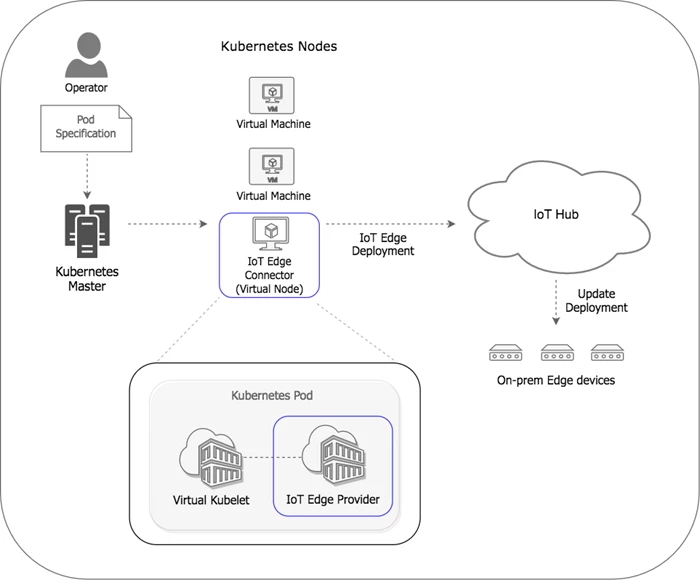
iot-edge-connector

Use cases

While this is an experimental project at this point, it does enable few interesting use cases that would be more difficult to achieve otherwise.

  • Consistency between cloud and edge software configuration: Imagine synchronizing roll out of a new version of a compression algorithm that is used in your cloud as well as edge deployments. This tool lets you manage the cloud and edge release from a single pane of glass allowing you to deliver latest innovations to your customers easily and consistently.
  • Applying identical deployments across multiple IoT hubs: Let’s say you have multiple edge devices that are connected to IoT hubs in different regions for performance or resiliency reasons, but the software configuration on these devices is identical. By creating a virtual Kubernetes node for each IoT hub, you can apply a deployment manifest to devices in different IoT hubs at the same time with a single command.

Next steps

We have open sourced the IoT Edge Virtual Kubelet provider on Github. The repo has instructions on how to set this up on a Kubernetes cluster, connect it to IoT Hub and author IoT Edge deployments as Kubernetes manifests. While not all of the integration is complete, we want to share this early work to get feedback to guide further investments. So kick the tires and let us know what you think!


WE ARE MICROSOFT

Explore Microsoft Foundry

The future of AI starts here. Envision your next great AI app with the latest technologies. Get started with Azure.