As the U.S. healthcare system continues to transition away from paper to more a digitized ecosystem, the ability to link all of an individual’s medical data together correctly becomes increasingly challenging. Patients move, marry, divorce, change names and visit multiple providers throughout their lifetime, with each visit creating new records, and the potential for inconsistent or duplicate information grows. Duplicate medical records often occur as a result of multiple name variations, data entry errors, and lack of interoperability—or communication—between systems. Poor patient identification and duplicate records in turn lead to diagnosis errors, redundant medical tests, skewed reporting and analytics, and billing inaccuracies.
The Azure platform offers a wealth of services for partners to enhance, extend, and build industry solutions. Here we will describe how one Microsoft partner, Nextgate, uses Azure to solve a unique problem.
Patient matching
The process of reconciling electronic health records is called “patient matching,” and it is a major obstacle to improving the quality of care coordination, and patient safety. Further, duplicate records are financially crippling, costing the average hospital $1.5 million and our nation’s healthcare system over $6 billion annually. As data sharing matures and the industry pivots toward value, an enterprise view of patient information is essential for informed clinical-decision making, effective episodic care, and a seamless patient-provider experience during every encounter.
As more data is generated and more applications are introduced into the health IT environment, today’s organizations must engage in more comprehensive patient matching approaches.
The puzzle of disjointed electronic health records
While electronic health records (EHRs) have become commonplace, the disjointed, competitive nature of IT systems contributes to a proliferation of siloed, disconnected information. Many EHR systems make sharing data arduous, even in a single-system electronic medical record environment. Further, master patient indexes (MPI) within EHR systems were designed for a single vendor-based environment and lack the sophisticated algorithms for linking data across various settings of care and disparate systems. When sent downstream, duplicate and disjointed patient demographics trigger further harm including increased waste and inefficiencies, suboptimal outcomes, and lost revenue. Without common technical standards in place, EHR systems continue to collect information in various formats that only serve to exacerbate the issue of duplicate record creation.
Solution
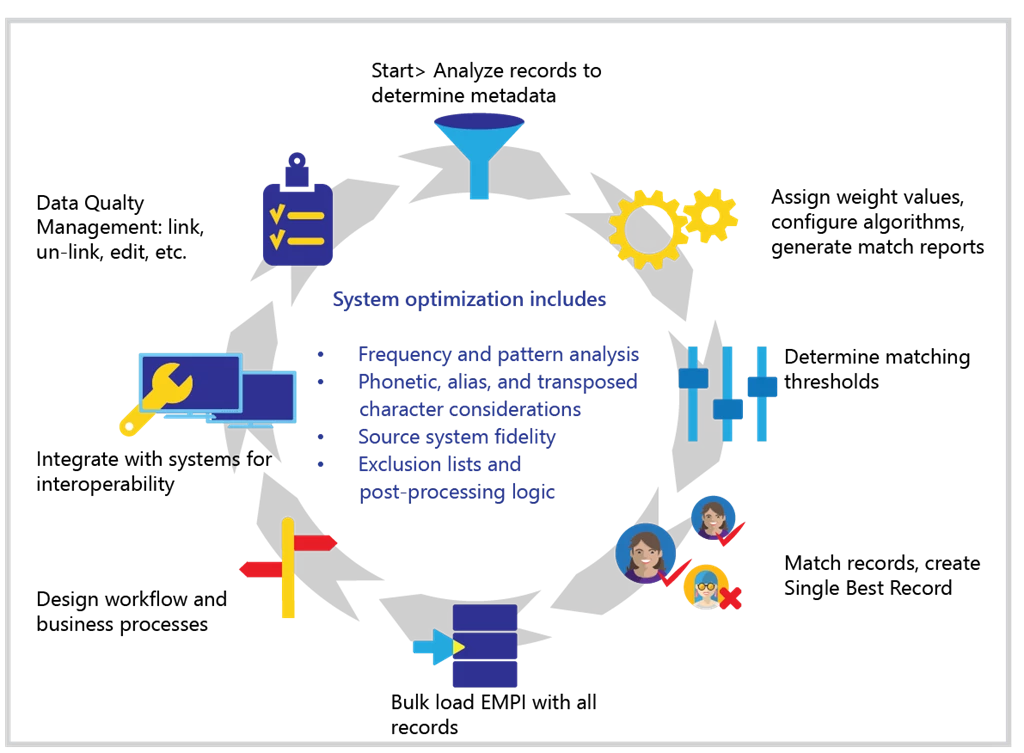
NextGate’s Enterprise Master Patient Index (EMPI) platform is a significant step towards improving a health system’s data management and governance framework. This solution manages patient identities for more than two-thirds of the U.S. population, and one-third of the U.K. population. It empowers clinicians and their organizations to make informed, life-saving decisions by seamlessly linking medical records from any given system and reconciling data discrepancies across multiple sites of care. The automated identity matching platform uses both probabilistic and deterministic matching algorithms to account for minor variations in patient data to generate a single best record that follows the patient throughout the care journey.
Benefits
- Enhanced clinical decision-making.
- Improved patient safety (or reduced medical errors.)
- Decreased number of unnecessary or duplicate testing/procedures.
- Improved interoperability and data exchange.
- Trusted and reliable data quality.
- Reduced number of denied claims and other reimbursement delays.
- Improved administrative efficiencies.
- Higher patient and provider satisfaction.
Azure services
- Azure Security Center reinforces the security posture of the NextGate solution against threats, and provides recommendations to harden the security.
- Azure Monitor provides telemetry data about the NextGate application to ensure its health.
- Azure Virtual Machines provide compute power; enabling auto-scaling and supporting Linux and open source services
- Azure SQL Database and Azure Database for PostgreSQL enable NextGate solutions to easily scale with more compute power (scale-up) or more database units (scale-out.)
Next steps
- To find out more about this solution, go to Nextgate EMPI and click Contact me.
- To see more about Azure in the healthcare industry see Azure for health.