It’s always been a tricky business to handle mission-critical processes. Much of the technical debt that companies assume comes from having to architect systems that have multiple layers of redundancy, to mitigate the chance of outages that may severely impact customers. The process of both architecting and subsequently maintaining these systems has resulted in huge losses in productivity and agility throughout many enterprises across all industries.
The solutions that cloud computing provides help enterprises shift away from this cumbersome work. Instead of spending countless weeks or even months trying to craft an effective solution to the problem of handling critical workloads, cloud providers such as Azure now provide an out-of-the-box way to run your critical processes, without fear of outages, and without incurring costs associated with managing your own infrastructure.
One of the latest innovations in this category, developed by the Azure Logic Apps team, is a new SAP connector that helps companies easily integrate with the ERP systems that are critical to the day-to-day success of a business. Often, implementing these solutions can take teams of people months to get right. However, with the SAP connector from Logic Apps, this process often only takes days, or even hours!
What are some of the benefits of creating workflows with Logic Apps and SAP?
In addition to the broad value that cloud infrastructure provides, Logic Apps can also help:
- Mitigate risk and reduce time-to-success from months to days when implementing new SAP integrations.
- Make your migration to the cloud smoother by moving at your own speed.
- Connect best-in-class cloud services to your SAP instance, no matter where SAP is hosted.
Logic Apps help you turn your SAP instances from worrisome assets that need to be managed, to value-generation centers by opening new possibilities and solutions.
What’s an example of this?
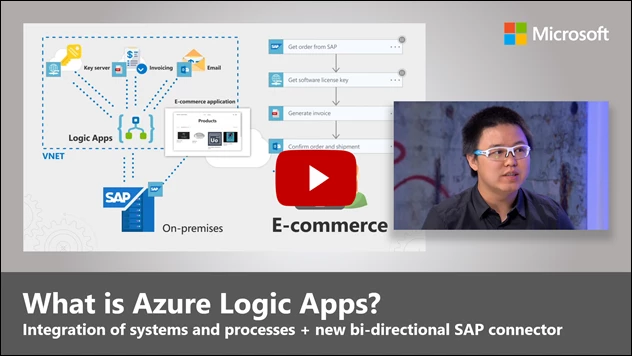
Take the following scenario—an on-premises instance of SAP receives sales orders from an e-commerce site for software purchases. In order to complete the entirety of this transaction, there are several points of integration that must happen—between the on-premises instance of the SAP ERP software, the service that generates new software license keys for the customer, the service that generates the customer invoice, and finally a service that emails the newly generated key to the customer, along with the final invoice.
In this scenario, it is necessary to move between both on-premises environments and cloud environments, which can often be tricky to accomplish in a secure way. Logic Apps solves for this by connecting securely and bi-directionally via a virtual network, ensuring that data stays safe.
Leveraging both Azure and Logic Apps, this solution can be done with a team of one, in a minimal amount of time, and with diminished risk of impacting other key business activities.
If you’re interested in trying this for yourself, or learning more about how we implemented this solution, you can follow along with Microsoft Mechanics as they walk through, step-by-step, how they implemented this solution.
How do I get started?
Azure Logic Apps reduces the complexity of creating and managing critical workloads in the enterprise, freeing up your team to focus on delivering new processes that drive key business outcomes.
Get started today: