In the modern business landscape, the intake of information and data is growing at an incredibly rapid pace. Organizations, regardless of size, need to quickly gain insights from all data to inform customer experiences and empower their employees. Current solutions are bespoke and siloed, leading to users spending considerable time and resources stitching together disparate products across a variety of vendors. This creates costly operational overhead and diverts resources away from value creation. In response to this high-pressure environment, many organizations are looking for cutting-edge data integration platforms and resources, and Microsoft is fully invested in empowering these companies to succeed.
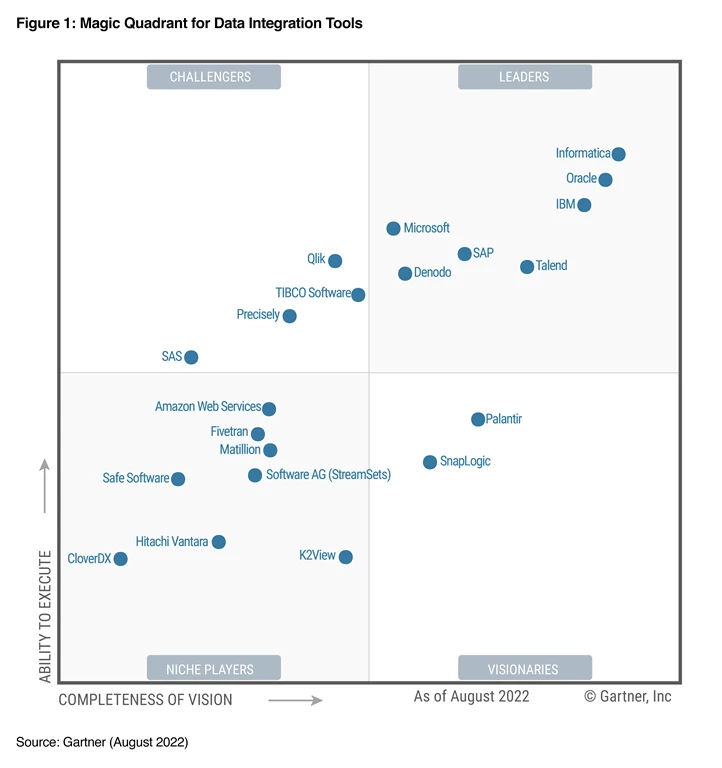
We are excited to share that Gartner has positioned Microsoft as a Leader once again in the 2022 Gartner Magic Quadrant for Data Integration Tools. We believe this recognition shows our continued growth and ongoing commitment to delivering comprehensive and cost-effective data integration solutions.
The Gartner Magic Quadrant for Data Integration Tools evaluated companies on a range of categories including data engineering, cloud migration, and operational data integration tasks.
Translating data into a competitive advantage
It’s easy to be overwhelmed with the amount of data businesses are generating every day. Not only do organizations need to deal with the technical requirements of processing their data, they also are operating in a high-risk environment, where the regulatory challenges are significant and noncompliance can mean an expensive penalty.
Against this backdrop, Microsoft brings an end-to-end data integration strategy to drive competitive advantage and deliver better business outcomes. Regardless of where source data is coming from—from operational databases to software as a service (SaaS) to multicloud—Microsoft data integration serves as the foundation that brings this data together and prepares it for cloud-scale analytics.
To lay the groundwork for reliable data pipelines, organizations can choose from more than 100 connectors to seamlessly move data. New capabilities also enable connections without time-consuming export, transform, and load (ETL) processes, so users can achieve insights faster. Microsoft data integration works seamlessly to combine data and prepare it for analysis in a central, secure environment. Simplified data migration, low or no-code ETL, enterprise business workflows, metadata management, and data governance help boost productivity and empowers organizations to achieve more with data. The company’s entire data team—from data engineers to business analysts—can discover and use the data they need, whether users want to write their own queries or leverage a low-code environment to ingest and transform data.
Microsoft services for data integration
With tooling that delivers a comprehensive set of capabilities, organizations can build a solid data integration foundation.
Azure Data Factory is a managed cloud service that’s built for petabyte-scale data ingestion, data transformation, and orchestration at scale. Use Azure Data Factory for data engineering (build, manage, and operationalize data ingestion and transformation pipelines), data and cloud migration (customers migrating data from on-premises or another cloud), and operational data integration (ongoing data integration and synchronization to support ongoing and critical business processes).
Azure Data Factory Studio is purpose-built to provide data engineers with a familiar and productive environment for authoring their data integration pipelines and data flows for code-free transformations at scale. The experience provides users with sophisticated control flow and orchestration capability to author robust data integration tasks that operate over large amounts of data. Hundreds of connectors enable data-source-specific connectivity from Azure Data Factory and Power Query.
Power Query is a data transformation and data preparation engine that delivers an approachable user experience with self-service and enterprise-ready connectors to hundreds of data sources, from cloud to on-premises. Power Query enables business analysts to handle data preparation tasks on their own for workloads across Power Platform, Dynamics 365, and Microsoft Excel.
Azure Synapse Link is a service that eliminates barriers between Microsoft data stores and Azure Synapse Analytics. Automatically move data from both operational databases and business applications without time-consuming ETL processes. Get an end-to-end view of the business by easily connecting separate systems—and democratize data access with a solution that brings the power of analytics to every data-connected team.
Azure Synapse Link already connects to a variety of Microsoft data stores, such as Azure Cosmos DB and Azure SQL Database, and will connect to more in the future. Here are the connections available now:
- Azure Synapse Link for Dataverse—now generally available.
- Azure Synapse Link for Cosmos DB—now generally available.
- Azure Synapse Link for SQL (both SQL Server 2022 and Azure SQL Database)—now in preview.
The future of data is integration
In this complex environment where data holds such immense value, our north star is to enable our customers to drive a data culture and power a new class of data-first applications. We want our customers to take intelligent action based on insights unlocked from their data, and turn it into competitive advantage, all while respecting and maintaining compliance. We do this by empowering every individual and organization, delivering data integration and analytic tools and resources to inform every decision, at any scale.
Learn more
- Read the full complimentary report from Gartner.
- Learn more about Azure Synapse Analytics.
- Get a free copy of the Limitless Analytics with Azure Synapse e-book.
- Learn more about the Microsoft Intelligent Data Platform.
- Get started with a free Azure account.
- Join the free Azure Synapse Influencers program.
Gartner, Magic Quadrant for Data Integration Tools, August 17, 2022, Ehtisham Zaidi, Robert Thanaraj, Sharat Menon, and Nina Showell.
This graphic was published by Gartner, Inc. as part of a larger research document and should be evaluated in the context of the entire document. The Gartner document is available upon request from Microsoft. GARTNER and Magic Quadrant are registered trademarks and service mark of Gartner, Inc. and its affiliates in the United States and internationally and are used herein with permission. All rights reserved. Gartner does not endorse any vendor, product, or service depicted in its research publications and does not advise technology users to select only those vendors with the highest ratings or other designation. Gartner research publications consist of the opinions of Gartner’s research organization and should not be construed as statements of fact. Gartner disclaims all warranties, expressed or implied, with respect to this research, including any warranties of merchantability or fitness for a particular purpose.