This post was co-authored by Gregory Moore, M.D., Ph.D., CVP for Microsoft Health Next.
Since the start of the pandemic, Microsoft Healthcare Bot has been at the leading edge of helping organizations be more agile with patient engagement. The U.S. Centers for Disease Control (CDC), Walgreens, Premera, and Providence are just a few of the many organizations that are leveraging Microsoft Healthcare Bot to create bots to triage symptoms, answer lab and COVID-related questions, locate nearby clinics, and more. Over the last year, the Healthcare Bot has been used to build thousands of bots and deliver close to 1 billion messages to over 80 million people worldwide, spanning 25 countries.
Today we are announcing that the Microsoft Healthcare Bot service is moving to Azure, further empowering organizations to benefit from Azure’s enhanced tooling, security, and compliance offerings. Customers will be able to seamlessly migrate from Microsoft Healthcare Bot to Azure Health Bot with a few simple steps and no downtime. Additionally, we continue to bring new capabilities to Azure Health Bot, such as new templates for checking eligibility for COVID-19 vaccines and providing answers to related questions.
Azure Health Bot empowers developers in healthcare organizations to build and deploy AI-powered, compliant, conversational healthcare experiences at scale. It combines built-in medical databases with natural language capabilities to understand clinical terminology and can be easily customized to support clinical and operational use cases. The service enables customers’ compliance with industry requirements including HIPAA.
As a native Azure service, Azure Health Bot benefits from Azure’s security investments as well as the most comprehensive compliance coverage of any cloud service provider. Now customers can use standard Azure management tools that they are familiar with and rely on the 99.9 percent SLA commitment. While currently available in two regions (East US and West Europe), it will expand availability to eight regions over the coming months.
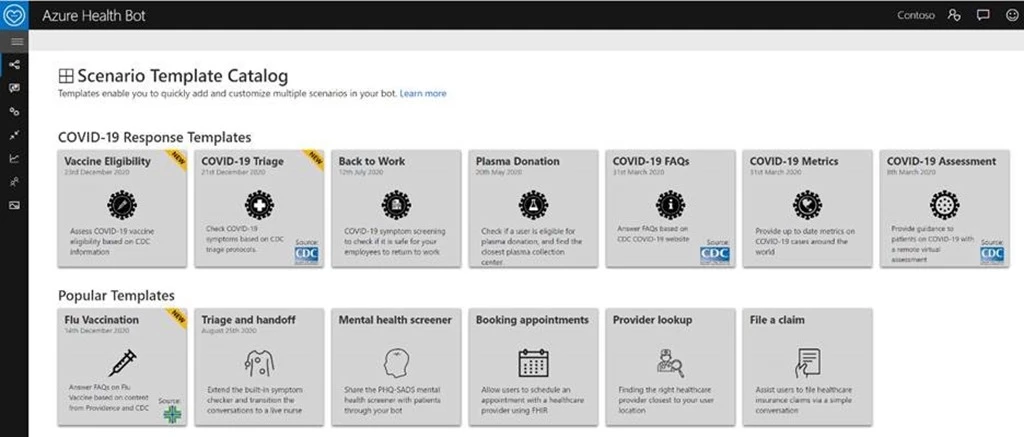
With this move to Azure, we are making it easier than ever before to build bots for healthcare-specific scenarios. Our customers have been using Microsoft Healthcare Bot to drive patient engagement in a variety of use cases and we are excited to see further innovation.
“As part of our Well-Being Initiative, we created the Stress Self-Assessment tool using the Azure Health Bot.This tool offers an anonymous way for nurses to check on themselves and receive guidance to safeguard their well-being. The bot helps nurses discover and make use of a variety of evidence-based ways to build strength and maintain health, like peer support, guided relaxation, apps with well-being tools, and webinars.” —Kate Judge, Executive Director, American Nurses Foundation
“We did not want to build from scratch, but we wanted a robust, scalable platform, that was highly secure. The health bot, built in partnership with Microsoft, started handling 30,000 enquiries a day within a few weeks of first getting up and running.” —Fran Thompson, Interim Chief Information Officer, Health Service Executive (HSE) Ireland
If you are an existing customer of Microsoft Healthcare Bot, you can easily migrate to Azure Health Bot in a few minutes with no downtime. While we highly encourage you to migrate to Azure Health Bot for the best experience, we will continue to support your existing service at least for the coming 12 months.
Get started today
- Azure Health Bot
- Step by step guide to creating your first health bot
- Migrating your Microsoft Healthcare Bot to Azure
- Learn about Microsoft Cloud for Healthcare