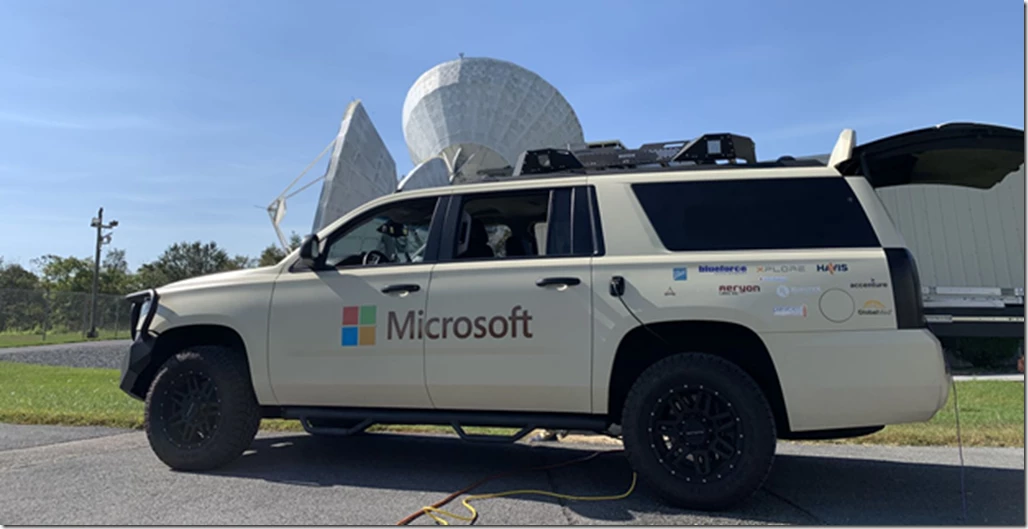
Over the past year, Microsoft has teamed with Ball Aerospace to develop the prototype for the Commercially Augmented Space Inter Networked Operations (CASINO) Program Office, facilitated by the Defense Innovation Unit, demonstrating agile cloud processing capabilities in support of the United States Space Force.
The rising number of satellites proliferating in low earth orbit (LEO) presents a new data challenge for the ground segment of missions—a segment that is often overlooked. For increasingly distributed mission environments, Microsoft Azure delivers the processing power and analysis necessary for these large datasets.
The CASINO Program Office demonstrated fast, flexible, and extensible commercial capabilities for ground processing in support of defense missions. The project also confirmed the potential to transform the analysis of space data across a wide array of industries, including agriculture, ecological study, sustainability, and disaster response.
Microsoft-Ball Aerospace team demonstrates a new method of space analytics
This project represents a huge leap forward in reducing the time to actionable insight—if you are on the ground in a tactical edge vehicle or located at a command center, users can obtain necessary information accurately, quickly, and securely.
To execute the demonstrations, the team transmitted simulated overhead persistent infrared (OPIR) data through Telesat satellites to Azure in the datacenter, as well as directly to a tactical vehicle equipped with an Azure Stack Edge device. The overhead satellites captured images of the environment, which were then pushed to both Azure and the Azure Stack Edge device where machine learning algorithms processed the images and detected certain activity or features. This machine learning identification generated insights that were converted to messages and disseminated across multiple endpoints.
Azure provided the foundational engine for the Ball Aerospace event-driven architecture, which was built in such a way to be extensible and fast. This build allowed for more satellite streams to be added with minimal disruption to speed and ensured different types of satellite imagery could be analyzed quickly.
These demonstrations exhibited:
- Speed, scale, resilience: In the majority of test scenarios, data was captured, processed, and re-deployed, on average, 5x faster than the customer’s established target speed. The architecture created a scalable model which allowed for multiple processing chains. Re-deployment and ready-to-go failover were achieved with no capital expenditure costs.
- Event-driven architecture: The system was built in a flexible and scalable way, making it easy to replace or add algorithms without major change to the production system.
- Cloud-native: The system was built in Azure and worked at the Azure edge. This construction significantly reduced development time, created predictable resiliency, reduced resource demands, increased compliance, and provided clear financial insight for rapid scaling.
- Continuous integration and deployment of AI and machine learning: Fast, repeatable, and traceable. The raw data captured by the satellites could be saved and worked on in the background, continuously improving the AI and machine learning model.
- Infrastructure as a code: Scripts were generated to deploy the required infrastructure into Azure at any datacenter, providing the ability to quickly adjust resources as required.
Our tests showed that the cloud is, in fact, a viable solution for data processing, exploitation, and dissemination of data that is not only fast but also flexible, secure, scalable, and resilient. For years, the military has envisioned an agile and connected force structure. During the demonstration, the CASINO team proved that we are ready to field low-latency links today, which moves this vision much closer to reality.”—Steve Smith, Vice President and General Manager, Systems Engineering Solutions, Ball Aerospace
Azure Machine Learning and AI allow our customers to gain advanced analytics capabilities that enable predictive modeling and actionable insights from a wide array of inputs, including OPIR satellite data. To disseminate this data securely and quickly, customers can harness Microsoft’s global fiber network.
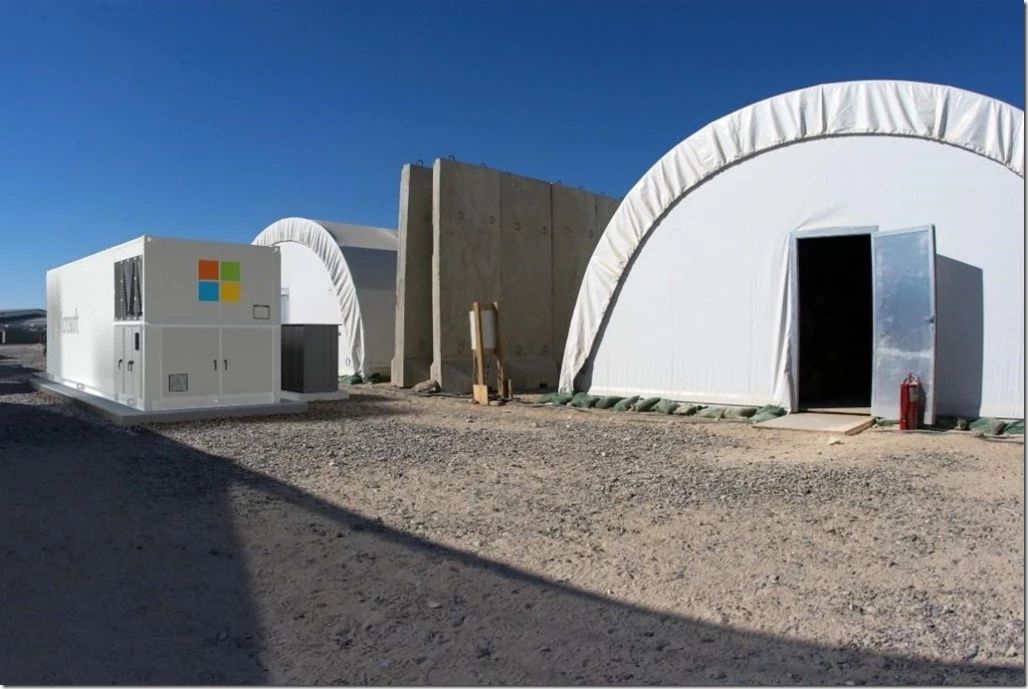
By combining satellite data with other sources directly in Azure, the Microsoft-Ball Aerospace team demonstrated an innovative approach for ground processing, which opens the possibilities for a range of public sector and commercial applications.
The joint demonstration with Ball Aerospace for direct satellite-to-cloud communication and accelerated ground data processing provides the Department of Defense, including the United States Space Force, with additional capabilities to support and shape the future as the mission continues to advance. Learn more about analyzing data from space—the ultimate intelligent edge scenario.