Over the past week, I visited customers and partners in Europe who want to bring cloud services to datacenters and edge locations to deliver new hybrid cloud solutions. Whether it’s due to latency, regulatory compliance or legacy data and systems, these customers can’t use the public cloud for several scenarios. They look for a true hybrid cloud solution to deliver a consistent experience across their entire digital estate. It was really great to listen and observe how some of these companies are already using Azure Stack and thinking of innovative ways to drive digital transformation using Microsoft’s intelligent cloud and intelligent edge approach.
It’s humbling to see customers across government, manufacturing, financial services, and healthcare industries in nearly 60 countries around the world use Azure Stack to unlock new scenarios that were not possible before. And this is just the beginning. We are committed to meeting customer needs and continuously delivering new updates and innovation on Azure Stack.
Consistent hybrid cloud
We have designed and engineered Azure Stack to be truly consistent with Azure. Azure Stack brings the agility and innovation of cloud computing to on-premises and edge, so organizations can build modern apps across their full environment with the flexibility and control they need. With Azure Stack, customers can develop and deploy apps in the cloud, on-premises or at the edge using the same development tools, APIs and processes. The result: simplified admin experience, increased developer productivity, and consistent software delivery.
And while extending datacenters with Azure services continues to be the core mission of Azure Stack, we’re seeing increasing customer needs to use Azure Stack in edge scenarios such as retail floors, oil rigs, and ships.
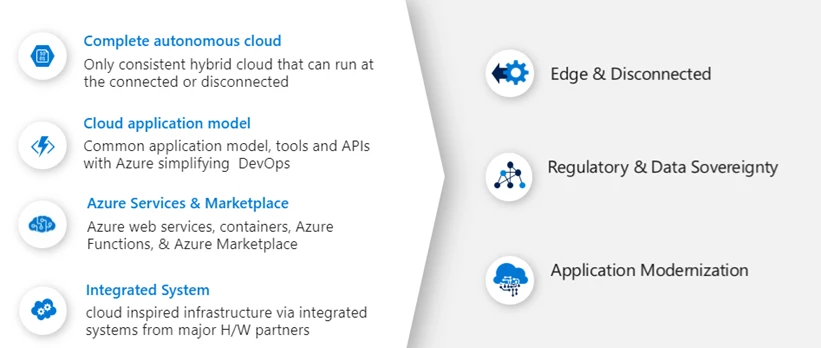
Figure 1 – Azure Stack capabilities
Continuous innovation
We are steadfastly committed to bringing innovation to Azure Stack. We’re adding more capabilities to Azure Stack regularly based on new Azure innovation, all to deliver on the promise of a consistent hybrid cloud experience. And, we prioritize Azure Stack services directly based on customer feedback.
A very recent example of this innovation is the launch of Cognitive Service containers, available on both Azure and Azure Stack. With Azure Stack you can use Cognitive Services containers in combination with AppServices, Functions, Storage and other services to develop complete applications following the Azure programming model. You can use Kubernetes cluster on Azure Stack to deploy and scale your application containers along with Cognitive Services containers. Developers can establish modern CI/CD practices and develop applications that can be easily deployed in both Azure and Azure Stack. You can read more in blog post, “Bringing AI to the edge.”
Since Azure Stack’s debut last year, we’ve added many services and features to Azure Stack, including additional nodes to an existing system, new VM types, services from our partners like Pivotal Cloud Foundry and RedHat OpenShift, and many others. We also have great roadmap of services that are currently in preview or in development like IoT Hub, Event Hubs, AKS, and SQL 2019.
The diagram below gives you a sense of where we’ve been and where we’re going with Azure Stack innovation.
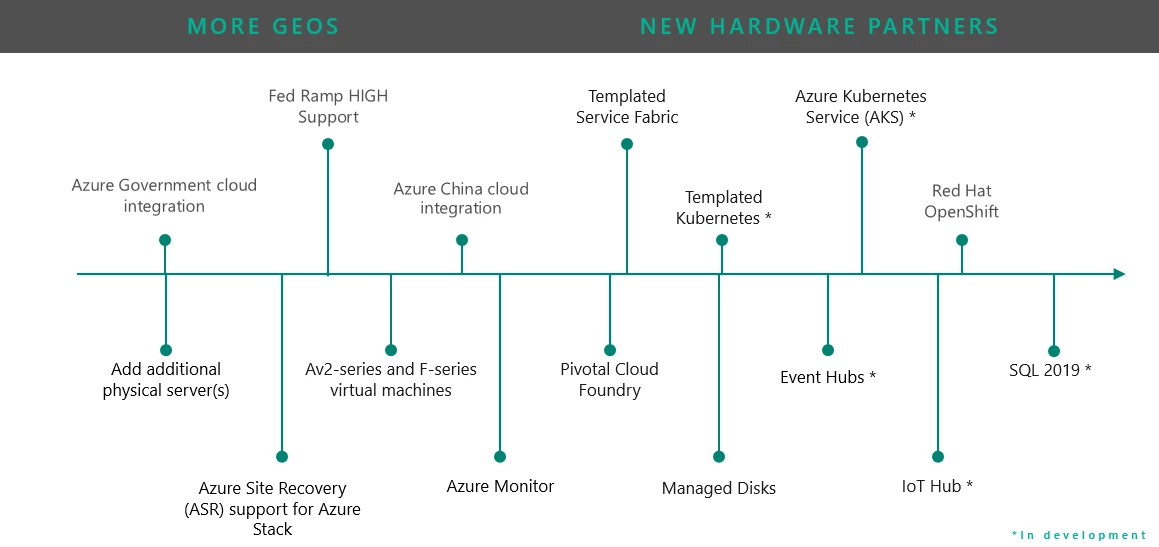
Figure 2 – Azure Stack capabilities and roadmap
Our customers are doing amazing things with Azure Stack today
As I mentioned, we’re seeing high interest and adoption of Azure Stack across a number of industries – manufacturing, financial services, healthcare, and state & local governments. This makes perfect sense, as these industries have some of the most stringent regulatory requirements, often require operations in areas with limited or no internet connectivity, and typically have some legacy applications.
Here are a couple of ways our customers in these industries are using Azure Stack today to address these real-world challenges.
Airbus Defence and Space turned to Azure Stack to meet customer requirements on regulatory compliance and data governance. They found Azure Stack to be the only off-the-shelf technology in the market to meet their private cloud needs and allow them to create modern apps that leverage IoT, big data, machine learning, and many other cloud services. Hear more from Airbus about why they’re excited about Azure Stack.
Manufacturing
Atos and Siemens recently announced a partnership to deliver Azure Stack for MindSphere, a cloud-based IoT operating system, and allow customers to deploy industrial IoT applications in a secure, managed private cloud infrastructure. This means customers will be able to bring the cloud to datacenters and unlock new edge and disconnected scenarios on the factory floor.
Financial services
Using Azure Stack, financial services companies can optimize operations through improved insight into risk and operational models, transforming products with open and connected systems and real-time predictive digital processes.
One example is KPMG Norway, a professional services firm that provides audit, tax, and advisory services. They recently deployed Azure Stack to help address GDPR data privacy restrictions. Read the full story and watch the video below to learn more.
Healthcare
Azure Stack offers an optimal solution for healthcare organizations that must store, manage, and process massive sets of sensitive data and face strict regulatory policies requiring secure environments. Through the capabilities of Azure Stack, organizations can build modern applications across hybrid cloud environments for clinical, customer and product analytics; and store and analyze personal and non-personal medical records in a secure, multi-tier cloud environment.
iMOKO, with partner Revera, is using Azure Stack in the rural, remote areas of New Zealand to deliver fast and reliable healthcare services to children and communities in need. This cloud-based health system allows healthcare providers to diagnose and deliver care in the field, where connectivity is not a guarantee. With Azure Stack, iMOKO has seen a significant increase in the reliability of their healthcare system while solving data sovereignty issues and inaccessibility to the public cloud.
Government: Smart Cities
Earlier this year, we made Azure Stack available to order for government organizations and agencies so they can benefit from a true hybrid cloud approach across identity, subscription, registration, billing, backup and disaster recovery solutions, and the Azure Marketplace.
City and national governments, Drammen Municipality in Norway, for example, are already deploying Azure Stack together with Azure, to deliver innovative digital services to residents while meeting strict data compliance, regulatory and policy requirements—all using a common set of tools for developing, deploying, and managing data and applications. They can now modernize on-premises legacy applications that aren’t quite ready for the public cloud due to cyber defense or any other requirements using a core set of Azure services on-premises with Azure Stack.
Government: Disaster Relief
A third area of high interest in the public sector is the ability to deploy tactical edge solutions. Azure Stack allows these organization to bring core and advanced cloud services to the edge, whether it’s a field office, vehicle, or aircraft.
These ruggedized systems are built for the most demanding environments, such as disaster relief efforts. With Azure Stack on board a tactical vehicle, agencies can process data in the field without worrying about latency or internet connectivity, and then run aggregated analytics in Azure to get precise predictions, such as the most efficient and effective routes to get aid to those in need.
Watch this video for a compelling example of tactical edge solutions in motion—our ruggedized one-ton vehicle that allows users to travel to a disconnected environment and operate Azure Stack leveraging Azure services.
Unlock your own hybrid cloud use cases and innovation with Azure Stack
As you can see, our customers across many industries are realizing the benefits of a truly consistent hybrid cloud with Azure Stack. The use cases for Azure Stack are nearly limitless, and I’m energized by the incredible momentum in just a little over a year – evidence of how Azure Stack has truly changed the game in terms of offering a hybrid cloud experience. And we’re just getting started! Take a peek at our Azure Stack roadmap to see what other innovation is coming soon.
I invite you to learn more about Azure Stack and start your journey toward bringing the agility and fast-paced innovation of the cloud where ever you need it. You can explore Azure Stack capabilities, read more customer stories, or download the Azure Stack Developer Kit.
As always, we love to hear about your experience with our products, so let us know in the comments below.