Skip to main content Get to know Azure Microsoft as Customer Zero View all products (200+) Microsoft Foundry Azure Copilot GitHub Copilot Azure Kubernetes Service (AKS) Azure Cosmos DB Azure Database for PostgreSQL Azure Arc Microsoft Fabric Linux virtual machines in Azure Foundry Models Foundry Agent Service Foundry IQ Foundry Tools Foundry Control Plane Observability in Foundry Control Plane Azure OpenAI in Foundry Models Azure Speech in Foundry Tools Azure Machine Learning View all databases Azure Cosmos DB Azure DocumentDB Azure SQL Azure Database for PostgreSQL Azure Managed Redis Microsoft Fabric Azure Databricks Linux virtual machines in Azure Windows Server on Azure Azure Functions Azure Virtual Machine Scale Sets Azure API Management Azure Container Apps Azure Kubernetes Service (AKS) Azure Kubernetes Fleet Manager Azure Container Registry Azure Red Hat OpenShift Azure Container Instances Azure Container Storage Azure Arc Azure Local Microsoft Defender for Cloud Azure Monitor Microsoft Sentinel Azure Migrate View all solutions (40+) Cloud solutions for small and medium businesses Cloud migration and modernization center Data analytics for AI Azure Databases AI apps and agents Microsoft Marketplace Microsoft Sovereign Cloud AI apps and agents Responsible AI with Azure AI Infrastructure Data analytics for AI Machine learning operations (MLOps) Low-code application development on Azure Integration Services Serverless computing DevOps Migration and modernization center .NET apps migration Databases on Azure Linux on Azure Oracle on Azure SAP on the Microsoft Cloud Adaptive cloud High-performance computing (HPC) Infrastructure as a service (IaaS) Resiliency Azure Essentials Frontier Accelerate for Azure FinOps on Azure Microsoft Marketplace Azure pricing overview Create an Azure account Free Azure services Flexible purchase options Pricing calculator FinOps on Azure Maximize ROI from AI Azure savings plans Azure reservations Azure Hybrid Benefit Virtual Machines Azure SQL Microsoft Foundry Microsoft Fabric Azure Kubernetes Service (AKS) Microsoft Defender for Cloud View more Software Development Companies Microsoft Marketplace Find a partner Resources for Azure partners Get started with Azure Customer stories Analyst reports, white papers, and e-books Videos Learn more about cloud computing Documentation Explore Azure portal Developer resources Quickstart templates Resources for startups Developer community Students Azure for partners Blog Events and Webinars Learn Support Contact Sales Get started with Azure Sign in

Web applications are increasingly becoming targets of attacks such as cross-site scripting, SQL injection, and application DDoS. While OWASP provides guidance on writing applications that can make them more resistant to such attacks, it requires rigorous maintenance and patching at multiple layers of application topology. Microsoft Web Application Firewall (WAF) and Azure Security Center (ASC) can help secure web applications against such vulnerabilities.

Microsoft WAF is a feature of Azure Application Gateway (layer 7 load balancer) that protects web applications against common web exploits using OWASP core rule sets. Azure Security Center scans Azure resources for vulnerabilities and recommends mitigation steps for those issues. One such vulnerability is the presence of web applications that are not protected by WAF. Currently, Azure Security Center recommends a WAF deployment for public facing IPs that have an associated network security group with open inbound web ports (80 and 443). Azure Security Center offers provisioning of application gateway WAF to an existing Azure resource as well as adding a new resource to an existing web application firewall. By integrating with WAF, Azure Security Center can analyze its logs and surface important security alerts.

In some cases, the security admin may not have resource permissions to provision WAF from Azure Security Center or the application owner has already configured WAF as part of the app deployment. To accommodate these scenarios, we are pleased to announce that Security Center will soon automatically discover WAF instances in the subscription that were not provisioned using Security Center. Previously provisioned WAF instances will be displayed in Security Center security solutions pane under discovered solutions where the security admin can integrate them with Azure Security Center. Connecting existing Microsoft WAF deployments will allow customers to take advantage of Security Center detections regardless of how WAF was provisioned. Additional configuration settings such as custom firewall rules sets are available in the WAF console which is linked directly from Security Center. This article on configuring Microsoft WAF can provide more guidance on provisioning process.
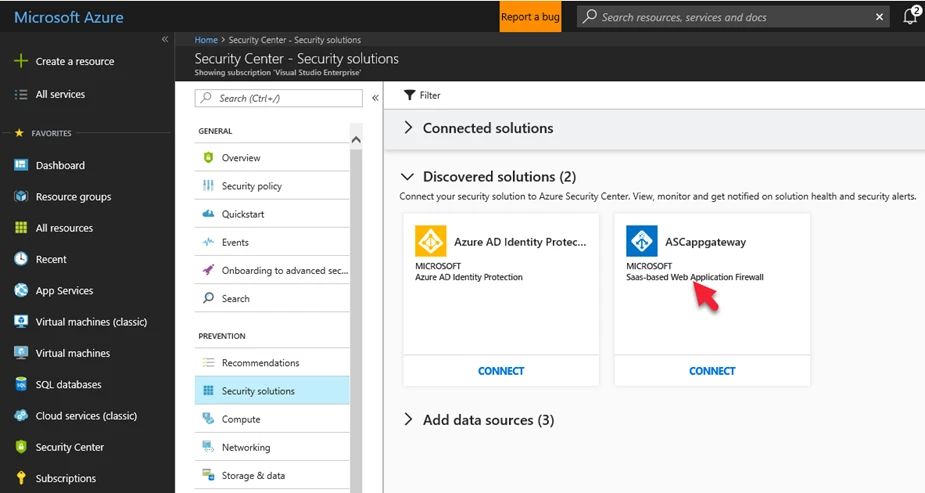
ASC_WAF_Blog_picture

We would love to hear your feedback! If you have suggestions or questions, please leave a comment at the bottom of the post or reach out to ascpartnerssupport@microsoft.com.

Interested in learning more about Azure Security Center?

Intro to Azure Security Center

Azure Security Center FAQ

WE ARE MICROSOFT

Explore Microsoft Foundry

The future of AI starts here. Envision your next great AI app with the latest technologies. Get started with Azure.