Skip to main content Explore View all products (200+) Microsoft Foundry Azure Copilot GitHub Copilot Azure Kubernetes Service (AKS) Azure Cosmos DB Azure Database for PostgreSQL Azure Arc Microsoft Fabric Linux virtual machines in Azure Foundry Models Foundry Agent Service Foundry IQ Foundry Tools Foundry Control Plane Observability in Foundry Control Plane Azure OpenAI in Foundry Models Azure Speech in Foundry Tools Azure Machine Learning View all databases Azure Cosmos DB Azure DocumentDB Azure SQL Azure Database for PostgreSQL Azure Managed Redis Microsoft Fabric Azure Databricks Linux virtual machines in Azure Windows Server on Azure Azure Functions Azure Virtual Machine Scale Sets Azure API Management Azure Container Apps Azure Kubernetes Service (AKS) Azure Kubernetes Fleet Manager Azure Container Registry Azure Red Hat OpenShift Azure Container Instances Azure Container Storage Azure Arc Azure Local Microsoft Defender for Cloud Azure Monitor Microsoft Sentinel Azure Migrate View all solutions (40+) Cloud solutions for small and medium businesses Cloud migration and modernization center Data analytics for AI Azure Databases AI apps and agents Microsoft Marketplace Microsoft Sovereign Cloud AI apps and agents Responsible AI with Azure AI Infrastructure Data analytics for AI Machine learning operations (MLOps) Low-code application development on Azure Integration Services Serverless computing DevOps Migration and modernization center .NET apps migration Databases on Azure Linux on Azure Oracle on Azure SAP on the Microsoft Cloud Adaptive cloud High-performance computing (HPC) Infrastructure as a service (IaaS) Resiliency Azure Essentials Frontier Accelerate for Azure FinOps on Azure Microsoft Marketplace Azure pricing overview Create an Azure account Free Azure services Flexible purchase options Pricing calculator FinOps on Azure Maximize ROI from AI Azure savings plans Azure reservations Azure Hybrid Benefit Virtual Machines Azure SQL Microsoft Foundry Microsoft Fabric Azure Kubernetes Service (AKS) Microsoft Defender for Cloud View more Software Development Companies Microsoft Marketplace Find a partner Resources for Azure partners Get started with Azure Customer stories Analyst reports, white papers, and e-books Videos Learn more about cloud computing Documentation Explore Azure portal Developer resources Quickstart templates Resources for startups Developer community Students Azure for partners Blog Events and Webinars Learn Support Contact Sales Get started with Azure Sign in

Microsoft has reached a milestone in text-to-speech synthesis with a production system that uses deep neural networks to make the voices of computers nearly indistinguishable from recordings of people. With the human-like natural prosody and clear articulation of words, Neural TTS has significantly reduced listening fatigue when you interact with AI systems.

Our team demonstrated our neural-network powered text-to-speech capability at the Microsoft Ignite conference in Orlando, Florida, this week. The capability is currently available in preview through Azure Cognitive Services Speech Services.

Neural text-to-speech can be used to make interactions with chatbots and virtual assistants more natural and engaging, convert digital texts such as e-books into audiobooks and enhance in-car navigation systems.

The milestone in text-to-speech joins a string of breakthroughs that our group has achieved over the past two years, including human parity in conversational speech recognition and human parity in machine translation.
Neural TTS

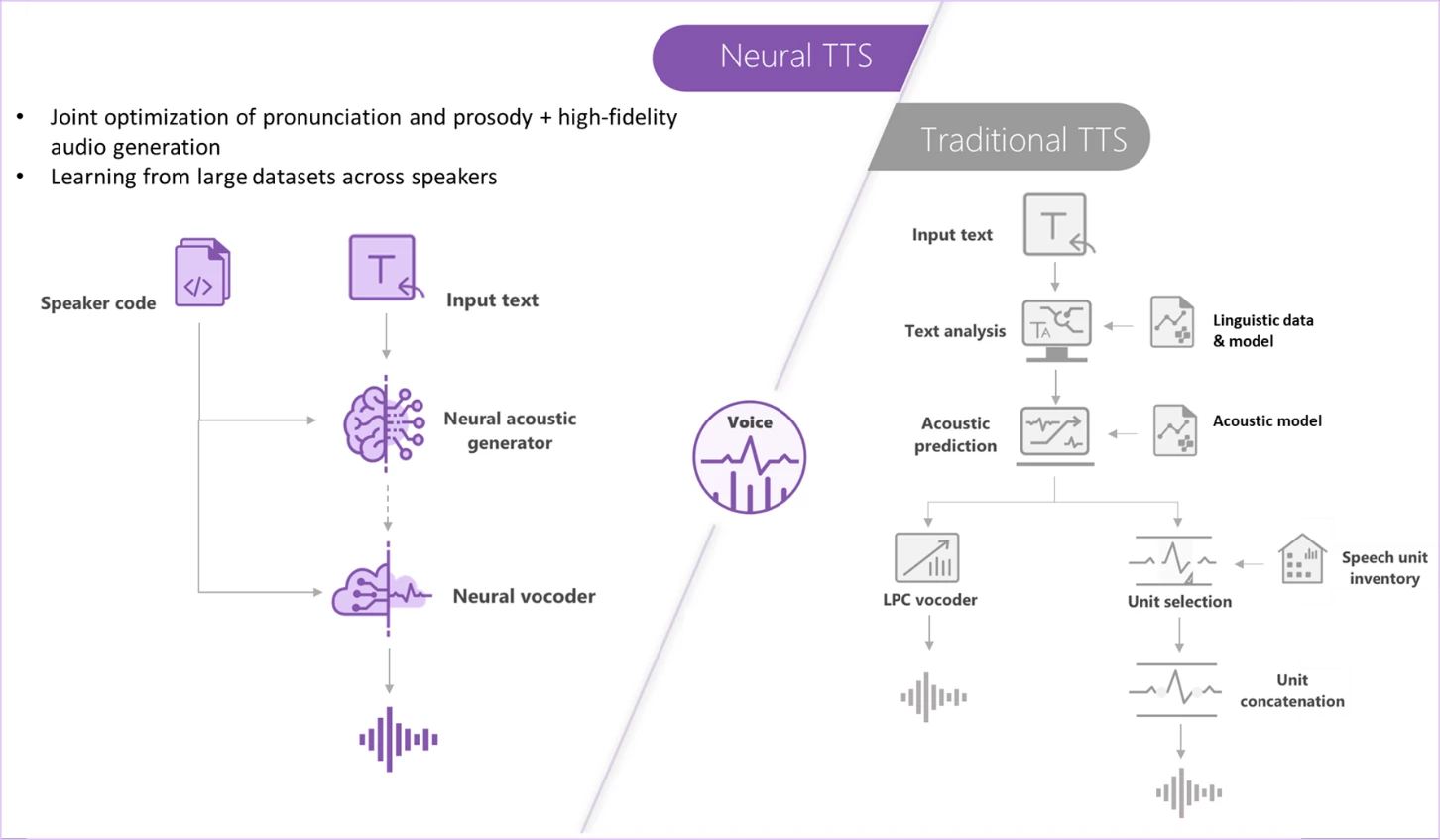
Our text-to-speech capability uses deep neural networks to overcome the limits of traditional text-to-speech systems in matching the patterns of stress and intonation in spoken language, called prosody, and in synthesizing the units of speech into a computer voice.

Traditional text-to-speech systems break down prosody into separate linguistic analysis and acoustic prediction steps that are governed by independent models. That can result in muffled, buzzy voice synthesis. Our neural capability does prosody prediction and voice synthesis simultaneously. The result is a more fluid and natural-sounding voice.

Sentence Recording Neural TTS
The third type, a logarithm of the unsigned fold change, is undoubtedly the most tractable. sound sound
As the name suggests, the original submarines came from Yugoslavia. sound sound
This is easy enough if you have an unfinished attic directly above the bathroom. sound sound

By using the computational power of Azure, we can deliver real-time streaming, which is useful for situations such as interacting with a chatbot or virtual assistant. The capability is served in the Azure Kubernetes Service. This ensures high scalability and availability and gives customers the ability to use neural text-to-speech and traditional text-to-speech from a single endpoint.

The preview service is currently offering two pre-built neural text-to-speech voices in English – Aria and Guy. More languages will be available soon, as well as customization services in 49 languages for customers who want to build branded voices optimized for their specific needs.

To learn more, visit us.

WE ARE MICROSOFT

Explore Microsoft Foundry

The future of AI starts here. Envision your next great AI app with the latest technologies. Get started with Azure.