Are you still hesitating to move some or all your workloads to the cloud due to the added cost? One of the easiest ways to significantly lower your cost of ownership is by using a special licensing offer called Azure Hybrid Benefit.
When migrating Windows Server or SQL Server on-premises workloads to Microsoft Azure, Azure Hybrid Benefit allows you to use your existing licenses covered by Software Assurance (SA) or other subscriptions in Azure. By bringing both Windows and SQL Server licenses with SA to Azure, you can save up to 85 percent compared to pay-as-you-go pricing.
Don’t pay double
Server migration cost concerns take several shapes, including paying double for the cloud and on-premises licenses while migrating, and the added infrastructure and security costs. During migrations, Azure Hybrid Benefit helps reduce risk by allowing 180 days to run Azure and on-premises workloads simultaneously at no additional cost. Or you can keep both licenses permanently to continue running a hybrid infrastructure.
When using cloud services from other providers, organizations are required to pay for both the infrastructure and the licenses. With Azure Hybrid Benefit, you pay only for additional infrastructure. You will need to repurchase your Windows Server license on other providers’ clouds. And only Azure offers free extended security updates. When you move a Windows or SQL Server workload to Azure, the extended security updates provide three years of free security updates after the end of support, reducing risk and cost.
Moreover, Azure Hybrid Benefit applies to active and unused on-premises Red Hat or SUSE Linux subscriptions, allowing you to use your existing Linux workloads on Azure and pay only for your virtual machine infrastructure costs.
Windows Server savings
Only Azure Hybrid Benefit enables Windows Server license assignment in the cloud. The benefit is applicable to customers with an active SA or subscription license, such as EAS, SCE, or Open Value subscription on Windows Server (both Standard and Datacenter editions of Windows Server 2012 R2, Windows Server 2016, and Windows Server 2019). It is supported in all Azure regions and on virtual machines that are running SQL or third-party marketplace software.
Only Azure Hybrid Benefit offers unlimited virtualization for dedicated hosts. For a breakdown of the number of virtual cores allocated for those licenses, their requirements, and how to apply for benefits, check out Azure Hybrid Benefit for Windows Server.
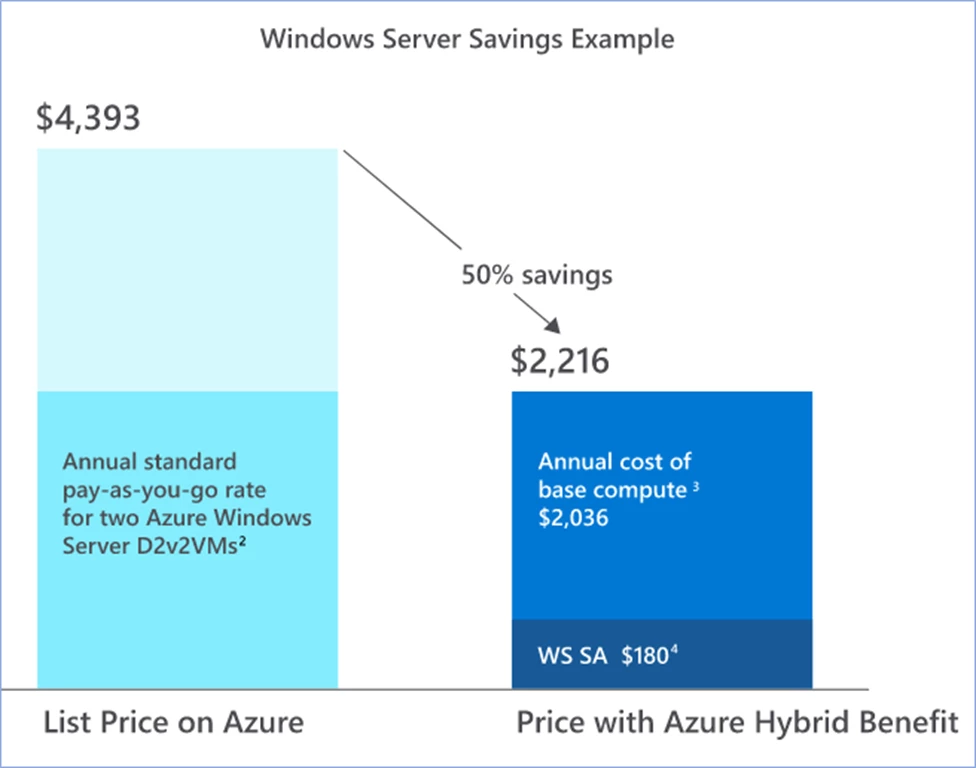
Below is a snapshot of how much Azure Hybrid Benefit can save when moving Windows Server workloads.
SQL Server savings
The Hybrid Benefit for SQL Server on Azure Virtual Machines allows customers with Software Assurance to use their on-premises licenses when they run SQL Server on Azure Virtual Machines. With Software Assurance, you can use the benefit when deploying a new SQL virtual machine or activate SQL Server Azure Hybrid Benefit for an existing SQL virtual machine with a pay-as-you-go license.
And know that only with Azure Hybrid Benefit can you leverage your existing SQL Server licenses in both IaaS and PaaS environments. And only Azure Hybrid Benefit applies to SQL Server DBaaS and gives you four virtual CPUs for one core of SQL Server Enterprise in the exchange.
You can centrally manage your Azure Hybrid Benefit for SQL Server across the scope of an entire Azure subscription or overall billing account. In the Azure portal, you can now centrally manage your Azure Hybrid Benefit for SQL Server by assigning licenses to the scope of an entire Azure subscription or overall billing account.
Here is an example of the benefit applied to SQL Server:
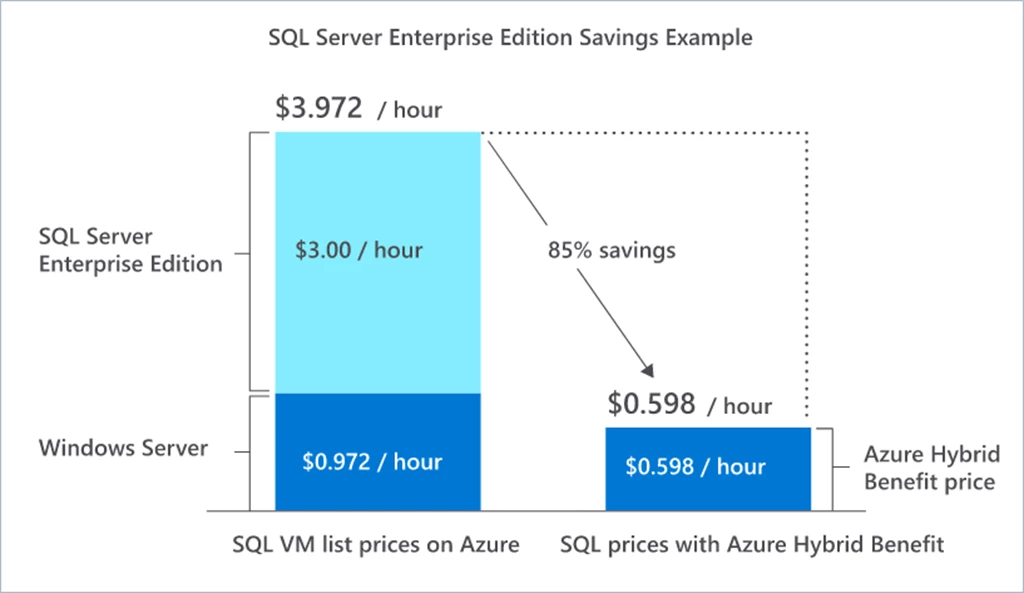
Azure Hybrid Benefit helps you to significantly reduce the costs of running your workloads in the cloud. See the benefit description and rules for more on the licensing structure and use cases.
More ways to save
Even more savings can be found by purchasing Azure reserved instances, which provides discounts on Azure services when purchasing predicted capacity in advance. It gives us visibility into your one-year or three-year resource needs, which allows us to be more efficient and these savings are passed on to you as discounts of up to 72 percent. Together with Azure Hybrid Benefit, these reservations can provide more than 80 percent savings over the standard pay-as-you-go rate. Your actual savings may vary so use the Azure Hybrid Benefit Savings Calculator to estimate your savings range.
Learn more
- Get more financial and technical guidance from Azure by visiting cloud economics.
- Find out more special offers at Azure benefits and incentives.