Skip to main content Explore View all products (200+) Microsoft Foundry Azure Copilot GitHub Copilot Azure Kubernetes Service (AKS) Azure Cosmos DB Azure Database for PostgreSQL Azure Arc Microsoft Fabric Linux virtual machines in Azure Foundry Models Foundry Agent Service Foundry IQ Foundry Tools Foundry Control Plane Observability in Foundry Control Plane Azure OpenAI in Foundry Models Azure Speech in Foundry Tools Azure Machine Learning View all databases Azure Cosmos DB Azure DocumentDB Azure SQL Azure Database for PostgreSQL Azure Managed Redis Microsoft Fabric Azure Databricks Linux virtual machines in Azure Windows Server on Azure Azure Functions Azure Virtual Machine Scale Sets Azure API Management Azure Container Apps Azure Kubernetes Service (AKS) Azure Kubernetes Fleet Manager Azure Container Registry Azure Red Hat OpenShift Azure Container Instances Azure Container Storage Azure Arc Azure Local Microsoft Defender for Cloud Azure Monitor Microsoft Sentinel Azure Migrate View all solutions (40+) Cloud solutions for small and medium businesses Cloud migration and modernization center Data analytics for AI Azure Databases AI apps and agents Microsoft Marketplace Microsoft Sovereign Cloud AI apps and agents Responsible AI with Azure AI Infrastructure Data analytics for AI Machine learning operations (MLOps) Low-code application development on Azure Integration Services Serverless computing DevOps Migration and modernization center .NET apps migration Databases on Azure Linux on Azure Oracle on Azure SAP on the Microsoft Cloud Adaptive cloud High-performance computing (HPC) Infrastructure as a service (IaaS) Resiliency Azure Essentials Frontier Accelerate for Azure FinOps on Azure Microsoft Marketplace Azure pricing overview Create an Azure account Free Azure services Flexible purchase options Pricing calculator FinOps on Azure Maximize ROI from AI Azure savings plans Azure reservations Azure Hybrid Benefit Virtual Machines Azure SQL Microsoft Foundry Microsoft Fabric Azure Kubernetes Service (AKS) Microsoft Defender for Cloud View more Software Development Companies Microsoft Marketplace Find a partner Resources for Azure partners Get started with Azure Customer stories Analyst reports, white papers, and e-books Videos Learn more about cloud computing Documentation Explore Azure portal Developer resources Quickstart templates Resources for startups Developer community Students Azure for partners Blog Events and Webinars Learn Support Contact Sales Get started with Azure Sign in

After first emerging as the basis for the Bitcoin protocol, blockchain has since gained momentum as a way to digitize business processes that extend beyond the boundaries of a single organization. While digital currencies use the shared ledger to track transactions and balances, enterprises are coming together to use the ledger in a different way. Smart contracts—codified versions of paper based agreements—enable multiple organizations to agree on terms that must be met for a transaction to be considered valid, empowering automated verification and workflows on the blockchain.

These digitized business processes, governed by smart contracts and powered by the immutability of blockchain, are poised to deliver the scalable trust today’s enterprises need. One Microsoft partner, SIMBA Chain, has created an offering that reduces the effort and time to start creating solutions using blockchain technology.

The Azure platform offers a wealth of services for partners to enhance, extend, and build industry solutions. Here we describe how one Microsoft partner uses Azure to solve a unique problem.

Simplifying blockchain app development

SIMBA stands for SIMpler Blockchain Applications. SIMBA Chain is a cloud based, Smart Contract as a Service (SCaaS) platform, enabling users with a variety of skill sets to build decentralized applications (dApps) and deploy to either iOS or Android.

The figure below shows the platform and the components (such as the Django web framework) used to communicate to a dApp using a pub/sub model. SIMBA Chain auto-generates the smart contract and API keys for deployment, and the app can be deployed to a number of backends for mobile apps (such as Android and iOS.) Communication to participate in the blockchain occurs through an API generated from a smart contract.
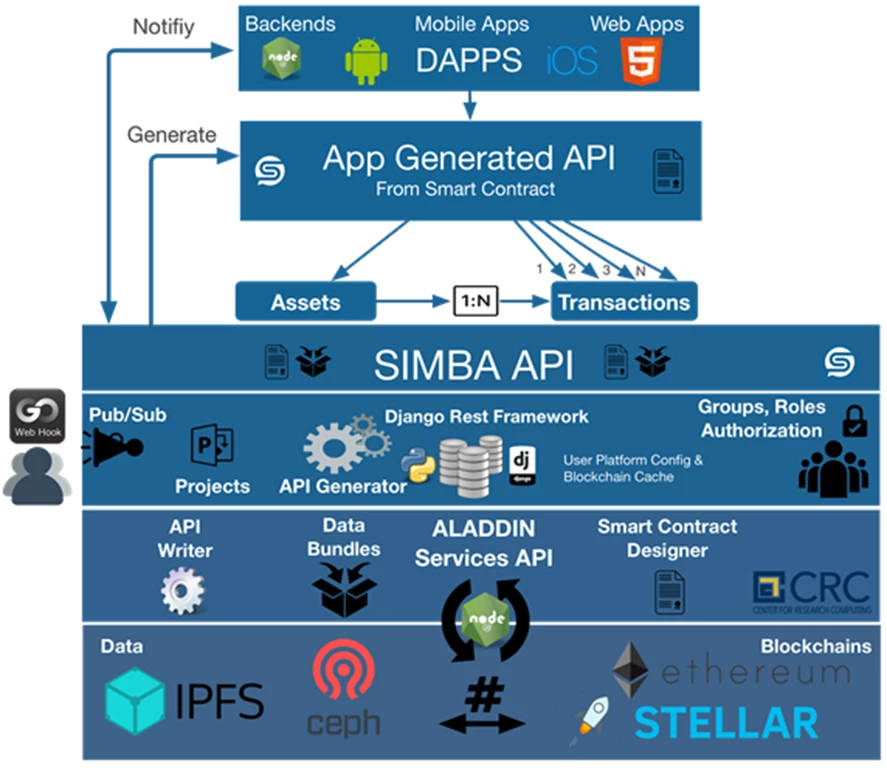
A graphic showing how SIMBA is used in blockchain app development.

With this platform, anyone with a powerful idea can build a decentralized application. SIMBA Chain supports Ethereum and will add more blockchain protocols to their platform.

A time-saving technology

SIMBA Chain’s user-friendly interface greatly reduces the time and custom code generation required to build and deploy a blockchain-based application. Users can create and model a business application, define the assets along with the smart contracts parameters, and in a few simple clicks the SIMBA platform generates an API which interfaces with the ledger. By reducing application development time, SIMBA enables faster prototyping, refinement, and deployment.

Go to the Azure Marketplace listing for SIMBA Chain and click Get It Now.

Learn more about Azure Blockchain Service.

WE ARE MICROSOFT

Explore Microsoft Foundry

The future of AI starts here. Envision your next great AI app with the latest technologies. Get started with Azure.