After wrapping up a successful preview with fantastic customer engagement, we are excited to officially announce the general availability of the Lsv2-series Azure Virtual Machines (VMs). Customers from all over the globe and across a broad range of industries participated in the Lsv2-series VMs preview during the second half of 2018.
General overview
The Lsv2-series features high throughput, low latency, and directly mapped local NVMe storage. The Lsv2 VMs run on the AMD EPYCTM 7551 processor with an all core boost of 2.55GHz. The Lsv2-series VMs offer various configurations from 8 to 80 vCPUs with simultaneous multi-threading. Each VM features 8 GiB of memory and one 1.92TB NVMe SSD M.2 device per 8 vCPUs, with up to 19.2TB (10 x 1.92TB) available on the 80vCPU L80s v2.
Target workloads
The Lsv2-series is well suited for your high throughput and high IOPS workloads including big data applications, SQL and NoSQL databases, data warehousing, and large transactional databases. Examples include Cassandra, MongoDB, Cloudera, and Redis. In general, applications that can benefit from large in-memory databases are a good fit for these VMs.
We have worked closely with AMD to maximize potential customer value:
“Designed from the ground up for the modern IT enterprise, the AMD EPYC™ 7551 processor featured in the Microsoft Azure Lsv2 VM instance has today’s highest core count for a server processor, exceptional memory capacity and bandwidth, coupled with phenomenal I/O density. Combine this with the strength of Azure, and it creates a perfect environment for workloads such as in memory databases and big data. Microsoft Azure was the first global cloud provider to deploy AMD EPYC processors and we’re excited to continue this partnership as we target even greater performance in 2019.”
– Daniel Bounds, Senior Director, Datacenter Solutions, AMD
Performance
With learnings from our preview, we have optimized our Lsv2-series VMs to drive maximum performance from the local NVMe disks. These performance levels are possible thanks to the optimization of Windows Server 2019 on Azure and Canonical’s latest Ubuntu 18.04 and 16.04 releases in the Azure Marketplace. Throughout 2019 we will continue to add Lsv2-series optimized Linux distributions in the Azure Marketplace. Please check the documentation, “Storage optimized virtual machine sizes” for future updates.
Available configurations and regional availability
The Lsv2-series VMs are available in the following sizes:
| Size | vCPU’s | Memory (GiB) | NVMe Disk | NVMe Disk Throughput (Read IOPS/MBps) |
| L8s_v2 | 8 | 64 | 1 x 1.92 TB | 340,000 / 2,000 |
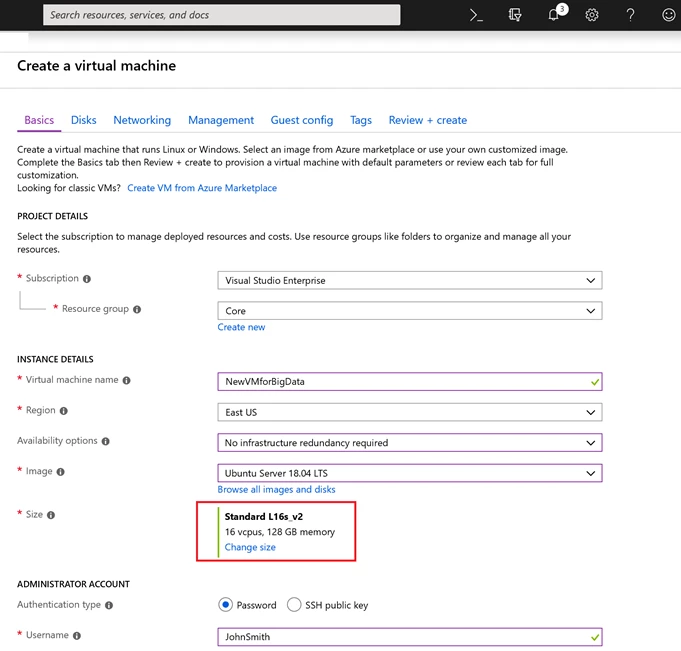
| L16s_v2 | 16 | 128 | 2 x 1.92 TB | 680,000 / 4,500 |
| L32s_v2 | 32 | 256 | 4 x 1.92 TB | 1,400,000 / 9,000 |
| L64s_v2 | 64 | 512 | 8 x 1.92 TB | 2,700,000 / 18,000 |
| L80s_v2 | 80 | 640 | 10 x 1.92 TB | 3,400,000 / 22,000 |
Your performance levels will vary depending on your workload, configuration, and choice of operating system. For example, on the L80s_v2 with 19.2 TB of NVMe direct to the VM, we were able to reach up to 3.7M read IOPS on WS2019 and 3.6M read IOPS on Ubuntu 18.04/16.04. To learn more watch the video, “Inside Azure datacenter architecture with Mark Russinovich” from Ignite 2018.
We are launching the Lsv2-series in the following regions: East US, East US 2, West Europe, and SE Asia. We plan to make these new VMs available in more regions by the end of H1 CY19, including West US 2 and North Europe.
Next steps
You can get more information about the Lsv2-series by reading the documentation, “Storage optimized virtual machine sizes.” Lsv2-series VMs support pay-as-you-go, low priority, and 1 or 3 year reserved instance (RI) pricing for both Windows and Linux.