Microsoft and Quantinuum applied Azure Quantum’s qubit-virtualization system to Quantinuum’s H2 trapped-ion quantum computer to create 12 highly reliable logical qubits. Additionally, the teams demonstrated the emerging capabilities of reliable quantum computing by using two logical qubits, integrated with an AI model and cloud high-performance computing (HPC), to accurately estimate the ground state energy of the active space of an important catalytic intermediate. These achievements demonstrate continued progress toward scientific quantum advantage, a milestone that will be reached when a hybrid quantum-classical supercomputer can solve scientific problems too complex for classical computers alone.
Microsoft Quantum Innovation Series
How can quantum and AI unlock a new generation of hybrid applications for science?

Tripling the number of highly reliable logical qubits
Earlier this year, Microsoft and Quantinuum created the most reliable logical qubits on record by applying Microsoft’s qubit-virtualization system to Quantinuum’s H-Series ion-trap qubits. At the time of that announcement, the teams had created four logical qubits from 30 physical qubits on Quantinuum’s H2 machine, with a logical error rate 800 times better than the physical error rate.
By expanding Microsoft’s error-correction algorithms and optimizing them for Quantinuum’s H2 machine, which now has 56 qubits with 99.8% two-qubit fidelity, the teams have created 12 highly reliable logical qubits. Previously, Microsoft and Quantinuum entangled two logical qubits in a Bell state preparation, whereas in this study, all 12 logical qubits were entangled in a more complex arrangement known as a cat state, or Greenberger-Horne-Zeilinger (GHZ) state. When these logical qubits were entangled, they exhibited a circuit error rate of 0.0011, which is 22 times better than the corresponding physical qubits’ circuit error rate of 0.024.
Microsoft and Quantinuum demonstrated several fault-tolerant computations with the improved logical qubits. On eight logical qubits, the teams successfully conducted five rounds of repeated error correction. Furthermore, the eight logical qubits were used to perform a fault-tolerant computation during error correction, successfully demonstrating the combination of logical entangling operations with multiple rounds of quantum error correction. The eight logical qubits exhibited a circuit error rate of 0.002, which is 11 times better than the corresponding physical qubits’ circuit error rate of 0.023. To our knowledge, this is the first demonstration of computation and error correction being beneficially combined, and it showcases the ability of these logical qubits to perform increasingly deeper quantum computations reliably, paving the way to fault-tolerant quantum computing.
Using logical qubits, cloud HPC, and AI to solve problems in chemistry
To demonstrate the emerging usefulness of quantum computing in chemistry applications, an end-to-end hybrid workflow was used to solve a real problem in chemistry, bringing together computation across cloud HPC, reliable quantum computing, and AI. In the quantum computation, two logical qubits—created with Microsoft’s qubit-virtualization system and Quantinuum’s H1 machine—were used to prepare the ground state of the active space of an important catalytic intermediate (Figure 1) and then measured. The measurement outputs were then integrated with AI to estimate the ground state energy of the active space. This is the first time that HPC, AI, and quantum-computing hardware have been applied in concert to solve a scientific problem.
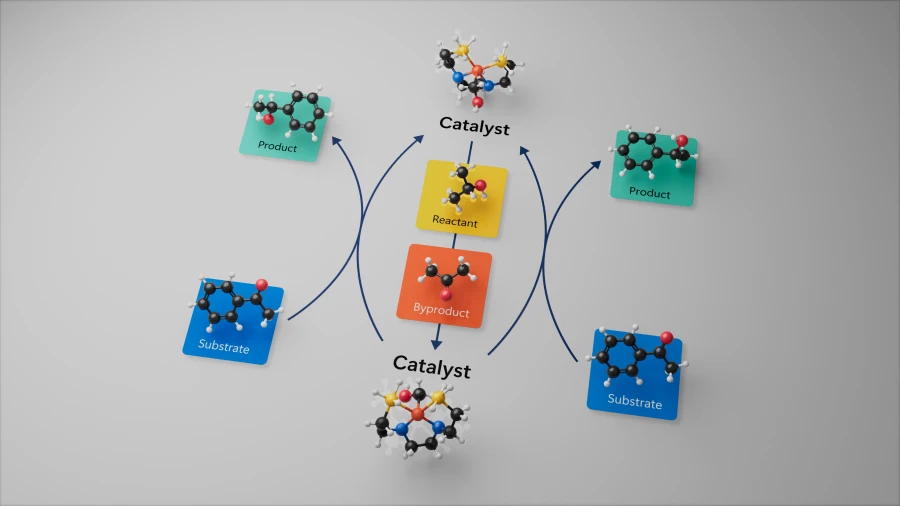
As a first step, the team at Microsoft used AutoCAS and AutoRXN in Azure Quantum Elements to conduct HPC simulations that identified the active space of the catalyst and the catalyst’s reaction pathways, respectively. The team then optimized error-detection codes for use within a customized quantum algorithm on two logical qubits to simulate the quantum behavior of the active space. The logical qubits were then measured to generate classical data using a method known as classical shadows, which uses the measurement outcomes as classical data to train an AI model on the quantum properties of the molecule. This “shadow data” was then used in combination with the AI model to determine chemical properties of the catalyst and estimate the ground state energy of the active space within chemical accuracy (Figure 2). For comparison, the same calculation was performed with physical qubits.
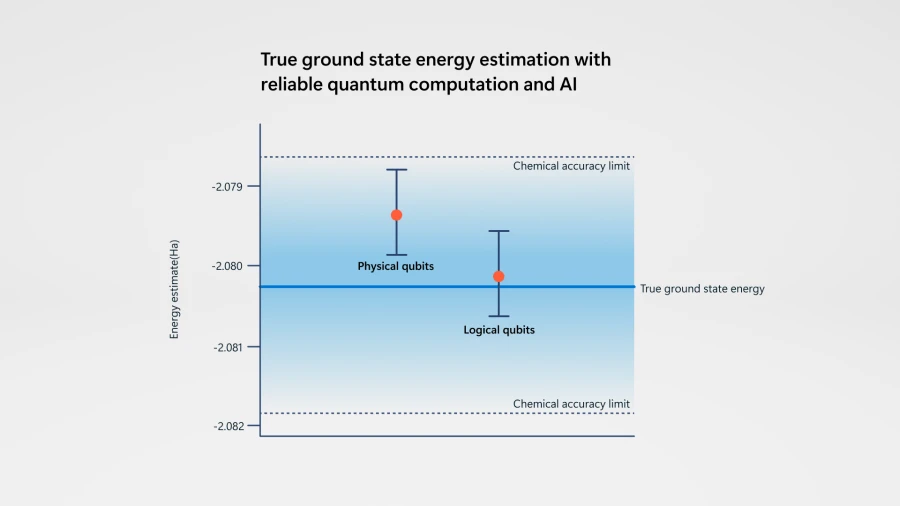
The ground state energy of the catalyst’s active space was calculated classically to gauge the accuracy of the hybrid quantum and AI-based result. Using qubits to solve this problem does not demonstrate scientific quantum advantage because the answer can be derived with classical computers. However, some complicated chemistry problems are unlikely to be solved classically with high accuracy, which provides an opportunity for quantum computers to outperform classical computation.
The proof-of-concept case study described here is notable for several reasons. To our knowledge, this is the first demonstration of an end-to-end workflow that employs quantum computing, HPC, and AI to simulate and solve a chemistry problem. Furthermore, the quantum-mechanical problem was solved with a high degree of accuracy. These logical qubits produced a better estimate of the ground state energy than the comparable computation with the underlying physical qubits, demonstrating the higher reliability of these logical qubits.
This demonstration provides evidence of the emerging usefulness of quantum-classical hybrid computing in chemistry, and it offers an example of how HPC, AI, and logical qubits can be used collectively to solve scientific problems. The logical qubits created with Microsoft’s qubit-virtualization system are being integrated into Azure Quantum Elements, our cloud platform designed to accelerate scientific discoveries. To increase our offerings further, we’re excited to announce that Quantinuum’s InQuantoTM computational-chemistry software package has been integrated into Azure Quantum Elements. InQuanto’sTM pioneering quantum-chemistry algorithms and methods expand Azure Quantum Elements’ tool kit and are available today through private preview.
Microsoft’s qubit-virtualization system extends to all types of qubits
Multiple types of qubit architectures are being explored as potential pathways toward a quantum-computing future. The logical qubits described above were created on Quantinuum’s ion-trap qubit hardware. The team at Microsoft is also applying the Azure Quantum compute platform to the neutral-atom qubits in Atom Computing’s second-generation systems, designed to have over 1,200 physical qubits. Together, Microsoft and Atom Computing have created logical qubits and are optimizing their systems to enable reliable quantum computation. The team at Microsoft also plans to apply their qubit-virtualization system to the topological qubits that are still in development.
As advances are made to both quantum hardware and software, qubits will continue to increase in number and fidelity, enabling deeper and more complex quantum computations with logical qubits. When approximately 100 logical qubits are available, scientific quantum advantage—which is expected to help solve some of the world’s most pressing challenges—will likely be achievable.
Making logical qubits available through a new hybrid-computing offering
At Microsoft, we’re ushering in a new era of reliable quantum computing by offering the Azure Quantum compute platform that brings together Microsoft’s qubit-virtualization system with industry-leading quantum processing units (QPUs) from hardware partners to create reliable logical qubits. Computation with those logical qubits is then integrated with cloud HPC and AI models. Additionally, in collaboration with Atom Computing, we have a commercial offering of a reliable quantum machine.
By providing access to reliable logical qubits, accelerated HPC simulations, Copilot for Azure Quantum, and advanced AI models, Azure Quantum brings the powers of quantum computing, classical computing, and AI together. To advance the safe use of these technologies, we will ensure that they are developed and deployed responsibly. We will continue to adopt thoughtful safeguards, building on our commitments to responsible AI and embracing responsible computing practices as these capabilities grow.
Learn more about Microsoft’s advances in quantum computing
- Read about Microsoft’s hybrid-computing offering and our collaboration with Atom Computing in the Official Microsoft Blog.
- Register for the upcoming Microsoft Quantum Innovator Series on how quantum and AI can unlock a new generation of hybrid applications for science.
- Read the technical papers on today’s logical qubit announcement and the chemistry simulation performed with logical qubits from Microsoft and Quantinuum.
- Get the latest news and announcements from Azure Quantum.