What if your cloud environment could help you move from insight to action in real time, with systems already working through the next set of decisions?
As applications scale across hybrid infrastructure, microservices, and AI workloads, leading organizations are moving toward operating models where insight flows directly into action as part of an ongoing, system-driven loop.
This is where agentic cloud operations comes in. Agentic cloud operations is an approach in which AI-powered agents—guided by user intent—continuously observe, reason, and assist with actions across the cloud lifecycle. Signals are not treated as isolated events. They are input into coordinated workflows that evolve over time, helping improve performance, cost, and reliability as systems run.
According to recent research conducted with Material, 79% of organizations are already deploying agentic AI in production, reflecting how quickly this model is becoming part of how cloud environments are operated.
Governance connects insight to action
To operate this model, governance needs to be built directly into how cloud operations run. Observability provides a continuous stream of signals and context, but those signals only become useful when they can drive action in a controlled and consistent way. As agents begin to take on more responsibility across detection, investigation, and remediation, every action should be designed to follow human-defined policies, respect access controls, and remain aligned with organizational intent.
At Microsoft Build, this emerged as a key requirement. Developers and IT need governance embedded within the same workflows that connect observability to optimization. As insights trigger actions, those actions remain constrained, auditable, and repeatable across environments.
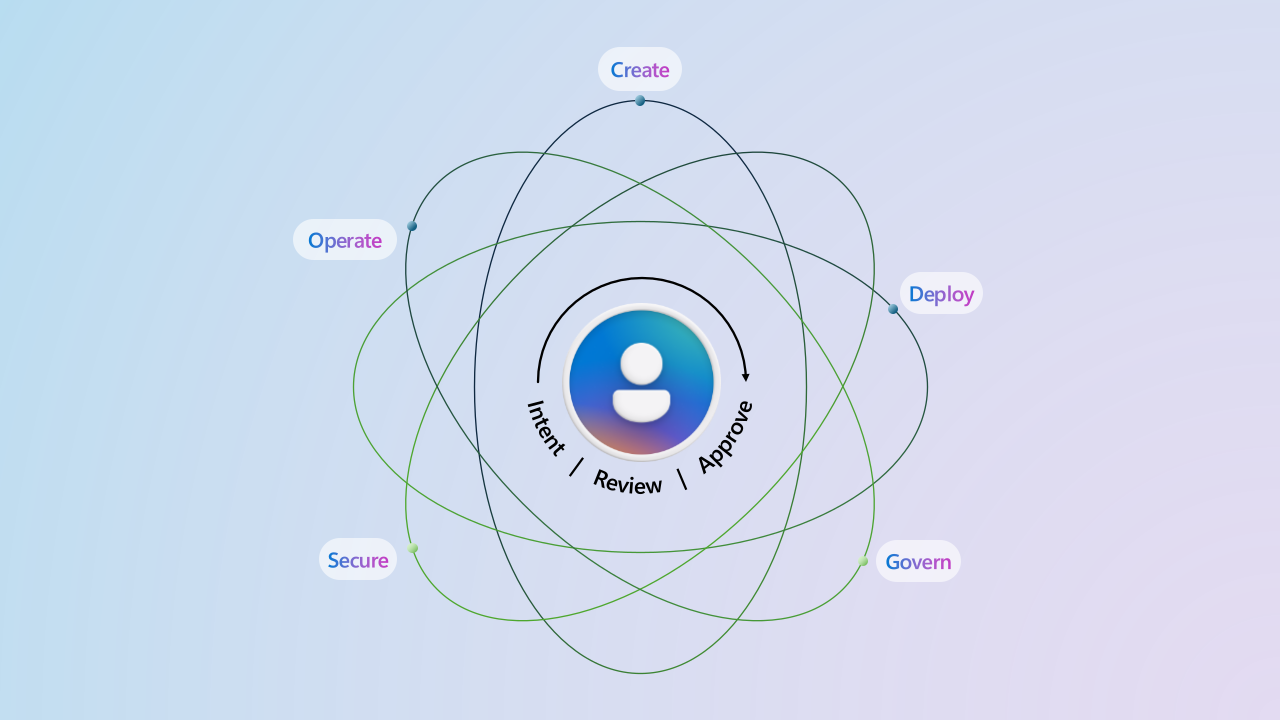
Our vision for agentic operations includes a shared operating model that brings observability and optimization together, where insights lead directly to action and every action is governed by built‑in policy and control, with humans always in the loop. In Azure, we’re building a system in which observability, governance, and optimization work together. Signals are continuously interpreted, actions are applied within policy boundaries, and outcomes feed back into the system to guide the next decision.
Observability is the intelligence layer
As cloud environments expand, telemetry and alerts have outpaced what teams can manage through manual processes alone. Engineers often spend significant time correlating signals, validating issues, and understanding what changed.
In an agentic model, observability aims to provide continuous intelligence. It gives AI agents the context they need to identify meaningful signals, understand dependencies across the environment, and surface relevant insights early. Observability helps answer what is happening and why, with greater clarity and timeliness.
From signals to resolution
Building on this foundation, the Azure Copilot observability agent, now generally available, brings this intelligence into day-to-day operations. The observability agent can continuously analyze telemetry across your environment, including application topology, dependencies, and baseline behavior. When an issue begins to emerge, it can identify patterns, begin investigation, and provide context before teams start their analysis.
Agentic observability changes how incidents are handled in practice. Issues can be surfaced earlier, with related signals already grouped to reduce noise. Investigations can begin automatically, tracing dependencies across services to help identify likely root causes. Teams are provided with clear, contextual recommendations that support faster decision-making.
Observability also extends to AI workloads, so agents, services, and infrastructure can be viewed together. The result helps enable more consistent flow from detection to understanding to action, with less manual effort required along the way.
The biggest value is speed… The observability agent helps us resolve incidents faster and reduce operational overhead… we’ve reclaimed an estimated 250 engineering hours monthly.
—Narmada Krishnaswamy, Head of KPMG Audit Application Support and Operations
Observability provides a clearer view of what is happening. It also creates the foundation for the next step. Observability answers the most urgent question in cloud operations: what’s happening, and why? But for organizations operating at scale, that’s only the beginning.
Optimization becomes continuous
When observability provides consistent, real-time context, it can be used to guide ongoing improvement.
Microsoft defines optimization as the continuous practice of improving cloud workloads across cost, performance, resilience, and sustainability. In an agentic model, optimization becomes part of everyday workflows rather than a separate, periodic activity.
At FinOps X 2026, many organizations shared that AI is introducing new cost dynamics. Usage patterns are more variable, less predictable, and often tied to rapid changes in workloads. This makes it harder to rely on periodic reviews and traditional cost management approaches. Optimization must happen closer to where decisions are made.
From dashboards to connected workflows
As optimization becomes more integrated, the way work gets done also evolves. Instead of switching between tools and dashboards, teams can interact with systems through guided workflows. Agents help estimate costs before resources are created, apply governance guardrails automatically, monitor usage patterns, and surface potential issues earlier.
For example, during development, cost implications can be surfaced before deployment, along with relevant policy guidance. As systems run, patterns in usage can be monitored and changes can be investigated with supporting context. When opportunities for improvement are identified, agents can help prioritize and guide next steps. This approach helps bring cost, performance, and efficiency considerations into the flow of work in a more consistent way.
Optimization intelligence across tools and environments
To support this model, Microsoft is extending cost and usage intelligence beyond the Azure portal into the tools teams already use.
The Azure Resource Manager MCP Server, now in public preview, enables AI agents to access cost and usage data through a standardized interface. This allows cost insights to appear within developer environments, copilots, and custom workflows without requiring custom integrations.
As a result, developers can build with greater awareness of cost implications, and operations teams can investigate and optimize using natural language interactions. Workflows can be applied more consistently across teams and environments.
Multi-step processes such as estimation, investigation, and optimization can also be organized into reusable workflows, helping teams scale these practices.
Bringing it all together in a closed loop system
Observability and optimization are increasingly connected. Observability provides continuous context. Agentic AI helps interpret signals and support actions. Optimization reflects the outcomes of those actions over time, guided by governance and policy. This creates a system where insights can more directly inform the next step, and where each action contributes to ongoing improvement. Over time, this supports more consistent operations across environments and teams.
In this model, progress comes from acting with better context and greater consistency. Microsoft is helping organizations adopt this approach by connecting people, data, and tools through Azure Copilot and related capabilities. Teams gain the ability to resolve issues more efficiently, apply optimization continuously, and operate with governance built in.
Get started with Azure
To see how these capabilities come together in practice, you can explore and try them across your environment:
- Azure Copilot
- An AI-powered assistant that helps translate operational signals into guided actions across your cloud environment.
- Azure Copilot observability agent (generally available)
- Identify root causes and accelerate resolution through continuous analysis and assisted investigation.
- Azure FinOps MCP Server (public preview)
- Connect cost and usage intelligence into agent workflows, developer tools, and custom environments through an open interface.
Azure Copilot
Learn how Azure Copilot can help you operate in cloud environments.