Skip to main content Explore View all products (200+) Microsoft Foundry Azure Copilot GitHub Copilot Azure Kubernetes Service (AKS) Azure Cosmos DB Azure Database for PostgreSQL Azure Arc Microsoft Fabric Linux virtual machines in Azure Foundry Models Foundry Agent Service Foundry IQ Foundry Tools Foundry Control Plane Observability in Foundry Control Plane Azure OpenAI in Foundry Models Azure Speech in Foundry Tools Azure Machine Learning View all databases Azure Cosmos DB Azure DocumentDB Azure SQL Azure Database for PostgreSQL Azure Managed Redis Microsoft Fabric Azure Databricks Linux virtual machines in Azure Windows Server on Azure Azure Functions Azure Virtual Machine Scale Sets Azure API Management Azure Container Apps Azure Kubernetes Service (AKS) Azure Kubernetes Fleet Manager Azure Container Registry Azure Red Hat OpenShift Azure Container Instances Azure Container Storage Azure Arc Azure Local Microsoft Defender for Cloud Azure Monitor Microsoft Sentinel Azure Migrate View all solutions (40+) Cloud solutions for small and medium businesses Cloud migration and modernization center Data analytics for AI Azure Databases AI apps and agents Microsoft Marketplace Microsoft Sovereign Cloud AI apps and agents Responsible AI with Azure AI Infrastructure Data analytics for AI Machine learning operations (MLOps) Low-code application development on Azure Integration Services Serverless computing DevOps Migration and modernization center .NET apps migration Databases on Azure Linux on Azure Oracle on Azure SAP on the Microsoft Cloud Adaptive cloud High-performance computing (HPC) Infrastructure as a service (IaaS) Resiliency Azure Essentials Frontier Accelerate for Azure FinOps on Azure Microsoft Marketplace Azure pricing overview Create an Azure account Free Azure services Flexible purchase options Pricing calculator FinOps on Azure Maximize ROI from AI Azure savings plans Azure reservations Azure Hybrid Benefit Virtual Machines Azure SQL Microsoft Foundry Microsoft Fabric Azure Kubernetes Service (AKS) Microsoft Defender for Cloud View more Software Development Companies Microsoft Marketplace Find a partner Resources for Azure partners Get started with Azure Customer stories Analyst reports, white papers, and e-books Videos Learn more about cloud computing Documentation Explore Azure portal Developer resources Quickstart templates Resources for startups Developer community Students Azure for partners Blog Events and Webinars Learn Support Contact Sales Get started with Azure Sign in

The SQL Security team is pleased to share the public preview release of Static Data Masking. Static Data Masking is a data protection feature that helps users sanitize sensitive data in a copy of their SQL databases.  
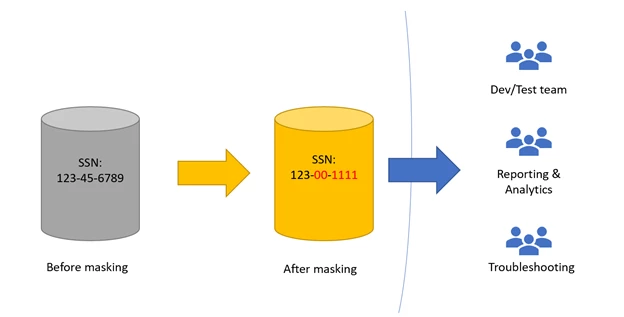
Static Data Masking

Use cases

Static Data Masking is designed to help organizations create a sanitized copy of their databases where all sensitive information has been altered in a way that makes the copy sharable with non-production users. Static Data Masking can be used for:

  • Development and testing
  • Analytics and business reporting
  • Troubleshooting
  • Sharing the database with a consultant, a research team, or any third-party

Static Data Masking facilitates compliance with security requirements such as the separation between production and dev/test environments. For organizations subject to GDPR, the feature is a convenient tool to remove all personal information while preserving the structure of the database for further processing.

How Static Data Masking works

With Static Data Masking, the user configures how masking operates for each column selected inside the database. Static Data Masking will then replace data in the database copy with new, masked data generated according to that configuration. Original data cannot be unmasked from the masked copy. Static Data Masking performs an irreversible operation.

In the example below, all entries in the column FirstName have been nullified. The column LastName is made of randomly generated strings. In the EmailAddress column, names have been replaced with randomly generated strings, but the domain extension has been maintained. A similar narrative applies to the Phone column where the area code has been preserved, but not the last 7 digits.
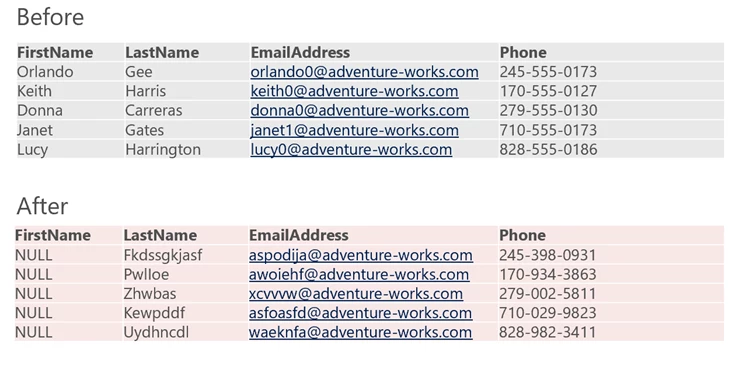
Before and after

Static Data Masking vs. Dynamic Data Masking

Data masking is the process of applying a mask on a database to hide sensitive information and replace it with new data or scrubbed data. Microsoft offers two masking options, Static Data Masking and Dynamic Data Masking

Static Data Masking

Dynamic Data Masking

  • Happens on a copy of the database
  • Original data not retrievable
  • Mask occurs at the storage level
  • All users have access to the same masked data
  • Happens on the original database
  • Original data intact
  • Mask occurs on-the-fly at query time
  • Mask varies based on user permission

How to download Static Data Masking

Static Data Masking ships with SQL Server Management Studio 18.0 preview 5 and above. To learn more, visit the documentation, “Static Data Masking.”

Compatibility

Static Data Masking is compatible with SQL Server (SQL Server 2012 and newer), Azure SQL Database (DTU and vCore-based hosting options, excluding Hyperscale), and SQL Server on Azure Virtual Machines.

The team is actively looking for feedback so please do share your thoughts at static-data-masking@microsoft.com.


WE ARE MICROSOFT

Explore Microsoft Foundry

The future of AI starts here. Envision your next great AI app with the latest technologies. Get started with Azure.