As IoT and artificial intelligence become more advanced, smart buildings are also being utilized to drive down energy usage and maintenance costs. They’re providing safer, more comfortable environments while preventing equipment breakdowns and disruptions to occupants. They’re even increasing productivity by adapting to how people live and work.
There’s a growing demand for smart buildings which offer multiple benefits for building owners, managers, and tenants. Some of the trends, scenarios, and payoffs just might surprise you. Attend our upcoming IoT in Action Smart Building webinar to learn more.
Benefits beyond infrastructure and operations
What most people think of when it comes to smart buildings and IoT are the basics around security and infrastructure. This includes egress, surveillance, elevators, parking, as well as building operations like power, HVAC, and water. These are key focus areas that are driving down costs and increasing sustainability, while keeping people safer and more comfortable.
Smart spaces are going beyond meeting these needs. A second less obvious area where IoT is driving change is productivity i.e., how a space can help people get more done in less time. As IoT gets more intelligent, smart spaces can sense the people in them and how they work, allowing it to tune itself to contextualize and adapt to our needs. From a productivity standpoint, IoT enables interactive workspaces, place and people finders, and concierge services. Smart space platform services include telepresence, location and traffic sensing, interactive walls, and even digital assistants.
Finally, there’s employee engagement and retention. It may seem surprising, but we’re finding that a space that helps employees do their best work, enables ambient intelligence, and provides more personal computing can have an impact on employee retention. If a space feels good and natural, employees are more likely to stay.
Spatial intelligence in action
You may recall that Azure IoT recently enabled spatial intelligence capabilities. Spatial intelligence models the relationships and interactions between people, places, and devices, while also monitoring how a space is being used to optimize areas ranging from heating and cooling to room-booking management. Microsoft is using IoT spatial intelligence to equip buildings on our new campus with some intriguing new options, such as cafés you can talk to, garages that help you park, and conference rooms that know who’s there and who’s missing.
In this modern meetings demo you can see spatial intelligence capabilities in action, including smart spaces that book your meeting space and identify attendees as they walk into the room. Other capabilities include smart spaces that use AI coupled with audio and video to identify speakers, recognize speech patterns, and provide a live transcription service. In addition, smart spaces can translate the transcription for meeting attendees in other countries.
Elevating business with IoT
The applications for IoT and smart buildings are seemingly endless. Datahoist is a great example of a business that is making buildings smarter. Datahoist gathers and processes elevator data using IoT devices combined with adaptive, self-learning algorithms. Cartop and door sensors send data through an edge gateway into Microsoft Azure, where data is processed and analyzed.
Datahoist’s IoT solution is fast, easy, and economical to install, plus it works with any elevator from any manufacturer. Datahoist monitors the health of elevators 24/7, learns patterns, and alerts users to any anomalies it detects. This innovative IoT solution saves on labor costs and eliminates the need for routine maintenance checks and unnecessary parts replacements. It also sends alerts before breakages happen, preventing unplanned outages.
Register for the IoT in Action Webinar
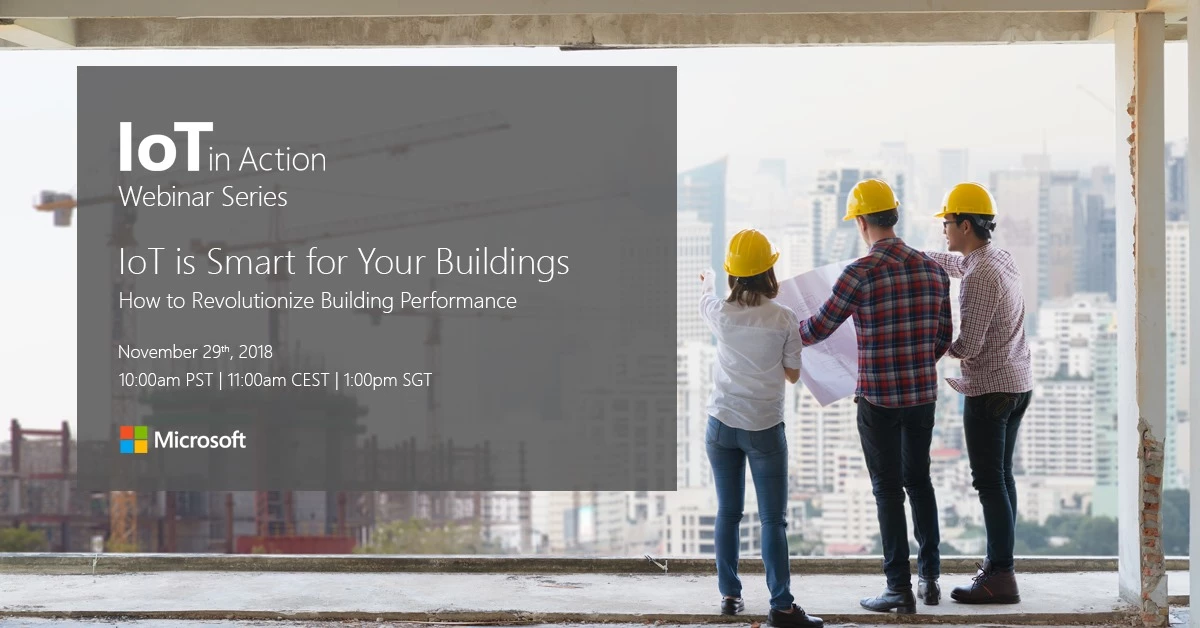
To explore smart buildings in more detail, be sure to register for our IoT in Action webinar, “IoT Is Smart for Your Buildings” on November 29, 2018 to explore how you can harness IoT to revolutionize building performance. Get insights to help you engage building tenants, empower employees, optimize operations, and save money. You’ll also learn how you can transform existing facilities to capture emerging opportunities using data as a strategic asset.
For further guidance around designing secure IoT solutions, adding business value to your IoT solutions, and advancing your technical skills, please register for the two-day IoT in Action Virtual Bootcamp. You can also learn how to better leverage the transformative potential of intelligent edge and intelligent cloud IoT solutions by signing up for a free IoT in Action in-person event coming to a city near you.