With the wrong architecture, APIs can be a bottleneck to not only your applications but to your entire business. Bottlenecks such as downtime, low performance, or high application complexity, can result in exaggerated infrastructure and organizational costs and lost revenue. Serverless APIs mitigate these bottlenecks with autoscaling capabilities and consumption-based pricing models.
Once you start thinking of serverless as not only a remover-of-bottlenecks but also as an enabler-of-business, layers of your application infrastructure become a source of new opportunities. This is especially true of the API layer, as APIs can be productized to scale your business, attract new customers, or offer new services to existing customers, in addition to its traditional role as the communicator between software services.
Given the increasing dominance of APIs and API-first architectures, companies and developers are gravitating towards serverless platforms to host APIs and API-first applications to realize these benefits. One serverless compute option to host API’s is Azure Functions, event-triggered code that can scale on-demand, and you only pay for what you use. Gartner predicts that 50 percent of global enterprises will have deployed a serverless functions platform by 2025, up from only 20 percent today. You can publish Azure Functions through API Management to secure, transform, maintain, and monitor your serverless APIs.
Faster time to market
Modernizing your application stack to run microservices on a serverless platform decreases internal complexity and reduces the time it takes to develop new features or products. Each serverless function implements a microservice. By adding many functions to a single API Management product, you can build those microservices into an integrated distributed application. Once the application is built, you can use API Management policies to implement caching or ensure security requirements.
Quest Software uses Azure App Service to host microservices in Azure Functions. These support user capabilities such as registering new tenants and application functionality like communicating with other microservices or other Azure platform resources such as the Azure Cosmos DB managed NoSQL database service.
“We’re taking advantage of technology built by Microsoft and released within Azure in order to go to market faster than we could on our own. On average, over the last three years of consuming Azure services, we’ve been able to get new capabilities to market 66 percent faster than we could in the past.” – Michael Tweddle, President and General Manager of Platform Management, Quest
Quest also uses Azure API Management as an serverless API gateway for the Quest On Demand microservices that implement business logic with Azure Functions and to apply policies that control access, traffic, and security across microservices.
Modernize your infrastructure
Developers should be focusing on developing applications, not provisioning and managing infrastructure. API management provides a serverless API gateway that delivers a centralized, fully managed entry point for serverless backend services. It enables developers to publish, manage, secure, and analyze APIs on at global scale. Using serverless functions and API gateways together allows organizations to better optimize resources and stay focused on innovation. For example, a serverless function provides an API through which restaurants can adjust their local menus if they run out of an item.
Chipotle turned to Azure to create a unified web experience from scratch, leveraging both Azure API Management and Azure Functions for critical parts of their infrastructure. Calls to back-end services (such as ordering, delivery, and account management and preferences) hit Azure API Management, which gives Chipotle a single, easily managed endpoint and API gateway into its various back-end services and systems. With such functionality, other development teams at Chipotle are able to work on modernizing the back-end services behind the gateway in a way that remains transparent to Smith’s front-end app.
“API Management is great for ensuring consistency with our API interactions, enabling us to always know what exists where, behind a single URL,” says Smith. “There are lots of changes going on behind the API gateway, but we don’t need to worry about them.”– Mike Smith, Lead Software Developer, Chipotle
Innovate with APIs
Serverless APIs are used to either increase revenue, decrease cost, or improve business agility. As a result, technology becomes a key driver of business growth. Businesses can leverage artificial intelligence to analyze API calls to recognize patterns and predict future purchase behavior, thus optimizing the entire sales cycle.
PwC AI turned to Azure Functions to create a scalable API for its regulatory obligation knowledge mining solution. It also uses Azure Cognitive Search to quickly surface predictions found by the solution, embedding years of experience into an AI model that easily identifies regulatory obligations within the text.
“As we’re about to launch our ROI POC, I can see that Azure Functions is a value-add that saves us two to four weeks of work. It takes care of handling prediction requests for me. I also use it to extend the model to other PwC teams and clients. That’s how we can productionize our work with relative ease.”– Todd Morrill, PwC Machine Learning Scientist-Manager, PwC
Quest Software, Chipotle, and PwC are just a few Microsoft Azure customers who are leveraging tools such as Azure Functions and Azure API Management to create an API architecture that ensures your API’s are monitored, managed, and secure. Rethinking your API approach to use serverless technologies will unlock new capabilities within your organization that are not limited by scale, cost, or operational resources.
Get started immediately
Learn about common serverless API architecture patterns at the Azure Architecture Center, where we provide high-level overviews and reference architectures for common patterns that leverage Azure Functions and Azure API Management, in addition to other Azure services.
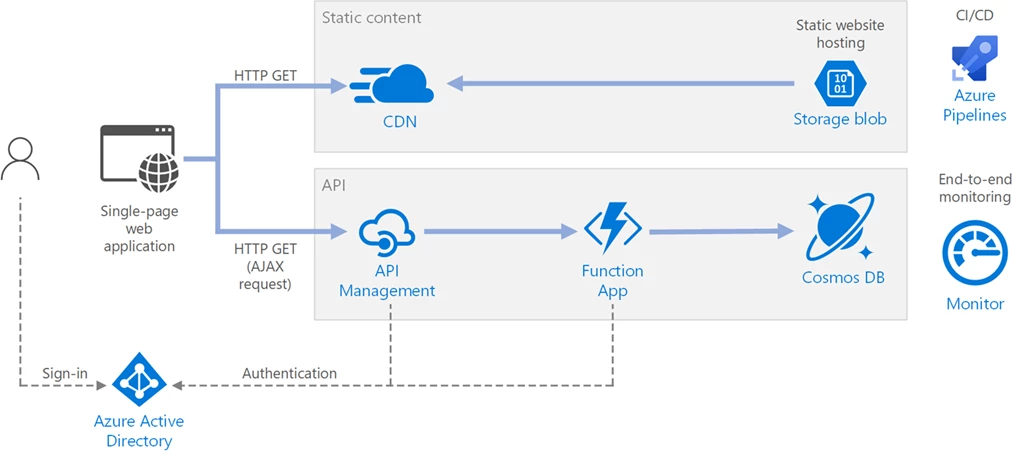
Reference architecture for a web application with a serverless API.