Skip to main content Explore View all products (200+) Microsoft Foundry Azure Copilot GitHub Copilot Azure Kubernetes Service (AKS) Azure Cosmos DB Azure Database for PostgreSQL Azure Arc Microsoft Fabric Linux virtual machines in Azure Foundry Models Foundry Agent Service Foundry IQ Foundry Tools Foundry Control Plane Observability in Foundry Control Plane Azure OpenAI in Foundry Models Azure Speech in Foundry Tools Azure Machine Learning View all databases Azure Cosmos DB Azure DocumentDB Azure SQL Azure Database for PostgreSQL Azure Managed Redis Microsoft Fabric Azure Databricks Linux virtual machines in Azure Windows Server on Azure Azure Functions Azure Virtual Machine Scale Sets Azure API Management Azure Container Apps Azure Kubernetes Service (AKS) Azure Kubernetes Fleet Manager Azure Container Registry Azure Red Hat OpenShift Azure Container Instances Azure Container Storage Azure Arc Azure Local Microsoft Defender for Cloud Azure Monitor Microsoft Sentinel Azure Migrate View all solutions (40+) Cloud solutions for small and medium businesses Cloud migration and modernization center Data analytics for AI Azure Databases AI apps and agents Microsoft Marketplace Microsoft Sovereign Cloud AI apps and agents Responsible AI with Azure AI Infrastructure Data analytics for AI Machine learning operations (MLOps) Low-code application development on Azure Integration Services Serverless computing DevOps Migration and modernization center .NET apps migration Databases on Azure Linux on Azure Oracle on Azure SAP on the Microsoft Cloud Adaptive cloud High-performance computing (HPC) Infrastructure as a service (IaaS) Resiliency Azure Essentials Frontier Accelerate for Azure FinOps on Azure Microsoft Marketplace Azure pricing overview Create an Azure account Free Azure services Flexible purchase options Pricing calculator FinOps on Azure Maximize ROI from AI Azure savings plans Azure reservations Azure Hybrid Benefit Virtual Machines Azure SQL Microsoft Foundry Microsoft Fabric Azure Kubernetes Service (AKS) Microsoft Defender for Cloud View more Software Development Companies Microsoft Marketplace Find a partner Resources for Azure partners Get started with Azure Customer stories Analyst reports, white papers, and e-books Videos Learn more about cloud computing Documentation Explore Azure portal Developer resources Quickstart templates Resources for startups Developer community Students Azure for partners Blog Events and Webinars Learn Support Contact Sales Get started with Azure Sign in

Azure Media Services provides a platform with which you can broadcast live events. You can use our APIs to ingest, transcode, and dynamically package and encrypt your live video feeds for delivery via industry-standard protocols like HTTP Live Streaming (HLS) and MPEG-DASH. You can also use our APIs to integrate with CDNs and deliver to millions of concurrent viewers. Customers are using this platform for scenarios ranging from multi-day sporting events and entire seasons of professional sports, to webinars and town-hall meetings.

Live transcriptions is a new preview feature in our v3 APIs, wherein you can enhance the streams delivered to your viewers with machine-generated text that is transcribed from spoken words in the audio feed. This feature is an option you can enable for any type of Live Event that you create in our service, including pass-through Live Events, where you configure a live encoder upstream to generate and push a multiple bitrate live feed into the service (visualized in the diagram below).
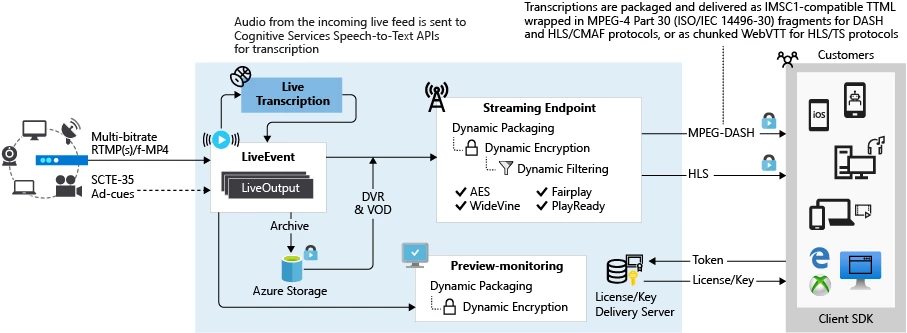
    pass-through_PRE

Figure 1. Schematic diagram for live transcription

When a live contribution feed is sent to the service, it extracts the audio signal, decodes it, and calls to the Azure Cognitive Services speech-to-text APIs to get the speech transcribed. The resultant text is then packaged into formats that are suitable for delivery via streaming protocols. For HTTP Live Streaming (HLS) protocol with media packaged into MPEG Transport Stream (TS) fragments, the text is packaged into WebVTT fragments. For delivery via MPEG-DASH or HLS with CMAF protocols, the text is wrapped in IMSC1.1 compatible TTML, and then packaged into MPEG-4 Part 30 (ISO/IEC 14496-30) fragments.

You can use Azure Media Player (version 2.3.3 or newer) to play the video, as well as display the text on a wide variety of browsers and devices. You can also play back the streams on the iOS native player. If building an app for Android devices, playback of transcriptions has been verified by NexPlayer. You can contact them to request a demo.
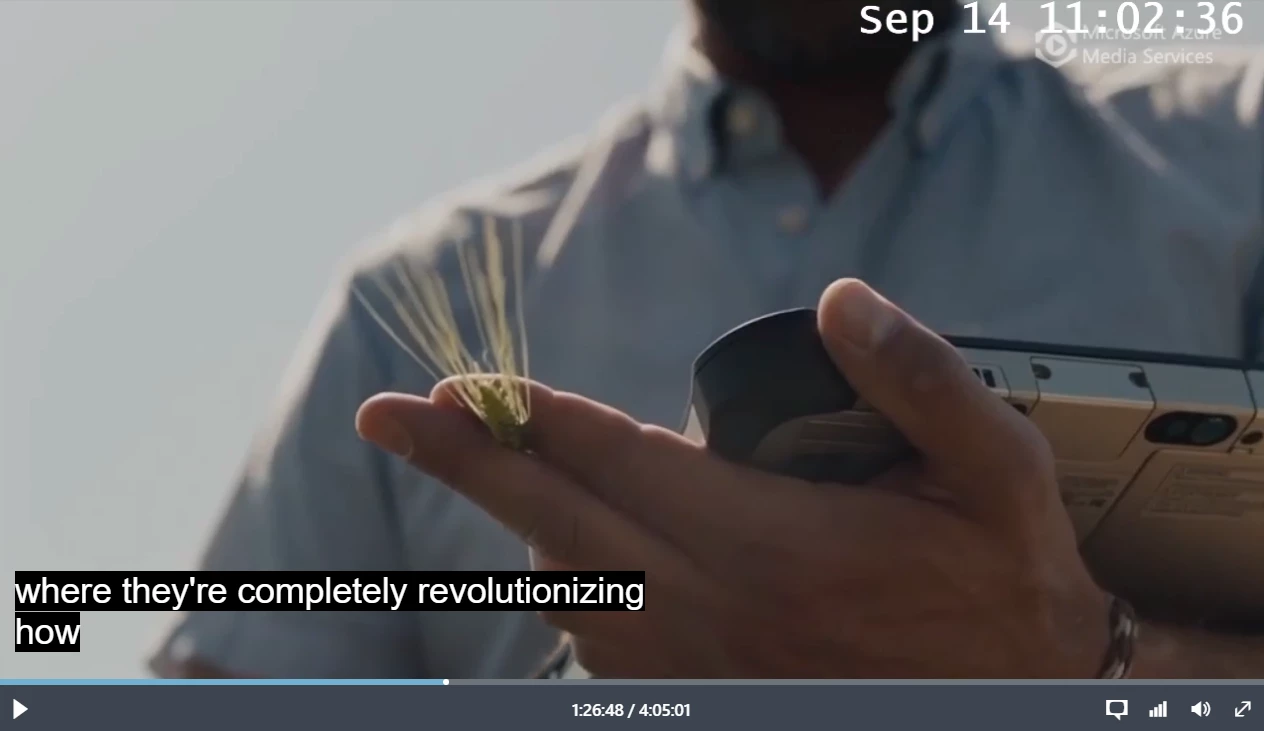
Display of live transcription on Azure Media Player

Figure 2. Display of live transcription on Azure Media Player

For HTTP Live Streaming (HLS) protocol with media packaged into MPEG Transport Stream (TS) fragments, the text is packaged into WebVTT fragments. For delivery via MPEG-DASH or HLS with CMAF protocols, the text is wrapped in IMSC1.1 compatible TTML, and then packaged into MPEG-4 Part 30 (ISO/IEC 14496-30) fragments.

The live transcription feature is now available in preview in the West US 2 region. Read the full article here to learn how to get started with this preview feature.


WE ARE MICROSOFT

Explore Microsoft Foundry

The future of AI starts here. Envision your next great AI app with the latest technologies. Get started with Azure.